Landlord Rules in 2026: What Changed and What Comes Next
October 3, 2026
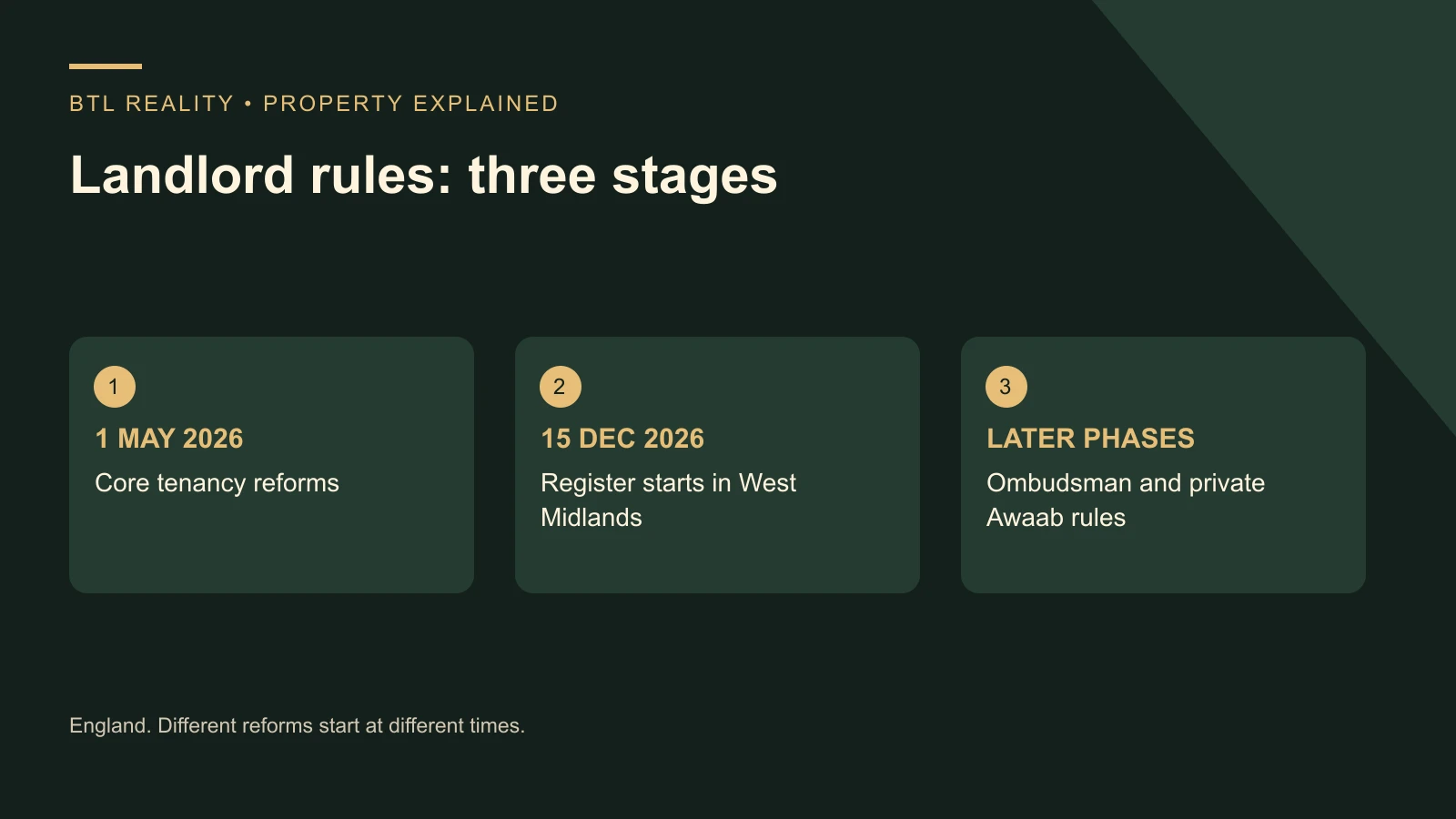
Landlord rules changed substantially in England in 2026. The useful question now is not whether the Renters’ Rights Bill might pass. It became the Renters’ Rights Act 2025, and its first major private-tenancy reforms took effect on 1 May 2026. Landlords need to operate under those rules while preparing for the next changes.
This guide brings the main decisions together: managing a tenancy, setting rent, keeping records, planning expenditure and understanding what has not started yet. It is written for ordinary private landlords in England. Tax reporting can have a wider UK reach, while tenancy law and energy-efficiency rules have different geographical scopes. Check the location of the property before applying any rule.
My approach to property is to turn a headline into an actual decision. Does this change the agreement, the monthly cashflow, the cash reserve or the way the property is managed? If it changes none of those yet, it may belong on a watchlist rather than in this week’s panic pile.
The dates that matter
The government’s implementation roadmap separates the reforms into phases. Read that alongside newer announcements, because a roadmap published in 2025 is not the last word on a 2026 rollout.
- 27 October 2025: the Renters’ Rights Act received Royal Assent.
- 27 December 2025: new council investigatory powers began.
- 6 April 2026: the first mandatory Making Tax Digital for Income Tax cohort started.
- 1 May 2026: England’s main private-tenancy reforms began.
- 31 May 2026: the deadline for relevant existing-tenancy information was reached.
- 15 December 2026: the announced landlord-register rollout is due to begin in the West Midlands.
The new private landlord ombudsman is a later step, with mandatory membership expected in 2028 under the published roadmap. Awaab’s Law for private rented homes has a separate implementation process. These are not all obligations that arrived on the same morning.
Your preparation checklist
Tick the records you have checked. This is a working list, not a compliance certificate. Selections stay in this page only.
Tenancies and possession: stop using the old assumptions
For covered private tenancies, assured periodic tenancies replaced assured shorthold tenancies. The tenancy rolls on rather than ending at a fixed date. Section 21 is no longer available for new notices. A landlord seeking possession needs a valid ground, the correct notice and, where the tenant stays, the appropriate court process.
That does not mean a tenant can never be required to leave. It means the reason and the evidence matter. Selling, moving in, rent arrears and antisocial behaviour have different conditions. One universal notice period copied into every letter is not a workable system.
The practical change is to stop promising a buyer vacant possession, assuming a tenancy will end on its printed expiry date, or treating a message to the tenant as a substitute for proper advice. Our Renters’ Rights Act explainer connects the main changes, while the Section 21 guide explains the new decision process.
Rent reviews need both evidence and a process
For assured periodic tenancies in England, rent increases use the revised section 13 process. The current form is Form 4A, with at least two months’ notice. Increases cannot take effect more than once a year or in the first year of a new tenancy. A tenant can challenge a proposed rent above the open market level.
The official rent-increase guidance says the process is required even where the tenant has agreed to the increase. Friendly agreement remains useful, but it does not remove the paperwork.
I would keep a dated rent-review file showing genuinely comparable properties, their condition and what the evidence does and does not prove. An expensive mortgage is a reason to review your investment; it is not evidence of market rent. Use our rent-review guide before assuming next month’s income will rise.
Advertising and selection have changed too
Rental adverts need a specific asking rent. For the covered England tenancies, landlords and agents cannot ask for, encourage or accept offers above it. Treating the advertised figure as the starting point for an auction is no longer an acceptable letting process.
The rules also restrict rent demanded before a tenancy begins and prohibit discrimination because an applicant receives benefits or has children, subject to the relevant legal exceptions. These changes reach beyond the tenancy document. Adverts, automated replies, viewing arrangements, referencing instructions and staff conversations all need attention.
Ask the agent to show you the process they actually use. A reassuring statement that everything is compliant is less useful than the current advert template, payment instructions and written selection policy. Our guides to the rental bidding ban and benefits and children rules examine those decisions separately.
Higher penalties make recordkeeping more valuable
Some tenancy-reform breaches can attract civil penalties of up to £7,000. Certain offences can attract penalties of up to £40,000 as an alternative to prosecution. Separate rent repayment order rules can expose a landlord to repayment of up to two years’ rent for qualifying offences under the new regime.
Those are maximums within particular legal processes, not automatic charges for every mistake. It would also be wrong to assume that every kind of breach follows an identical escalation route. The government’s enforcement guidance explains the distinctions.
A useful property file contains agreements, deposit records, safety documents, repair reports, communications and evidence of documents delivered to each tenant. Keep access controlled and retain information in line with your lawful obligations. A large folder of personal data is not better just because it is large; the information should have a purpose and be retrievable when needed.
The landlord database: prepare for your region
The 9 September announcement says the register will launch on 15 December 2026, beginning in the West Midlands. Landlords will be called forward by region and have a three-month registration period. It states that actively letting landlords will need to be registered by 14 November 2027.
That is a reason to organise your information now, not to pay an unsolicited registration demand. Check the official service, the property’s region and the actual window. Our landlord database guide separates the announced requirements from illustrative cost assumptions.
Energy standards and tax reporting belong in the same budget
The government’s January 2026 energy-efficiency response sets a policy direction towards a higher standard by 1 October 2030 in England and Wales, with legislation and detailed implementation steps involved. Do not confuse the future policy with the minimum standard already applying today. Our EPC C guide explains that difference.
Making Tax Digital is different again. It is about reporting income, not property safety or tenancy rights. The first threshold was qualifying gross self-employment and property income over £50,000 in 2024/25, bringing affected individuals into the system from 6 April 2026. The HMRC eligibility guide also sets out later thresholds and exemptions.
A worked budget: small costs can change the margin
Consider a hypothetical rental producing £1,000 a month. Suppose mortgage interest is £562.50, management £120 including any applicable VAT, maintenance reserve £100, void allowance £50 and other running costs £50. That leaves £117.50 monthly before tax, capital expenditure and exceptional costs.
Add an illustrative £30 monthly allowance for additional administration and the remaining margin becomes £87.50. If finance rises by £100 instead, the original margin shrinks to £17.50. These are assumptions, not prescribed government charges. They show why the full cost stack matters more than an argument about one line item.
Use the buy-to-let deal calculator to enter your own figures. Include compliance work, accounting and a realistic reserve. Do not put a hoped-for rent increase into the base case before it is lawful, evidenced and collectable.
What I would do this week
Start with any live safety issue, notice, missing required document or deadline. Those need attention before a general portfolio review. Then check agreements and agent processes, organise the property file and identify which future rules affect the next purchase.
Give each task an owner and a completion date. If your agent handles a task, record what they are responsible for and what evidence they will provide. If a decision requires legal or tax advice, take it to the relevant professional instead of trying to resolve it with an investment spreadsheet.
For the broader investment plan, Starter Club provides education, group support and a personal roadmap. It does not replace legal representation or an accountant. The free resources remain available whether or not you join.
Turn the rule into a completed property task
The policy dates above are only part of managing a rental. For an ordinary English private letting, use the relevant practical guide to identify the task, responsible person and evidence of completion; check the stated jurisdiction and any property-specific conditions.
At the start of a tenancy
Use the smoke and carbon monoxide alarm handover guide to organise the actual day-one test and record, rather than assuming an earlier inspection covers it. For joint tenants or a parent paying the deposit, the prescribed-information guide keeps the amount, recipients and complete delivered pack together.
Safety work and access
If a tenant will not allow the annual visit, the gas-check access-refusal guide explains a practical appointment and evidence process with clear limits on entry. For supplied appliances, the annual PAT-testing guide separates the safety task from fixed-installation checks and any licence or policy conditions.
Checks that do not follow one annual clock
Use the landlord Legionella review guide to distinguish a risk review, changed water-system circumstances and laboratory sampling. For an occupier needing an immigration-status follow-up, the right-to-rent follow-up guide explains the date record and cases that do not require routine repeats.
Tenant information and the agent’s role
If you rely on an agent, the landlord ICO-fee guide starts with the personal information you actually use rather than the management-service label. When organising the property file, the tenant-document retention guide separates tax and checking requirements from records no longer needed.
Find the guide for your next decision
The reforms and the debate
- What Is the Renters’ Rights Act? The Former Bill Explained
- Are Landlords Facing Bigger Fines Under Labour?
- Will Labour Introduce Rent Controls in England?
- Why Does Labour Hate Landlords? Look at the Policies
Running a tenancy
- Has Section 21 Been Abolished? What Landlords Do Now
- Can I Sell My Rental Property Under the New Rules?
- Tenant Not Paying Rent: What Changed in 2026?
- How Much Can a Landlord Increase Rent in 2026?
- Can a Landlord Accept More Than the Advertised Rent?
- Can a Landlord Ask for Six Months’ Rent in Advance?
- Can a Landlord Refuse Pets? The England Rules and a Fair Process
- Can Landlords Refuse Benefits or Families With Children?
- Missed the Renters’ Rights Information Sheet Deadline?
Preparing for what comes next
- Landlord Database in England: Dates, Costs and Your Checklist
- Do Private Landlords Need to Join an Ombudsman Yet?
- Does Awaab’s Law Apply to Private Landlords?
- Do Rental Properties Need EPC C by 2030?
- Making Tax Digital for Landlords: Do You Need It Now?
- Can a Tenant Claim Two Years’ Rent Back? RROs Explained
The wider investment decision
- Is Now a Good Time to Buy Property in the UK?
- Is Property Falling in Value After Inflation?
- When Will Interest Rates Come Down in the UK?
- UK Property Price Predictions 2027: Could Prices Rise 5%?
Frequently asked questions
Do these new landlord rules apply across the whole UK?
No. This guide’s tenancy discussion concerns England’s private assured tenancies. Wales, Scotland and Northern Ireland have different housing regimes. Making Tax Digital is a separate UK tax-reporting framework, and the energy-efficiency policy discussed here concerns England and Wales. Always check the scope of the specific rule.
Is the Renters’ Rights Bill still waiting to become law?
No. It became the Renters’ Rights Act 2025 on 27 October 2025. Major private-tenancy changes in England began on 1 May 2026. Some other measures have later implementation dates, so “the Act is law” does not mean every provision is already operational.
Must every landlord register immediately in October 2026?
The announced England rollout begins on 15 December 2026 in the West Midlands, followed by other regions. Check the official invitation, regional timetable and registration window. Preparing records now is sensible, but a nationwide immediate deadline would misdescribe the announced programme.
Can an agent take responsibility for all compliance?
An agent can perform agreed tasks, but appointing one does not automatically remove every landlord duty. Check the management contract, the actual legal requirement and the evidence you receive. For the database, also check who is permitted to make each entry under the final operational rules.
Should I sell because of the new landlord legislation?
Legislation alone does not answer that. Compare sustainable after-cost returns, work, risk, sale costs, tax and alternative uses of capital. Address legal duties while you make the decision. A property that only works by ignoring required costs needs reassessment, whatever your view of the policy.
Can these guides replace a solicitor or accountant?
No. They explain the practical issues and point to official sources. Notices, disputes, unusual tenancies and tax positions need advice on the actual facts. Use the articles to prepare better questions and records, not as a guarantee that a particular action will be lawful.