Do Private Landlords Need to Join an Ombudsman Yet?
October 3, 2026
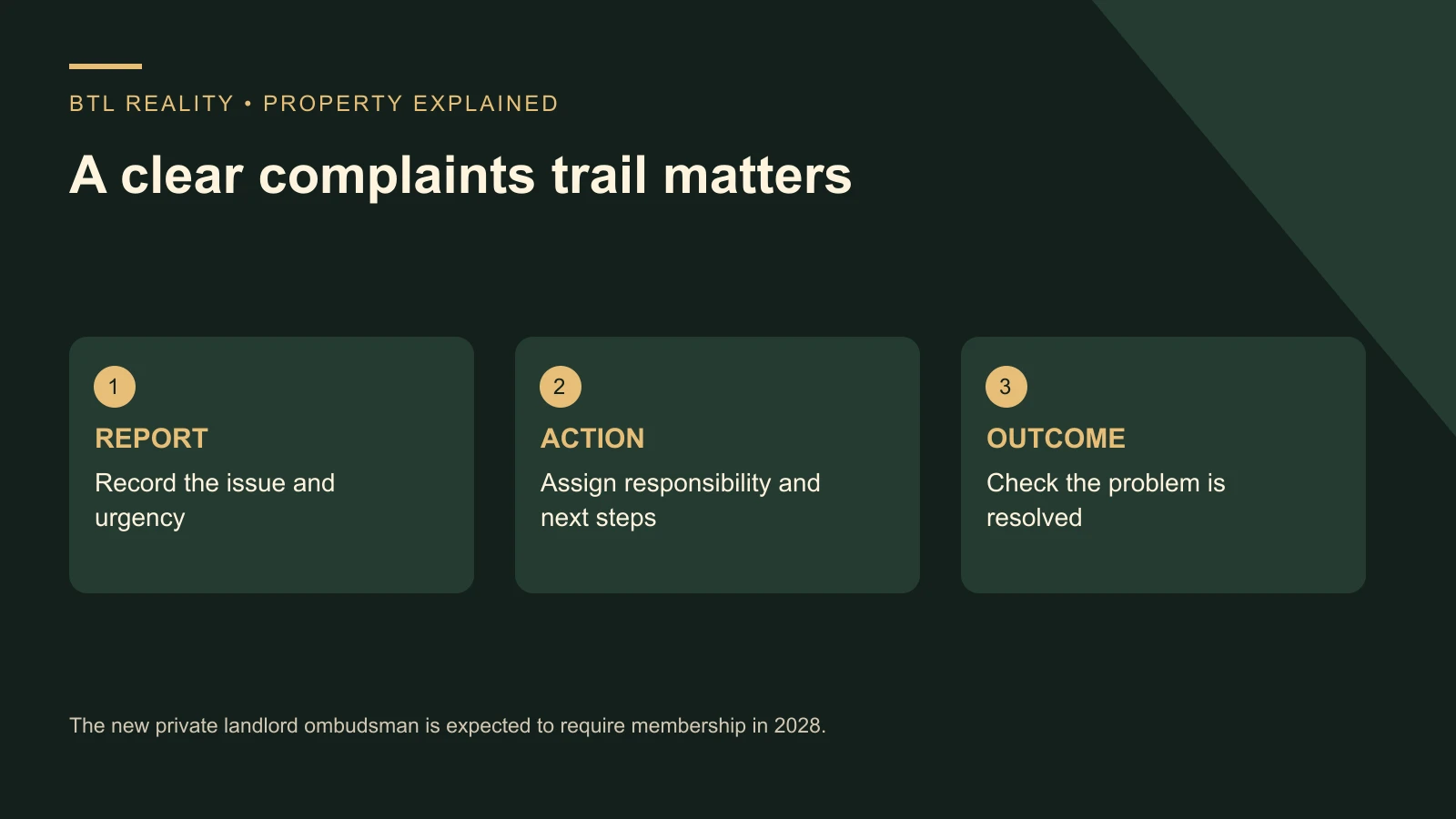
The new mandatory private landlord ombudsman in England is expected to require landlord membership in 2028, according to the government’s implementation roadmap. It is a later phase of the Renters’ Rights Act reforms, following the database rollout. It should not be confused with an ombudsman or redress scheme already covering a letting agent or a social landlord.
That timing does not mean complaints can wait until 2028. Landlords already need to deal with repairs, safety, tenancy obligations and disputes under the rules that apply now. The sensible preparation is a clear complaints process, accurate records and enough operational capacity to put genuine problems right.
This guide explains the distinction, shows what an effective complaint record looks like and gives a practical example of the cost of repeated administration. It is general education for England’s private rented sector, not a determination of an individual dispute or a promise about the final scheme rules.
What is the private landlord ombudsman intended to do?
The Renters’ Rights Act implementation roadmap describes a redress service for private tenants when things go wrong. It also envisages tools, guidance and training to help landlords resolve complaints earlier. Membership will be mandatory for private rented sector landlords once the relevant requirements commence.
The planned service is meant to provide a route for resolving problems without every disagreement becoming a court case. That does not mean every legal issue will move to the ombudsman or that existing courts, tribunals and local authorities cease to matter. The precise complaint, legal power and scheme arrangements determine the appropriate route.
For an investor, the practical implication is that the quality of the service and its records will matter. A landlord who responded appropriately but cannot show what happened can find a dispute much harder to resolve. Conversely, a neat spreadsheet is not a substitute for completing a repair or addressing an actual failure.
When does it start, and is the date guaranteed?
The roadmap expects compulsory membership in 2028. It describes choosing a scheme administrator at least 12 to 18 months before implementation, giving the service time to develop. That is a published implementation expectation, not a reason to invent an exact enrolment day or assume every operational detail is settled.
Check subsequent official announcements as the scheme develops. The database has its own regional timetable and should be tracked separately. A December 2026 database start does not mean landlords must also join a fully operating new ombudsman that same day.
This distinction is especially useful when a commercial email urges you to pay immediately. Check what the sender is actually offering, whether membership is already required for your situation and whether the organisation is the relevant authorised scheme. Preparation support and statutory membership are different services.
How much will membership cost?
The roadmap says landlords will fund the service through a fair and proportionate charging model, with the details confirmed nearer launch. Do not put an invented official fee in a financial forecast or assume it will be included in another registration charge.
Until terms are published, use a clearly marked planning allowance if you need one. Keep that assumption separate from confirmed annual costs such as an existing insurance premium or management contract. This makes later revisions easier and prevents an uncertain number being repeated as fact across several spreadsheets.
The less visible cost is your capacity to handle complaints well. Time spent retrieving missing messages, explaining contradictory updates and repeating visits can be significant even where no formal redress charge exists. A modest investment in a clear system may improve both the tenant’s experience and the efficiency of your business.
See the cost of repeated handling
Illustration only. Not an ombudsman fee, compensation forecast or repair quotation. Excludes the underlying repair.
A complaint is a service problem to investigate
Imagine a tenant reports a recurring leak. The landlord says the contractor attended; the tenant says the problem remains. Treating the first attendance as a completed outcome leaves the core disagreement unresolved. The useful next question is whether the cause was identified, the work completed and the result checked.
A good record separates the original report, urgency assessment, investigation, proposed action and completion evidence. It also records what the tenant was told. That makes it possible to identify whether the problem is technical, scheduling-related, a communication failure or something else.
If the complaint involves an immediate danger or serious hazard, act according to the urgency and current legal duties. Do not place it in a routine complaints queue while waiting for an administrative deadline. Acknowledging an email and making the property safe are separate actions.
A practical complaint record
For each complaint, use a consistent structure that another responsible person could understand without a long telephone explanation. The record should be factual, proportionate and securely stored. Avoid unnecessary personal commentary about the tenant or assumptions about their motives.
- Record the report date, property and contact details needed to respond.
- Describe the issue in the tenant’s terms, then record your investigation separately.
- Identify any safety urgency and the action taken to address it.
- Assign responsibility, the next action and an expected update date.
- Retain relevant correspondence, inspection findings and contractor evidence.
- Record the outcome and check whether the reported problem was actually resolved.
This is a practical management framework, not a substitute for a scheme’s eventual prescribed process or a legal timetable. Adapt it to current duties, the circumstances and any professional advice. Do not retrospectively alter records to make an earlier response look better.
Worked example: the cost of repeated handling
Suppose a complaint generates eight hours of administration across emails, chasing contractors and recreating missing notes. If you value that time at £30 an hour, the internal time cost is £240. Three avoidable additional visits at an assumed £75 each bring the combined illustrative cost to £465.
Those are not ombudsman fees or a prediction of compensation. They show how disorganised handling can consume a rental margin before considering the actual repair. If your property produces £250 a month before tax, £465 represents almost two months of that surplus.
Now imagine a clear initial diagnosis prevents two of the additional visits and reduces administration by three hours. On these assumptions, that saves £240. No process guarantees such a saving, but the example explains why effective management is an investment rather than merely paperwork.
Use the tool to change the time and visit assumptions. Keep the actual repair budget separate: efficient communication cannot make a necessary roof repair free. The buy-to-let deal calculator is useful when checking whether the wider property model includes realistic maintenance and management costs.
What if you use a letting agent?
Clarify who receives complaints, who can authorise expenditure and when an issue must reach you. A tenant should not be passed indefinitely between an owner and an agent, each saying that the other person has the information or authority.
An agent’s existing redress membership concerns the agent’s service and the applicable scheme. It should not be assumed to replace a future landlord membership requirement. Ask the agent to explain both its current complaint route and how it is preparing for the new landlord regime.
Check the contract’s financial authority limit. If every urgent repair needs your permission but nobody can reach you, the process contains an obvious weakness. Agree an appropriate escalation route and emergency arrangements with the managing professional. The correct limit depends on the property and service; it is not a universal figure from a blog.
What can landlords do before the scheme launches?
Review a handful of recent maintenance cases. Can you trace the first report, the action and the outcome? Are there recurring problems that were repeatedly marked complete after cosmetic work? Do contractor invoices explain what was actually done?
Then test the handover. If your normal property manager is on holiday, could someone else identify an unresolved serious issue and contact the right contractor? A system that depends on one person remembering a conversation is fragile, even when that person is conscientious.
Finally, check how tenants are told to report problems and raise concerns. Make the route clear and accessible. Explain who will respond, while avoiding service promises you cannot meet. Keep the final published ombudsman rules on the review list, so your process can be adapted when details are confirmed.
How this fits your investment strategy
A rental property is a long-term service as well as an asset. Its return depends partly on how well the building is maintained and the tenancy managed. Buying at an attractive price does not remove those responsibilities, and price growth does not compensate a tenant for an unresolved hazard.
For an investor who wants to delegate, compare the quality and scope of management as carefully as the quoted percentage. For a hands-on landlord, include the time and professional support the role requires. Both approaches can be planned, but neither should assume that complaints will never happen.
Starter Club can help you build a clearer investment plan and understand the questions to ask your professional team. For the wider sequence of reforms, read the landlord rules hub and the separate database guide. Use qualified advice for a contested complaint, legal claim or uncertainty about your duties.
Frequently asked questions
Is the private landlord ombudsman already mandatory in 2026?
The implementation roadmap expects mandatory membership of the new private landlord scheme in 2028. Do not confuse it with existing arrangements affecting agents or social landlords. Check the latest official announcements and the requirements that already apply to your own business and properties.
Will all private landlords need to join the ombudsman?
The government’s stated plan is mandatory membership for private rented sector landlords when the requirement is brought into force. Check the final scope, exemptions and enrolment instructions when published. Owning only one property or appointing an agent should not be assumed to remove the future obligation.
How much will the landlord ombudsman charge?
The roadmap describes a landlord-funded charging model, with details to be confirmed nearer launch. This guide does not identify a confirmed fee. Use labelled assumptions for planning and replace them with published terms, rather than presenting a guessed annual amount as an official charge.
Does my letting agent’s redress scheme cover me too?
Do not assume that an agent’s membership replaces the future landlord requirement. The agent’s service and your responsibilities are distinct. Ask for the current complaint arrangements and review the final landlord scheme rules when available, including how complaints involving both parties will be handled.
Should tenants wait for the new ombudsman before reporting repairs?
No. Repairs and safety issues should be reported and addressed through current arrangements and legal duties. The future scheme does not suspend existing protections or responsibilities. Urgent hazards need an appropriate prompt response, rather than being treated as routine administration for a later date.
Can a complaints checklist protect me from every claim?
No checklist guarantees that outcome. Accurate records and a clear process help, but the actual quality and timeliness of your response matter. Investigate the issue, carry out necessary action and obtain professional advice when appropriate. Paperwork should support good service rather than replace it.