Can I Sell My Rental Property Under the New Rules?
October 3, 2026
Yes, a landlord can still sell a rental property under the Renters’ Rights Act. The important choice is whether to sell with the tenant remaining or seek vacant possession using a lawful route. The reforms did not ban sales, but they changed how an owner can recover a covered private rented home in England.
If your plan depends on the property being empty by a precise date, work backwards with a solicitor before committing to a buyer. A notice period is not a guaranteed possession date. Nor should a sale ground be used as a convenient way to replace a tenant.
This guide separates the legal process from the financial decision. It covers England’s assured-tenancy framework as checked on 4 October 2026. Different rules apply elsewhere in the UK and to excluded tenancy types.
Selling with the tenant still living there
A sale does not necessarily require the tenant to leave. A buyer may purchase the property as an investment with the tenancy continuing. The buyer needs to understand the agreement, rent, deposit arrangements, compliance history and responsibilities they will inherit.
This can preserve rent during the sales process and avoid relying on a possession claim. It can also narrow the buyer pool. An owner-occupier who needs to move in generally wants a different proposition from an investor buying an occupied home.
Ask the agent for evidence of comparable tenanted sales as well as vacant sales. A suggested price should reflect the actual rent, condition, borrowing environment and local investor demand. A higher vacant valuation is not automatically a better net outcome if reaching vacancy takes time and money.
Your solicitor should handle the tenancy and deposit arrangements on transfer. Keep the tenant informed, agree lawful access for viewings and respect their home. Ownership does not create an unrestricted right to enter whenever an agent has a prospective buyer.
When can Ground 1A be used?
Ground 1A is the possession ground for a landlord who genuinely intends to sell, subject to its conditions. The official grounds-for-possession guidance explains who can use it and the evidence required.
For the ordinary covered tenancy, the notice period is four months and the notice cannot require departure during the first twelve months. A notice can be served within that protected period if its expiry respects the rules. This is not a universal calculation for every agreement.
An important exclusion concerns older non-shorthold assured tenancies that existed before 1 May 2026. Do not assume Ground 1A applies to these simply because you own the property. A solicitor should establish the tenancy’s legal status before preparing any notice.
The sale intention must be real. Retain evidence of the decision and the steps taken, including appropriate agent instructions and communications. Inventing a sale to obtain possession can expose the owner to enforcement and a rent repayment claim.
A four-month notice is not a four-month eviction
Serving the appropriate section 8 notice begins a process. If the tenant remains when the valid notice expires, the landlord may need a possession order and, if necessary, lawful enforcement. Court timing and the facts of the case affect how long this takes.
The government’s tenancy-ending guidance explains the route. Missing requirements, incorrect service or disputed evidence can create delay. A buyer’s preferred completion date does not override the tenant’s rights.
Do not change locks, remove belongings, shut off services or pressure the tenant to leave. Financial urgency is not a substitute for the legal process. If a tenant agrees voluntarily to surrender the tenancy, have the arrangement properly documented rather than relying on an ambiguous conversation.
Our Section 21 guide explains why an old fixed-term expiry or an unused historic notice is not a shortcut under the current framework.
What happens if the sale falls through?
Using the sale ground can trigger restrictions on remarketing and reletting. The government enforcement guidance describes a restricted period and exceptions. It is not safe to assume that a disappointing offer lets you return immediately to the rental market.
That changes the decision before notice is served. Consider the likely selling price, debt repayment, early repayment charges, tax and the ability to cover costs if the property remains unsold. A plan that works only at the agent’s highest suggested price is fragile.
There are defined exceptions and detailed rules about when restrictions operate. Get advice on the actual timeline rather than treating “twelve months” as an easy date to calculate yourself. Keep records showing the genuine sale effort if circumstances change.
Compare net proceeds, not just the headline price
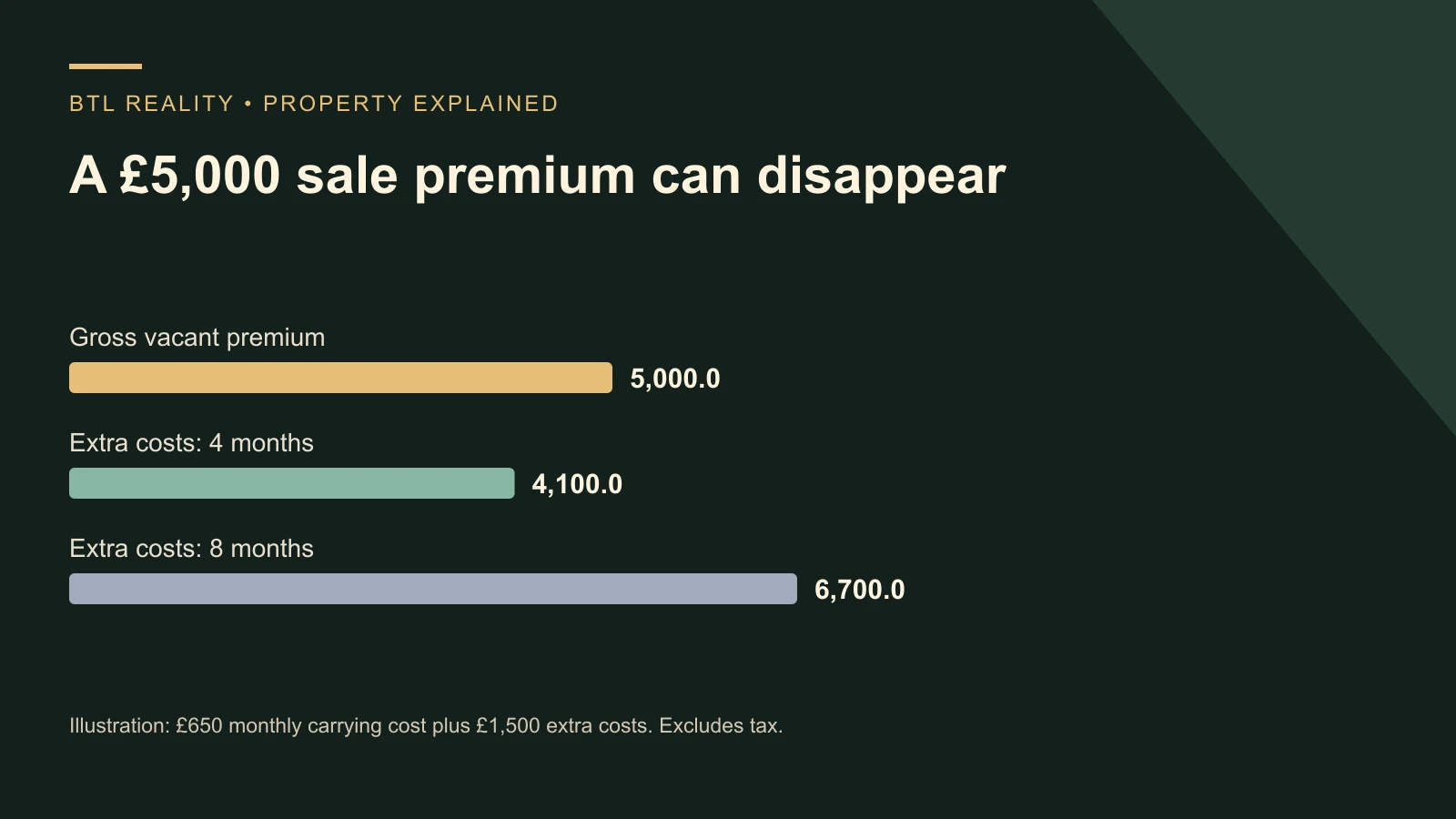
Suppose a hypothetical tenanted property might sell for £145,000 while a vacant sale could achieve £150,000. At first glance, seeking vacancy appears to create an extra £5,000. But that is the gross price difference, not the owner’s additional return.
Assume illustrative extra legal and preparation costs of £1,500, plus £650 monthly carrying costs for four months without rent. That totals £4,100. The £5,000 price advantage becomes £900 before any difference in tax, agent fees, mortgage charges or eventual sale price.
If the same no-rent period lasts eight months, those extra costs become £6,700, exceeding the assumed price advantage. These are stress examples, not forecasts of court duration or professional quotations. Rent may continue during part of a real possession process, so model receipts and outgoings month by month.
Compare a vacant-sale premium
Illustrative comparison excluding tax and costs common to both routes. No prediction of possession timing.
The comparison tool lets you test the vacant-sale premium against additional costs. It deliberately does not decide whether possession is lawful. A financial result cannot establish that a particular legal ground is available.
Include debt, tax and the next use of the money
Your spendable proceeds are not the selling price. Start with the sale receipt, deduct the mortgage redemption amount and selling costs, then allow for any tax due. Ask an accountant to calculate the tax based on ownership, purchase history, allowable expenditure and personal circumstances.
Early repayment charges can make timing important. Obtain a redemption statement rather than estimating from last month’s mortgage balance. If you own through a company, money in the company is not automatically the same as money available personally after extraction.
Then assess the alternative. Selling an awkward low-margin rental may simplify your finances. Selling a resilient property just because a headline sounds alarming may remove future rental income and incur avoidable transaction costs. Compare the actual holding with a realistic next use of the cash.
The buy-to-let deal calculator helps review the operating side of an existing rental. Keep selling costs and tax separate if they are outside your model. Our buying-now guide adds market context without assuming all locations move together.
Prepare a sale file before contacting buyers
Organise the tenancy agreement, rent statement, deposit records, safety documents, licences where required, repairs history and information supplied under the new rules. For a leasehold property, gather service-charge, ground-rent and major-works information early.
Record any arrears, disputes or outstanding repairs accurately. Concealing a problem does not improve the underlying asset and can create difficulties during conveyancing. A well-organised file gives the buyer and their advisers something concrete to assess.
Ask the agent to explain their proposed buyer audience, valuation evidence, marketing costs and access arrangements. Agree what happens if offers are lower than expected. The point is to make a considered decision before a possession route limits your options.
What would I do first?
I would establish the tenancy status, obtain realistic tenanted and vacant valuations, and calculate the net difference. Then I would seek specific legal advice before serving anything. This order avoids spending money on a process before knowing whether it serves the investment plan.
The wider landlord rules hub connects the relevant changes. If you need help deciding what role property should play in your wider plans, Starter Club provides education and structured support. It does not replace a solicitor handling possession or an accountant calculating disposal tax.
The aim is a sale that is commercially sensible and properly executed. Neither panic selling nor pretending the rules have not changed is a strategy.
Frequently asked questions
Can I sell my buy-to-let with tenants in place?
Yes, a tenanted sale may be possible, with the tenancy continuing under the new owner. The buyer, solicitors and lender need to understand the arrangement. Obtain advice about transferring the landlord’s responsibilities and deposit records, and agree appropriate arrangements for viewings.
How much notice must I give if I want to sell?
Ground 1A generally requires four months’ notice for a covered tenancy and cannot require departure within the first twelve months. Availability and validity depend on the tenancy and circumstances. Do not use that summary to prepare a notice without checking the full requirements.
Can I make the tenant leave when the fixed term ends?
An old fixed-term end date does not automatically terminate a covered assured periodic tenancy under the new regime. You need a lawful route, or a properly agreed surrender. A buyer’s request for vacant possession does not itself create a right to recover the home.
Can I relet if I decide not to sell after eviction?
Restrictions can apply following use of the sale ground, with specified exceptions. Get advice before advertising or granting another tenancy. Changing your commercial preference is not automatically an exception, and unlawful reletting can lead to substantial enforcement consequences.
Is a vacant sale always worth more than a tenanted sale?
Not necessarily, and a higher headline price may still produce lower net proceeds. Compare evidence from the local market and deduct additional preparation, financing, no-rent periods and professional costs. The property’s condition and rent can affect investor demand materially.
Do the same sale rules apply across the whole UK?
No. This article covers England’s assured-tenancy framework. Wales, Scotland and Northern Ireland have different systems, and some English arrangements are outside this framework. Identify the jurisdiction and tenancy type before relying on any general notice-period statement.