Deposit Prescribed Information: What About Joint Tenants and a Parent Who Pays?
October 22, 2026
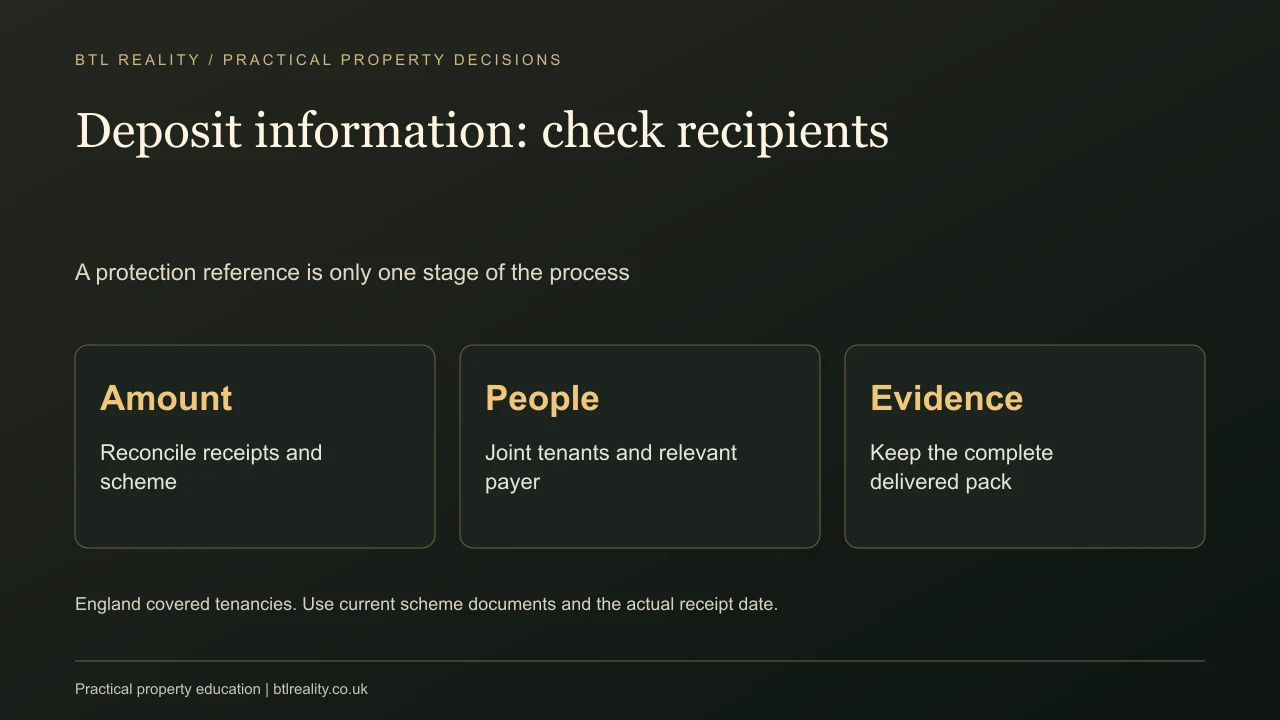
Protecting a tenancy deposit and giving the required information are related jobs, but they are not the same job. A scheme reference in your inbox does not prove the complete prescribed information reached the right people.
Joint tenants and a parent paying the deposit make the administration more important. You need accurate names, a clear record of who paid, the current scheme pack and evidence of delivery. Do not assume the person who transferred the money is the only person who needs information.
This guide focuses on English private tenancies within the deposit-protection rules, using government material checked on 19 October 2026. Wales, Scotland and Northern Ireland have different tenancy or scheme arrangements. Use the current documents for your actual scheme and obtain advice where an older or changed tenancy creates uncertainty.
What information is required?
GOV.UK’s landlord information guide sets out the thirty-day requirement and the information about the property, deposit, scheme, contacts, repayment and disputes. It includes details of a third party who paid the deposit.
Use the current scheme’s complete prescribed-information process and required supporting material. A protection certificate alone should not be assumed to contain everything needed for every tenancy.
The government overview confirms that protection still applies where somebody else, such as a parent, pays. Current English guidance reflects assured periodic tenancies from May 2026, so an old template referring to a fixed-term model should be checked rather than reused automatically.
Identify the tenants and any relevant payer
Start with the names on the agreement and the actual payment history. For a joint tenancy, keep all joint tenants’ details accurate. A lead contact used by a scheme does not mean the other names disappear from your records.
Where a parent or another person paid on a tenant’s behalf under an arrangement with them, consider the relevant-person requirements. The Renters’ Rights Act explanatory notes describe the continuing prescribed-information requirement for the tenant and any relevant person. Use the current scheme process and obtain advice if the payment arrangement is unclear.
A guarantor is not automatically a deposit payer. A parent may be one, the other, both or neither. Record the actual role instead of copying every parent into every tenancy message.
Do not invent a separate deposit for each tenant where there is one joint tenancy deposit. Keep the total and individual payment history clear without changing the scheme arrangement to fit your spreadsheet.
Use a recipient and document checklist
| Item | What to confirm | Evidence to keep |
|---|---|---|
| Tenancy | Property and all relevant tenant details | Accurate agreement and current record |
| Payment | Amount, receipt date and payer role | Payment record and clarification |
| Pack | Current complete scheme information | The exact version delivered |
| Recipients | Joint tenants and any relevant person | Delivery record for the proper recipients |
| Review | Errors, required confirmation and changes | Corrections and final completion record |
As a practical way to reduce recipient uncertainty, arrange the complete information for all joint tenants and any relevant payer through an appropriate delivery process. This is a cautious workflow, not a claim that every possible lead-tenant service method has been conclusively ruled invalid.
Reconcile the money before producing the pack
Suppose an illustrative joint deposit totals £1,400. One tenant pays £1,100 and a parent pays £300 on the other tenant’s behalf. Those receipts add to £1,400; they do not make the parent an occupier or the first tenant the only joint tenant.
Record the amounts, dates and the basis of the parent’s payment. Ask for clarification where needed without collecting unrelated financial history. Match the protected total and the information pack to the actual arrangement.
If a later £100 is returned because the initial amount was incorrect, reconcile the corrected £1,300 with the scheme and the required information. Do not leave one figure in the bank record, another on the certificate and a third in the tenant’s pack.
These amounts are examples, not an assessment of the permitted deposit cap for a particular rent. Check that separate issue using the actual tenancy and current rules.
Keep the receipt date visible
Do not treat the date you opened an agent’s email as the date the deposit was received. Establish the relevant receipt event, including the agent’s handling, and organise the protection and information process promptly.
A useful internal workflow starts when funds arrive, not when the tenant collects keys. If a deposit reaches an agent before the tenancy begins, waiting until move-in can consume valuable time.
Set an internal completion target earlier than the legal deadline so errors can be corrected. Your chosen administrative reminder does not extend the statutory period.
Keep separate statuses for funds received, protection completed, pack checked, information delivered and required confirmations handled. A single green tick labelled “deposit” can hide an unfinished stage.
Use the current pack and check every field
Download or generate the scheme’s current documents for the actual arrangement. Check the property address, total, landlord or agent contacts, tenant details and any relevant payer, together with the required scheme and dispute information.
Do not leave template instructions in the final document. A field saying “insert relevant clauses” is a reminder to do work, not information that helps a tenant understand the proposed deductions.
Keep the pack’s statements consistent with the agreement. If the landlord is a company, check the correct legal identity rather than using a trading name from a website banner without further thought.
Ask a second person or use a structured review to check the final version. The cost of a few minutes reviewing names and figures is usually easier to manage than reconstructing what an incorrect pack was meant to say.
Retain evidence of what was delivered
Save the exact documents sent, their version and the delivery record. “We always send it” is a description of normal practice, not evidence for this tenancy.
For electronic delivery, ensure the method fits the applicable requirements and arrangements and that recipients receive accessible files. A portal upload nobody can access or an attachment that failed to send should not be marked complete without follow-up.
Keep the required certificate or confirmation process within the current scheme instructions, including any opportunity to check and sign. Do not add a tenant’s signature or state they agreed when they did not.
If the tenant identifies an error, correct it transparently and retain the old and revised versions. Avoid changing the file silently and relying on the original sending date as though the corrected information had been there all along.
Make the agent’s completion report specific
Ask the agent to confirm the receipt date, scheme, protected amount and completion of the information process, with the evidence held. It is reasonable to want clarity without circulating sensitive documents unnecessarily.
The remote management guide explains how to make responsibilities and reporting visible. A fully managed label should still lead to a record of the actual completed task.
If management changes, confirm where the records will be held and how they can be retrieved. Do not wait until a dispute to discover that the former agent’s portal has closed.
The landlord rules overview helps organise the broader compliance diary. Keep deposit information distinct from other documents such as the inventory or safety reports, because they have different purposes and requirements.
What if you discover a missed deadline or wrong recipient?
Obtain advice promptly using the real dates, documents and payment history. Complete appropriate corrective steps, but do not assume a late correction erases every consequence of the earlier failure.
Do not backdate a pack, invent delivery evidence or ask an agent to amend a receipt date. A factual record gives an adviser something useful to work with; an altered history creates another problem.
Keep the deposit money separate from ordinary rental income. The rental account guide helps with financial organisation, but the protected deposit is not available cash for the property’s next repair.
The best process is easy to verify: the right amount, the right scheme, complete current information, the proper recipients and evidence of timely delivery. Each stage deserves its own confirmation.
Your questions answered
Is the deposit certificate the whole prescribed-information pack?
Do not assume it is. Follow the current scheme process and include all required information and supporting material for the actual tenancy.
Does naming a lead tenant remove the other joint tenants?
No. Keep all joint tenant details accurate. For a clear practical workflow, arrange appropriate delivery of the complete information to all joint tenants rather than relying on an assumption about one contact.
Does a parent who pays need to be considered?
Yes. Establish whether they paid on the tenant’s behalf under an arrangement and fall within the relevant-person requirements. Follow the current legal and scheme process for that role.
Is every guarantor also a relevant deposit payer?
No. A guarantor and a person paying a deposit are different roles. Record who actually paid and the arrangement rather than assuming family involvement means both.
Can I wait until move-in to start the deposit process?
Do not use move-in as a substitute for the relevant receipt date. Record when funds were received, including agent handling, and complete protection and information requirements within the applicable period.
Does correcting the pack late erase an earlier breach?
Do not assume so. Take appropriate corrective steps and obtain advice on the actual dates and consequences. Keep a truthful history rather than backdating documents.