Can a Landlord Refuse Pets? The England Rules and a Fair Process
October 3, 2026
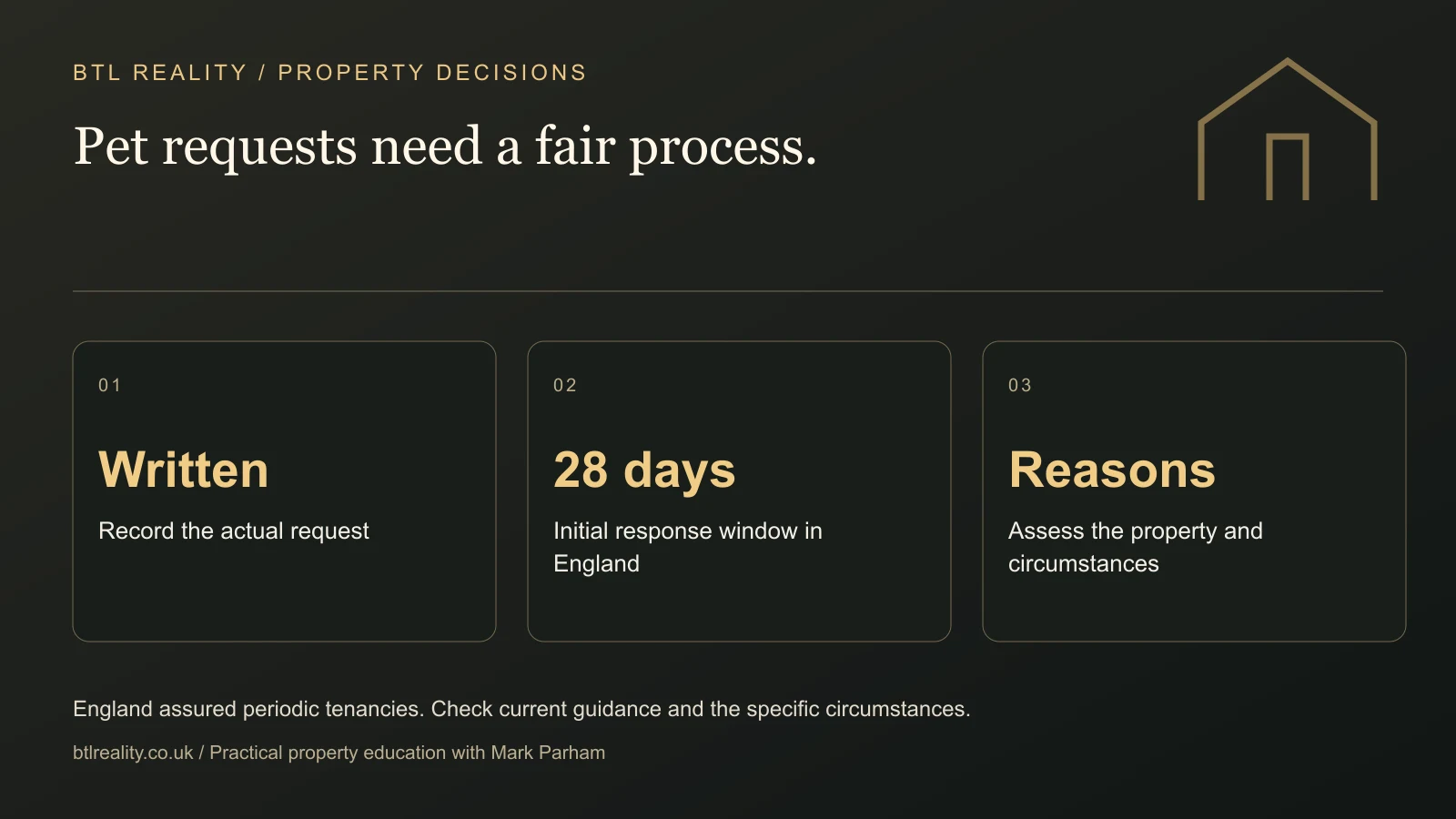
For an assured periodic tenancy in England, a landlord must consider a tenant's written request to keep a pet and cannot refuse without a fair reason. That does not mean every animal must be accepted in every property. It means the decision should be based on the actual request, relevant circumstances and a proper written process.
This guide is for England's current assured-periodic-tenancy framework, checked in October 2026. Other nations and tenancy types can differ. Use it to organise the response, then obtain qualified advice where a lease restriction, assistance animal, disputed refusal or unusual situation needs individual assessment.
Begin with the actual request
Ask the tenant to put the request in writing and describe the pet. The useful details depend on the animal and accommodation: type, size, number and relevant space requirements can help you assess the situation.
Record when the request arrived and who is responsible for responding. If an agent manages the property, make sure the request is not left between the agent and landlord while each assumes the other is dealing with it.
GOV.UK's pet-request guidance sets out the current process. It specifies a written response within 28 days and explains the timing where additional information is needed. Keep that source with your file rather than relying on an old tenancy template or an outdated article about proposed legislation.
Assess suitability rather than applying a blanket answer
The property, animal and relevant occupancy circumstances should drive the review. A request for one small enclosed animal is different from a request for several large animals in a compact flat. The assessment needs to fit the facts.
Distinguish evidence from assumptions. A previous tenant's pet causing damage does not establish that the current request is unsuitable. Similarly, a general dislike of animals does not identify a property-specific reason for refusal.
Write down the issue you are considering and why it matters. If you cannot explain it clearly without relying on “pets are always a problem”, you probably need to investigate further or obtain advice before refusing.
Make the example your own
Have you recorded a fair pet-request process?
For covered assured periodic tenancies in England. Use current guidance and legal advice for the decision itself.
0 of 6 checks reviewed
This is a working checklist, not a legal decision or compliance certificate. Selections stay in this page and are not saved or sent.
The checklist is a process record, not a legal decision engine. It does not tell you that a particular refusal is reasonable or that permission must be granted. Use the current guidance and qualified advice for the actual circumstances.
Keep the response timetable visible
Create a diary entry when the request arrives, with enough time for any necessary lease checks and a considered reply. Do not leave the first review until the last day of the response window.
If more information is genuinely needed, ask promptly and explain the relevant question. The official guidance provides an adjusted response period after the tenant supplies additional information. Do not treat asking a question as permission to delay indefinitely or restart the process without reference to the rules.
Keep copies of the request, clarification, reply and any relevant professional advice. A short, clear record is more useful than a long chain of informal messages with no identifiable decision or date.
Check a superior lease where relevant
If you own a leasehold flat, review the lease and any applicable consent requirements. You may need to approach the freeholder or managing agent. Identify the actual provision rather than assuming that all flats prohibit pets.
Give the relevant party enough information to consider the request and retain the response. If the position is unclear, ask your conveyancer or a landlord legal adviser to interpret it. A casual statement from another resident is not a reliable substitute for the lease.
Do not promise consent you are not entitled to give, but do not invent a restriction to avoid assessing the request. The landlord's tenancy obligations and the superior lease need to be considered together.
Assistance animals need particular care
Do not treat an assistance animal as though the only question is your ordinary pet preference. Disability-related rights and reasonable-adjustment issues can be relevant, and the official guidance warns against unreasonable refusal in this context.
Ask for advice if you are unsure how the particular circumstances should be handled. Keep requests for information relevant and proportionate, and avoid collecting unnecessary sensitive personal details.
The practical objective is to understand the housing arrangement and resolve the request fairly. A generic “no animals” policy is not an adequate substitute for considering the actual situation and applicable duties.
Write a useful decision, not just yes or no
An approval should identify the request being accepted so both parties understand the animal and arrangement discussed. Keep the communication clear and consistent with the applicable rules and agreement. The Renters' Rights Act provisions underpin the consent process. Do not assume you can simply withdraw an approval later; obtain advice before attempting to change an agreed arrangement.
If you intend to refuse, explain the reasons in writing and ensure they relate to the circumstances rather than speculation. Have a disputed or legally uncertain decision reviewed before treating it as settled. A tenant may challenge a refusal they consider unreasonable.
Avoid adding conditions or charges simply because they sound reassuring. Any proposed requirement needs to be lawful and appropriate. An informal promise extracted during a pet discussion does not automatically override tenant protections or the tenancy agreement.
Do not invent an extra pet fee or deposit
Pet requests are not a reason to ignore the Tenant Fees Act rules. In England, permitted payments and deposit caps still apply. GOV.UK's tenancy-fee guidance sets out what can be charged and explains that a landlord cannot require a tenant to buy insurance as an unlisted condition of the tenancy.
Do not rely on old commentary about proposed pet-insurance measures as though it describes the current law. Check the enacted position and obtain advice on any proposed payment or condition.
A pet-related discussion also should not become an improvised route to increase an existing tenant's rent. Any rent change must follow the applicable lawful process. Keep the permission decision separate from an unsupported demand for extra money.
Good property records help with genuine damage
An accurate inventory and dated condition record are useful whether or not the tenant has a pet. Record the condition of floors, doors, furniture and relevant garden areas at the appropriate stages, with agreed access and respect for the tenant's home.
If damage occurs, establish what happened and distinguish it from ordinary wear, age or an existing defect. Obtain reasonable repair evidence and discuss the issue with the tenant. Do not automatically assume every mark in a pet-owning household was caused by the animal.
The Deposit Protection Service's guidance on fairness and betterment explains why deposit claims must account for condition and wear rather than fund an upgrade. A damaged old carpet does not automatically justify charging for a brand-new premium replacement.
Avoid counting the same loss twice
If an insurance policy responds to an incident, coordinate it with any proposed deposit claim or other recovery. Keep invoices, settlements and contributions in one record. The aim is to resolve the actual loss, not collect twice for the same damage.
An insurance policy may have exclusions, excesses and conditions. Review the wording rather than assuming ordinary landlord cover includes every pet-related event. If you choose your own suitable insurance, treat the premium and excess as part of your business planning.
This is a records and risk-management question, not a reason to presume that every pet will cause damage. Apply the same evidence-based approach you would use for other repair or tenancy issues.
Make the home practical to maintain
Durable, suitable finishes and clear repair reporting help any tenancy. Consider the property's normal use, cleaning and maintenance needs without turning a pet request into a costly speculative refurbishment.
Compare carpet and hard flooring by whole-life cost, while checking lease restrictions and room suitability. Choosing a material solely because you believe it can never be damaged is unlikely to be a realistic strategy.
Provide clear contact details for reporting problems. If a concern arises, discuss it promptly and use the appropriate process. A calm early conversation is usually more useful than allowing a minor issue to become a dispute built on assumptions.
Use a consistent management process
Whether you own one rental or several, keep a standard way to log requests, check dates, review relevant documents and issue a written decision. Consistency means following a fair process; it does not mean giving every property and animal an identical answer.
Review your agent's procedures and templates against current guidance. Make clear who has authority to respond and when a matter needs legal advice. A policy that was convenient years ago may no longer reflect the current framework.
Starter Club supports practical property planning and learning. It does not provide a legal ruling on a disputed pet request. Use the free resources for financial modelling and the appropriate legal or professional service for tenancy decisions.
For the connected reforms, see our 2026 landlord rules hub and rent review guide.
Frequently asked questions
Does every landlord have to accept every pet?
No. For the covered England tenancies, requests must be considered fairly and refusal needs a reasonable basis. The actual animal, property and relevant circumstances matter. Avoid blanket assumptions and obtain advice where the decision is disputed or involves complex lease or disability-related issues.
How should a tenant request permission for a pet?
The request should be in writing and include a description of the animal. Useful relevant details help the landlord assess the specific situation. Keep the request and any follow-up information in the tenancy record, with the date received clearly identified for managing the response process.
How long does a landlord have to respond?
The official England guidance specifies 28 days for a written response. Where additional information is requested and supplied, the final-response period is the remaining original period or seven further days, whichever is later. Check the current guidance and diarise the actual dates rather than estimating informally.
What if the superior lease restricts pets?
Review the exact terms and seek any required freeholder permission. Keep the written evidence and obtain legal advice if the restriction or its application is unclear. Do not assume every lease prohibits pets, or that a restriction can simply be ignored when responding to the tenant.
Can a landlord charge an extra pet deposit or fee?
Do not impose an unlisted pet fee or exceed the applicable deposit cap. The Tenant Fees Act rules still matter, and compulsory insurance should not be assumed lawful. Obtain advice before proposing a payment or condition, rather than relying on older discussions of draft legislation.
How should pet damage be documented and handled?
Use dated condition evidence, a clear account of the issue and reasonable repair information. Distinguish damage from fair wear and existing defects, follow the appropriate deposit or insurance process and avoid duplicate recovery. Discuss concerns with the tenant and seek advice where responsibility is disputed.
Put the next step into practice
Use the free tools to test your numbers, then choose the level of support that fits your next decision.