How Long Should a Landlord Keep Tenant Documents?
October 22, 2026
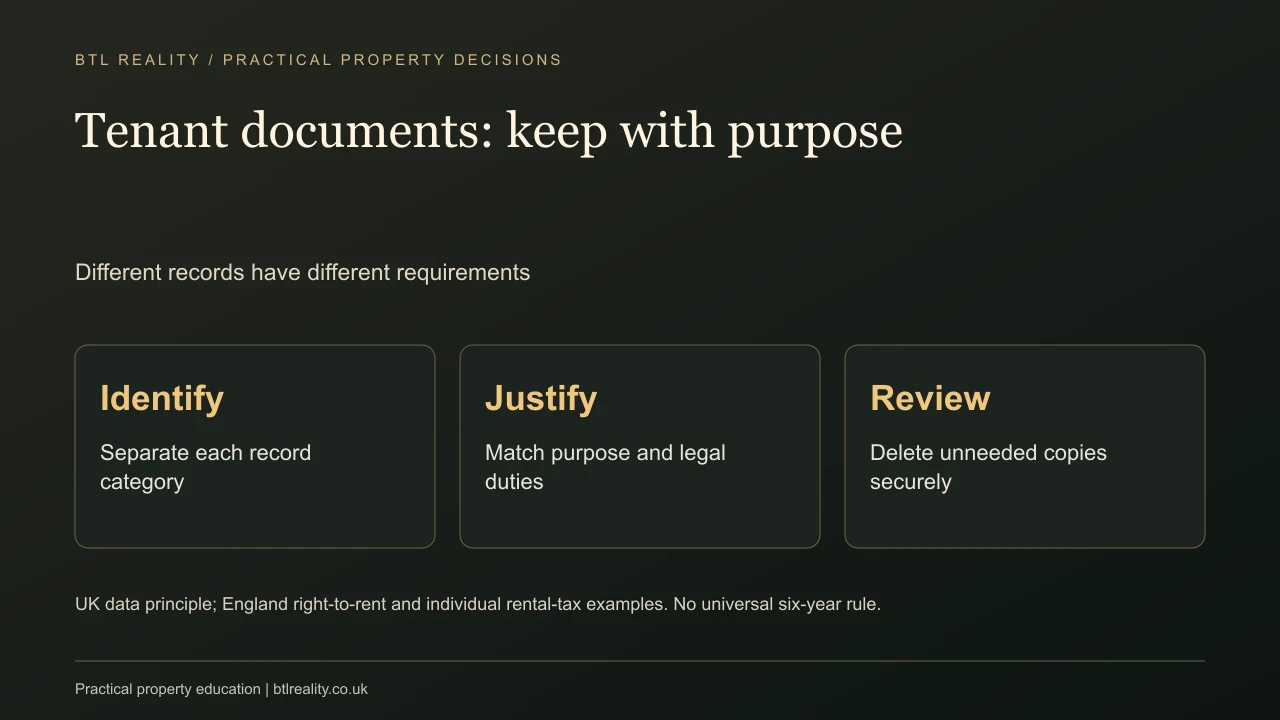
There is no single GDPR rule saying a landlord should keep every tenant document for six years. Different records serve different purposes, and some have specific retention requirements. Keeping everything forever and deleting everything at check-out can both be poor answers.
A useful retention plan separates tax records, identity-check evidence, tenancy agreements, repair records and unsuccessful applications. You can then explain why each category is held and when it will be reviewed or removed.
This guide uses UK data-protection guidance checked on 19 October 2026. The right-to-rent example concerns England, and the rental-tax example concerns an individual landlord’s records. Company, overseas and other legal requirements need their own assessment.
Start with purpose, not a universal number
The ICO’s storage-limitation guidance says personal information should not be kept longer than needed. UK GDPR does not itself set a fixed period for every data type. You should justify retention, review records and delete or anonymise information no longer needed. The ICO notes that this guidance is under review following the Data (Use and Access) Act.
That means a file name such as “tenant documents” is too broad for a useful decision. A rent ledger and a rejected applicant’s detailed bank statement have different purposes. One may still be needed when the other is not.
Record the purpose and relevant requirement before choosing a period. Do not use “might be useful someday” as the reason for storing every copy indefinitely.
Separate the main categories
| Record category | Purpose to establish | Review question |
|---|---|---|
| Rent and expense evidence | Tax and accounting records | Which tax rule and period applies? |
| Right-to-rent evidence | Prescribed England checking record | What does current Home Office guidance require? |
| Agreement and deposit records | Tenancy, rights and possible claims | What needs retaining and why? |
| Repair and safety history | Property work and compliance evidence | Can tenant personal details be minimised? |
| Unsuccessful applications | Selection process and any justified follow-up | Is the original information still necessary? |
Set the review date for each category and identify who makes the decision. A table nobody follows is not much better than a folder nobody opens.
Tax records have a specific starting point
HMRC’s individual rental-income guidance says records must be kept for at least five years after the 31 January tax-return deadline for the tax year. It identifies records such as rent, receipts, invoices and bank statements.
For a straightforward 2025/26 example with a 31 January 2027 filing deadline, five years later is 31 January 2032. That is not simply five years from the day the tenant moved out. Check additional circumstances, such as an enquiry, with your accountant.
The tax requirement does not automatically justify retaining every identity image, medical detail or applicant report in the same folder. Keep the evidence needed for the tax purpose and assess other categories separately.
The repairs-versus-improvements guide explains why property expenditure records can matter to different tax questions. Do not destroy purchase or capital-work evidence just because a routine tenancy folder reached a review date.
Right-to-rent records follow their own rule
The Home Office guide dated1 October 2026 specifies retention of the checking evidence and date during the tenancy and at least one year afterwards, with secure handling and disposal under the guidance. This is an England checking requirement, not a UK-wide instruction to copy every tenant’s passport.
If the tenancy ends on 31 December 2026, the one-year point is 31 December 2027. Record the actual end date and the relevant evidence category rather than guessing from the last rent payment.
A follow-up task log and the full identity evidence are different records. Limit who needs access to the documents. A contractor arranging a repair does not need the right-to-rent file.
Where you are uncertain about overlapping duties or an active case, seek advice. Do not delete a prescribed record early because an unrelated document was no longer required.
Tenancy and claim records need a reasoned decision
Agreements, deposit information, correspondence and repair evidence may be relevant to rights or claims after occupation ends. Establish the applicable legal basis and retention period with suitable advice rather than inventing a universal GDPR deadline.
If a dispute is active, identify the records needed and preserve them appropriately while the matter is resolved. A routine deletion cycle should not silently destroy relevant evidence. Equally, an unresolved general worry is not a reason to keep every duplicate forever.
Record any exception to the normal schedule, its reason and the next review point. That lets a later manager understand why one tenancy file was retained longer without assuming all files should be kept indefinitely.
Keep factual property history where needed, but consider whether a named former tenant or detailed personal information is necessary in every version. An anonymised record of a replaced boiler may serve a different purpose from the original correspondence.
Review unsuccessful applicant information
Once a property has been let, ask what information about unsuccessful applicants remains necessary and for what purpose. Do not automatically retain complete financial reports because an applicant might enquire again years later.
Explain the relevant retention approach in your privacy information and follow a consistent process. If you need advice about a particular record or complaint risk, obtain it and document the conclusion.
A contact list for people who asked to hear about future properties is also a different purpose from screening a past application. Do not silently repurpose an old application file as a marketing database.
Ask the agent what it retains independently and what copies are disclosed to you. Reducing unnecessary receipt at the start can make later retention much easier to manage.
Find the duplicate copies
A controlled property folder can be secure while the same passport image remains in a personal email account, phone download folder and messaging attachment. Include those copies in the review.
For a hypothetical four-tenancy review, suppose each file has three unnecessary duplicate attachments. That is twelve duplicate copies to address. Removing only the four main-folder copies would leave eight elsewhere.
This is a simple illustration, not a count of your own records. The point is to identify storage locations and responsible people rather than assume one folder represents the whole picture.
Do not upload tenant identity documents to an unfamiliar online cleaner or summarising service to save time. Use appropriate secure systems and delete or dispose of records in a way suitable for their sensitivity.
Make deletion reviewable
Keep a proportionate record that a scheduled review occurred, the category reviewed and the action taken. You usually do not need to reproduce all the deleted personal information in the deletion log, which would defeat the purpose.
For paper records, use suitable secure disposal. For electronic records, understand the system’s deletion and backup arrangements and obtain support where needed. Removing a desktop shortcut is not deleting the underlying file.
Restrict access before deletion as well as afterwards. A long retention requirement is not permission for every member of an organisation to view a former tenant’s documents throughout that period.
If an individual asks for erasure, assess the request under the applicable rules and respond properly. Do not assume either that every request overrides all other obligations or that a blanket retention policy lets you ignore it.
Agree the process with your agent and accountant
Ask what documents you need to retain, who holds the authoritative copy and what happens when an agent or staff member leaves. Keep financial evidence accessible to the accountant without exposing unrelated tenant information unnecessarily.
The rental account guide helps organise the financial side, while the remote management guide helps assign responsibilities. Neither replaces a clear category-by-category retention decision.
Review the schedule when the law, business process or provider changes. A practical record tells you what you hold, why you hold it, when the next review occurs and who will act. That is far more useful than a folder labelled “keep everything for six years”.
Your questions answered
Does GDPR say keep every tenant file for six years?
No. ICO guidance does not set one fixed period for every type of personal information. Establish the purpose, applicable requirements and justified retention for each category.
How long does HMRC require individual rental records?
The cited guidance says at least five years after the 31 January tax-return deadline for the tax year. Additional circumstances can affect the position, so check with your accountant.
Can I delete right-to-rent evidence at check-out?
Follow the current Home Office requirements for England, which include keeping the checking evidence and date during the tenancy and at least one year afterwards. Do not apply an unrelated deletion rule.
Should unsuccessful applicant files be kept forever?
No. Assess what remains necessary and why, explain the approach appropriately and review the records. Do not retain complete reports indefinitely simply because storage is inexpensive.
What if a deposit or repair dispute is still active?
Identify and preserve the relevant evidence under the applicable basis and obtain advice where needed. Record the exception and review point rather than allowing routine deletion to destroy needed records.
Does deleting the main folder remove every copy?
Not necessarily. Review email attachments, downloads, messaging files, paper records and system arrangements. Keep the process secure and avoid recreating unnecessary personal data in the deletion log.