When Does a Landlord Need a Follow-Up Right to Rent Check?
October 20, 2026
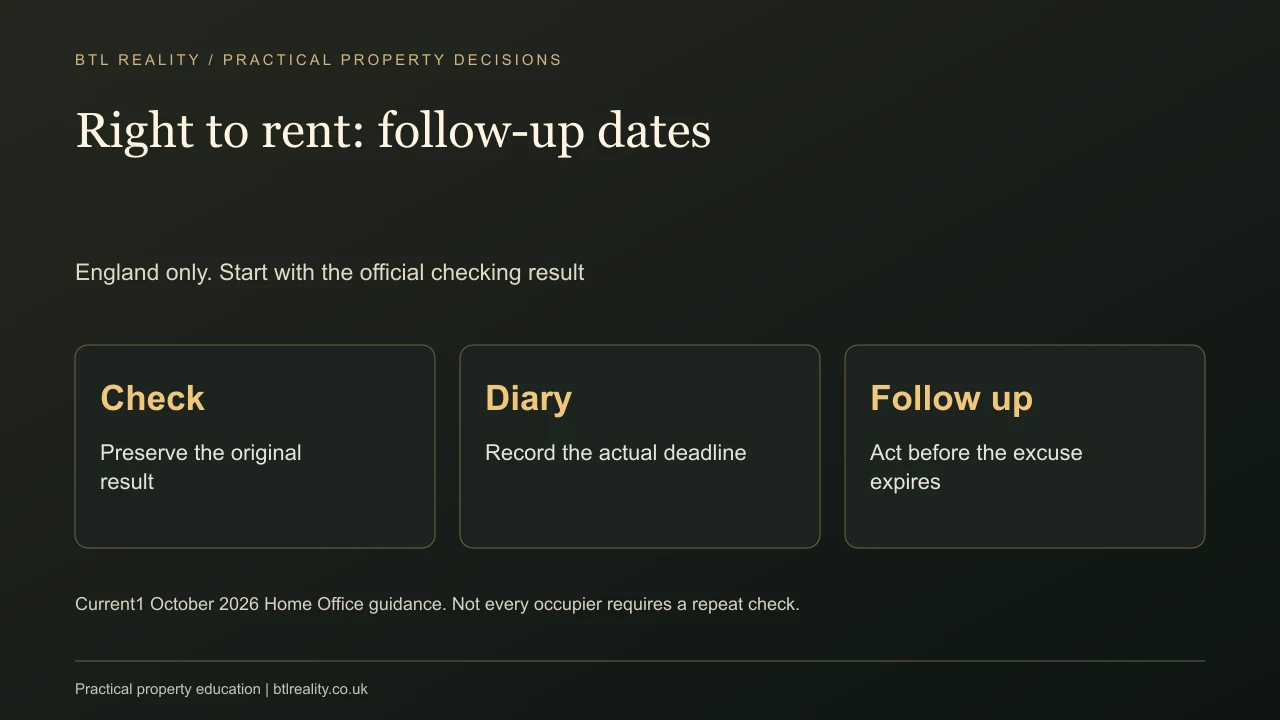
A right-to-rent check is not automatically an annual appointment for every tenant. In England, some occupiers need a follow-up check and others do not. The correct date depends on the evidence and checking route, not simply the anniversary of moving in.
The practical job is to retain the original result, identify whether follow-up is required and put the actual deadline into a system somebody monitors. Sending every tenant the same yearly passport request can create unnecessary work while still missing a genuine deadline.
This guide uses the Home Office landlord guidance dated 1 October 2026, checked on 19 October 2026. Right to rent applies in England, not throughout the UK. It is a checking process, not an assessment of a person’s nationality, affordability or suitability as a tenant.
Start with the recorded checking result
The current Home Office landlord guide sets out the permitted routes and records. The official online service can specify whether follow-up is needed and the deadline. Preserve that result rather than relying on a recollection that the tenant “had a visa”.
For the usual time-limited calculation, GOV.UK’s follow-up guidance uses the later of the permission end date and twelve months after the previous check. Route-specific rules and the actual official result still need to be followed.
Do not use a screenshot of a tenant’s personal status page as though you had completed the required landlord checking service. Keep the evidence of the prescribed process you actually carried out.
Who does not need repeated checks?
Where an unlimited right to rent has been established, routine follow-up is not required during the tenancy. Current Home Office guidance also says no repeat checks are required for EU Settlement Scheme settled or pre-settled status following the prescribed initial check.
That exception is easy to miss if an old spreadsheet labels every status with an expiry date as a repeat-check case. Review the basis of the original entry and the current guidance rather than automatically requesting fresh evidence.
Apply the process consistently to all adult occupiers. A person’s name, accent or appearance does not establish which route applies. Keep checking decisions based on the prescribed evidence and avoid discriminatory selection or repeated demands.
If the record is unclear, obtain clarification through the appropriate official route or competent advice. Do not invent a follow-up requirement simply to make a file appear complete.
Three dated examples
| Case | Recorded position | Planning result |
|---|---|---|
| A: usual time-limited check | Checked 1 November 2026; permission ends 1 March 2027 | Twelve-month date is later: plan follow-up before 1 November 2027 |
| B: usual time-limited check | Checked 1 November 2026; permission ends 1 June 2028 | Permission date is later: plan follow-up before 1 June 2028 |
| C: EUSS pre-settled status | Prescribed initial check completed and retained | No routine repeat check required under current guidance |
These examples show why permission expiry and the follow-up deadline must not be treated as interchangeable. They are illustrations, not a substitute for reading the official result on a particular check.
A Positive Right to Rent Notice from the Landlord Checking Service has its own twelve-month period. Record the notice and its date accurately rather than applying an unrelated visa expiry entry from another document.
Use reminders before the deadline
A deadline entered in a diary is only useful if somebody sees it in time to act. Choose internal reminders that leave time for the occupier to respond and for the appropriate official process if the evidence is not immediately available.
For example, you might set a review reminder thirty days before the recorded deadline and a second reminder seven days before. Those are management choices, not official statutory intervals or an extension of the deadline.
Assign a named person to check the result and close the task. An automated email saying “reminder sent” is not proof that a follow-up check was completed. Keep separate statuses for requested, received, checked and recorded.
If an agent manages several properties, ask how overdue tasks are escalated and who covers staff absence. A shared inbox with no owner can leave everybody assuming somebody else completed the check.
Agree the agent’s responsibility in writing
Specify whether the agent undertakes initial checks, follow-up checks or both, and how the evidence and deadline are communicated. A generic promise to “reference the tenant” is not a precise statement of right-to-rent responsibility.
Ask for confirmation that the required process was completed and where the evidence is held. You do not need unnecessary copies circulating through several personal email accounts, but you do need a reliable arrangement for access and continuity.
The remote management guide helps structure those responsibilities. Living overseas makes a clear process more important; it does not make the task disappear.
When changing management arrangements, reconcile the outstanding follow-up list with the records being transferred. Keep the checking route, original date, recorded deadline and responsible person together, so the new manager does not have to guess.
What if the tenant cannot provide evidence?
Use the official guidance and Landlord Checking Service where appropriate. A pending application or missing document needs the correct checking route, not an assumption that the person has no right to rent.
Where the follow-up process indicates the occupier no longer has the right to rent, the Home Office guidance explains reporting requirements. Act promptly and seek advice if the position is uncertain. Keep the actual result and the action taken.
Do not equate a missed email with an immediate right to change locks or remove belongings. Right-to-rent compliance and the lawful process for ending occupation are separate matters. Obtain proper advice about any tenancy action.
Keep communication factual: what evidence or official process is needed, by when, and where the occupier can respond. Avoid threatening a legal consequence that you have not established applies.
Retain the evidence securely
The Home Office guide specifies keeping the checking evidence and date for the tenancy and at least one year afterwards, with secure disposal when appropriate. Do not store passport copies in a public shared folder or an unsecured photo album.
Separate the useful deadline log from the full identity evidence. A task list can identify the tenancy, checking route, due date and owner without exposing the complete document to every contractor or staff member.
Restrict access, keep the record retrievable and have a sensible process for staff departures and device changes. A check completed correctly can still be difficult to evidence if the only copy disappeared with an employee’s phone.
Do not retain every duplicate forever because storage is cheap. Keep the required evidence in the appropriate controlled record and review the other copies you no longer need.
Check the process across a small portfolio
Suppose six properties each have two adult occupiers. That is twelve people to account for in the initial checking record, not six property-level ticks. It does not mean twelve annual follow-ups are required.
If four occupiers have recorded time-limited follow-up requirements, the monitoring list contains those four actual deadlines. The others should have a clear recorded basis for no follow-up rather than being forgotten entirely.
A quarterly file review can compare the tenancy list with the checking log, identify missing evidence and confirm the next due tasks. That review is an internal control, not a fresh immigration check imposed on every tenant.
For the broader property calendar, see the landlord rules overview. Keep right-to-rent deadlines alongside other responsibilities while preserving the different legal basis and timing of each.
Make the next action clear
For each relevant occupier, you should be able to answer four questions: what check was completed, where is the evidence, is follow-up required and who will do it before the recorded deadline?
If one answer is missing, resolve that specific gap. Repeatedly asking everyone for a passport can look thorough while doing less to protect the process than one accurate, secure and monitored record.
Your questions answered
Does every tenant need an annual right-to-rent check?
No. Follow-up depends on the checking route and result. Unlimited rights do not require routine repeats, and current guidance also provides the EUSS settled and pre-settled exception.
Does pre-settled status need repeat checks?
The Home Office guide dated1 October 2026 says no repeat checks are required for EUSS pre-settled or settled status after the prescribed initial check. Keep that initial evidence and follow current official guidance.
Is the follow-up always due when the visa expires?
No. The usual time-limited rule uses the later of permission expiry and twelve months after the previous check, while particular routes and official results need to be followed.
Can my letting agent carry out the follow-up?
An agent can undertake the agreed role, but set out the responsibility, timescales and evidence arrangements clearly in writing. Do not assume ordinary referencing automatically includes ongoing checks.
What if the tenant has a pending Home Office application?
Use the appropriate official checking route, including the Landlord Checking Service where required. Do not assume an unavailable document means the person has no right to rent.
How long should the check evidence be kept?
Follow the Home Office retention requirements: the tenancy and at least one year afterwards, with secure storage and appropriate disposal. Keep the check date and actual evidence retrievable.