Smoke and Carbon Monoxide Alarms: What Must a Landlord Check on Day One?
October 20, 2026
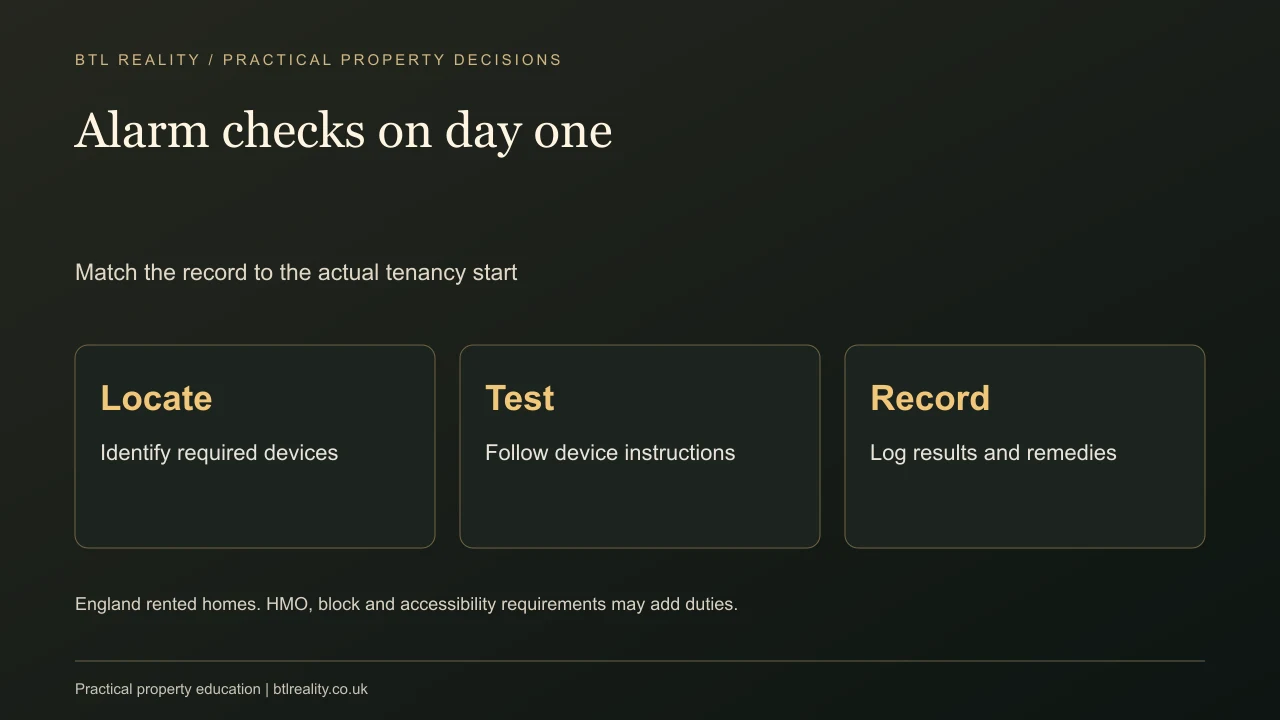
Having alarms fitted is only part of a landlord’s job. For a new tenancy in England, you also need to check the required alarms work on the day the tenancy begins. A gas check completed several weeks earlier does not replace that particular handover check.
This is a small task that deserves a clear place in the move-in process. Agree who will do it, test according to the manufacturer’s instructions and keep an accurate record. Do not let it fall into the gap between the landlord, letting agent and inventory clerk.
This article covers ordinary rented homes in England, with official guidance checked on 19 October 2026. Scotland, Wales and Northern Ireland have different requirements. Licensed HMOs and blocks of flats also need their own fire-safety arrangements; the checklist here is not a complete fire-risk assessment.
Which alarms are we talking about?
The government’s amended alarm guidance requires a smoke alarm on each storey containing living accommodation and a carbon monoxide alarm in a living-accommodation room with a fixed combustion appliance, excluding gas cookers. It also covers day-one testing, records and repair of reported faults. Follow the manufacturer’s installation and testing instructions.
That is why an old checklist asking only whether there is a solid-fuel fire can miss the current position. Look at the actual rooms and appliances. Do not reuse the alarm list from another property simply because both are two-bedroom houses.
A heat detector is not a replacement for the prescribed smoke alarm. If you are unsure whether a room, layout or appliance falls within the rules, check the official guidance and obtain competent advice rather than guessing at installation locations.
Make a room and storey list before handover
Prepare the list while there is time to resolve missing or unsuitable equipment. Record the storeys used as living accommodation, the locations of the smoke alarms and the rooms containing relevant combustion appliances.
Then identify the actual devices. A clear description such as “first-floor landing, ceiling-mounted smoke alarm” is more useful than “alarm upstairs”. Record the model or reference where practical so future replacement decisions are based on the equipment installed.
Keep photographs for identification, but do not treat a photograph of an alarm as proof that it sounded or otherwise operated correctly. Presence and a successful test are separate facts. A handover form should have separate places for each.
| Location | Item to identify | Day-one record |
|---|---|---|
| Ground-floor hall | Smoke alarm | Date, person, test result |
| First-floor landing | Smoke alarm | Date, person, test result |
| Kitchen with gas boiler | Carbon monoxide alarm | Date, person, test result |
| Any additional relevant room | Check actual appliance and guidance | Required equipment and completed action |
This example does not specify where an alarm should be mounted. That depends on the device instructions and the property. A list that helps you remember a task should not become an amateur installation specification.
Agree who is doing the check on the actual start date
Handover arrangements can become confusing when keys are collected on Friday but the tenancy starts on Monday. Put the actual tenancy start date on the work instruction. Do not assume the date on an appointment calendar is necessarily the legal start date.
Ask the person carrying out the visit to confirm the job includes testing each required alarm and recording the result. A standard inventory quote may include photographing devices but not the check you intended. Resolve that before the booking.
If the start date changes, move the task with it. A rent-account amendment and a rescheduled moving van do not automatically update the contractor’s instructions. One named person should confirm the final date to everyone involved.
The landlord rules overview is useful for the wider compliance diary. Keep this task as a dated handover action rather than assuming it is covered by the annual gas or five-year electrical process.
Record a result, not just a tick
A useful record identifies the property, tenancy start date, visit date, person undertaking the check, alarm location and result. Include any fault and the action taken. “All done” in a group chat is difficult to match to a particular device later.
If the inventory is reviewed with the tenant on day one, invite them to acknowledge the recorded tests. Government guidance identifies a signed inventory entry as one possible way to evidence the checks. A signature is not a substitute for doing them and does not waive future responsibilities.
Where the tenant does not attend or sign, preserve the factual record and supporting evidence. Do not add their signature, imply agreement they did not give or leave a blank result that somebody might later mistake for a pass.
Store the record where the managing agent or replacement manager can retrieve it. A careful check on a contractor’s phone is less useful if nobody can obtain the report when a question arises.
What if an alarm fails?
Do not mark it as satisfactory because a replacement has been ordered. Record the fault and arrange the necessary remedy promptly. Confirm the replacement or repaired device has been checked and update the record with what actually happened.
The House of Commons Library explanation distinguishes these landlord responsibilities from the wider fire-safety arrangements that can apply in shared buildings. A problem with a communal system should be raised with the responsible building manager as well as recorded in your own file.
If someone reports a carbon monoxide alarm sounding or a suspected emergency, tell them to follow the alarm and relevant emergency-service instructions immediately. Do not remotely reset, silence or diagnose it as a paperwork issue.
For a routine defect, give the tenant a clear appointment and reporting route. If access is difficult, document the efforts and seek advice on the appropriate process. Do not assume that sending a replacement to the property proves it has been installed and works.
Give the tenant a useful demonstration
Show the tenant where the devices are and provide the manufacturer instructions or a clear route to them. Explain how to report a fault and who to contact outside office hours. This should be simple enough to find during a stressful situation.
Ask whether the alarm arrangement meets the occupant’s practical needs. Someone who is deaf or hard of hearing may require a different alert arrangement. Do not assume that an audible signal which works for the clerk will work for every resident.
Keep the explanation factual. Avoid telling the tenant that anything happening after move-in is entirely their problem. Ongoing testing and battery issues need clear arrangements, and a landlord must act on reported faults under the applicable duties.
A welcome pack with a hundred pages is not necessarily useful. A short alarm section with locations, instructions and contact details is easier to use than a generic paragraph copied from another tenancy.
Put the actual costs in the handover budget
Alarm checks are easier to organise when the handover budget includes the work needed rather than only the cost of the inventory report. Ask whether attendance, batteries, replacement devices and a return visit are included or separately authorised.
For an illustrative budget, assume a £55 handover visit, a £28 replacement alarm and a £20 additional fitting charge. The total is £103. The extra equipment and fitting cost £48. These are made-up planning figures, not quoted market prices or an indication that fitting is appropriate as a DIY task.
If an agent’s package is £90 and includes the same visit and fitting labour, compare the remaining device cost and the exact scope. Comparing £55 with £90 without the extras would miss the point. The cheaper headline does not always produce the lower completed cost.
Use the maintenance budget guide for planned replacement allowances and the quote comparison guide when the property needs wider safety or installation work. Record an agreed scope before instructing work.
Close the handover loop
Before filing the tenancy as ready, check that every listed device has a result, every fault has a completed action and the tenant has a reporting route. If something is outstanding, assign an owner and a clear next step.
The strongest process is easy to repeat without becoming automatic. Start with this property’s layout, this tenancy’s date and these devices. A familiar checklist is useful only when somebody still pays attention to what is in front of them.
Your questions answered
Can the gas safety visit replace the day-one alarm check?
A check weeks earlier does not replace the requirement to check the prescribed alarms work on the day a new tenancy begins. Arrange the handover task for the actual start date.
Does a gas boiler require a carbon monoxide alarm?
In England the guidance covers a living-accommodation room containing a fixed combustion appliance, with gas cookers excluded. A gas boiler can fall within that requirement. Check the actual room and installation instructions.
Must the tenant sign the alarm record?
A signed inventory entry is one possible form of evidence, but a signature does not replace the test. Keep a truthful record of who checked each alarm, when and with what result.
Can a heat detector replace the smoke alarm?
Government guidance says heat detectors are not a replacement for smoke alarms. Obtain competent advice for the required arrangement in the actual property.
Who deals with a faulty alarm during the tenancy?
The tenant should report a fault through the agreed route. Landlords must repair or replace a reported faulty alarm as soon as practicable under the applicable rules.
Does this checklist cover a licensed HMO?
It is not a complete HMO fire-safety checklist. Licensing and other fire-safety duties can require more. Check the licence, building arrangements and competent fire-safety advice.