Is Now a Good Time to Buy Property in the UK?
October 3, 2026
Now can be a good time to buy a UK investment property if the specific deal works at today’s borrowing costs, leaves adequate reserves and fits your objectives. It is not automatically a good time because national prices look cheaper after inflation, and it is not automatically a bad time because one region is falling. The purchase price, local demand and financial resilience matter more than a national yes-or-no headline.
The latest official figures available for this October 2026 review show substantial regional differences. That creates questions worth investigating, but it does not tell you which street, building or tenancy will produce a suitable return. A national forecast is context for a decision, not the decision itself.
This guide combines the current data with a worked £150,000 property example. You can change the borrowing and rent assumptions, then use the free calculators to examine the wider cash requirement. None of the examples is a forecast or a personal recommendation to buy.
What do the latest UK house-price figures show?
The ONS September 2026 release reports an average UK house price of approximately £273,000 in July 2026, up 1.4% over the year. The publication date and reference month are different because completed-transaction data arrives with a lag and can be revised.
Within England, the North East recorded 4.9% annual growth while London recorded a 3.3% fall. That is a significant difference in direction, but it is still a comparison of regional averages. A particular flat, house type or neighbourhood may behave differently from its regional headline.
The correct response is to investigate local evidence: recent comparable transactions, current competing listings, achievable rents, employment access, supply and property condition. Avoid choosing a location solely because it topped the latest annual-growth table. A strong recent rise does not prove the next purchase is attractively priced.
Are homes cheaper after inflation?
They can be, even when the cash price has risen. Inflation-adjusted prices compare a house-price index with a general price index over the same period. If house prices rise more slowly than consumer prices, the house-price index falls in real terms.
That is different from saying the home became easier for every buyer to afford. Mortgage rates, deposits, disposable income and lending criteria matter too. A buyer can face a lower real house price but a higher monthly mortgage payment than a few years earlier.
Our real house-prices and inflation guide sets out the calculation. It also compares house prices with earnings separately. Do not add cumulative wage growth and inflation together to invent a larger “catch-up” target; they are different benchmarks addressing different questions.
Why your buying price can matter more than the national year
Imagine a property independently supported at a £150,000 market value is available for £135,000. The £15,000 difference is 10% of that assumed market value. It may provide useful headroom, but only if the valuation is credible and there is no hidden cost explaining the apparent discount.
A £15,000 discount is not £15,000 of cash profit on completion. Purchase tax, fees, refurbishment, finance and selling costs still matter. A lender may also use the lower purchase price rather than the hoped-for market value when deciding the initial loan.
Compare this with paying £155,000 for a similar property because you expect national prices to rise. Both buyers face an uncertain market, but they start from different cost bases. The more useful discipline is to establish value and total costs before deciding whether the timing supports your plan.
Worked example: can the rental carry itself?
Take a £150,000 purchase with a 75% interest-only loan of £112,500. Assume rent of £1,000 a month, management at 12% including VAT, maintenance at 10% of rent, a 5% void allowance and £50 monthly other operating costs. These are illustrative inputs, not market quotes or universal cost ratios.
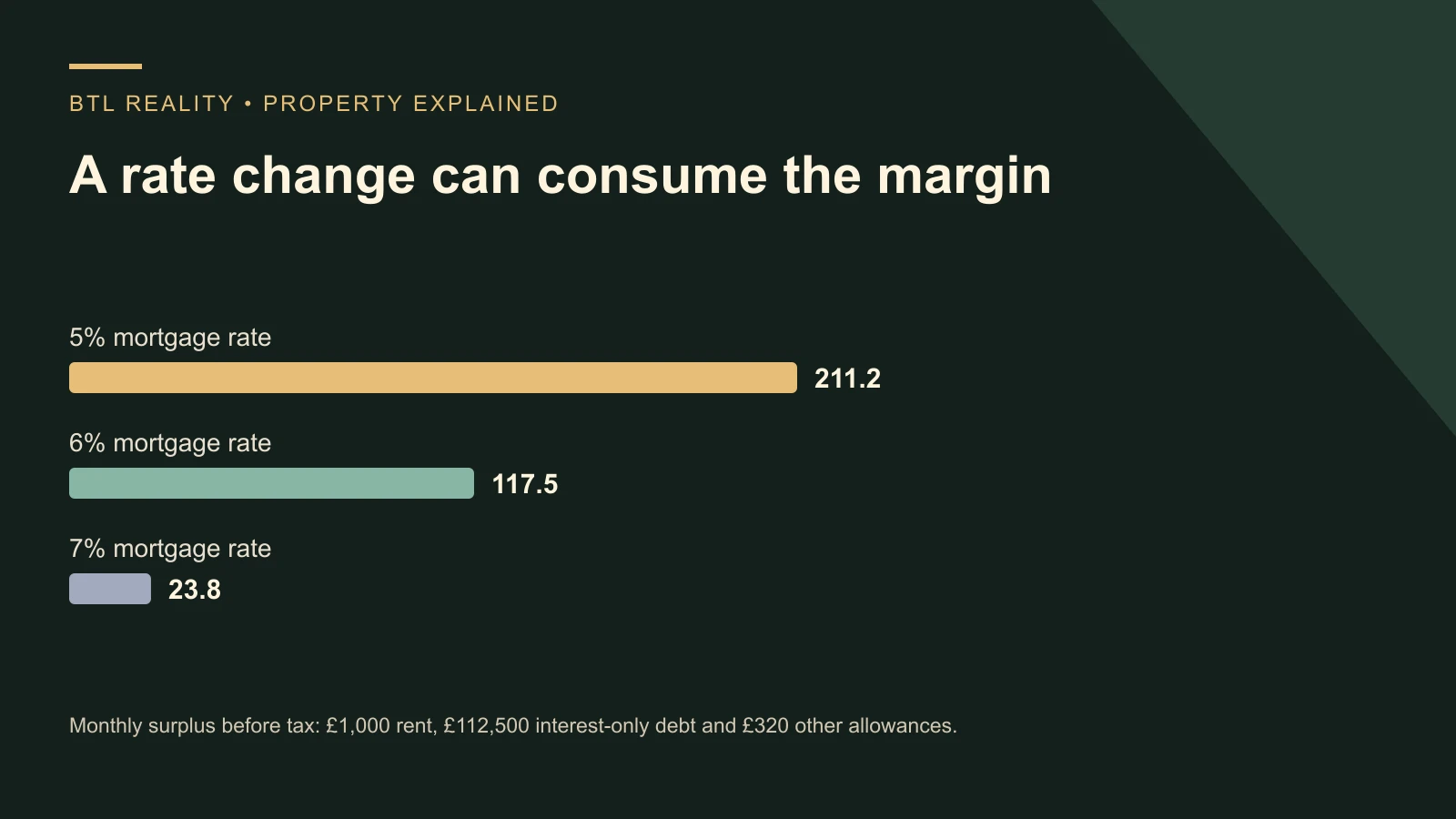
Before interest, the model leaves £680 a month: £1,000 less £120 management, £100 maintenance, £50 void allowance and £50 other costs. At a 5% mortgage rate, interest is £468.75, leaving £211.25 monthly before tax and any costs not included.
At 6%, interest becomes £562.50 and the surplus falls to £117.50. At 7%, interest is £656.25 and the surplus is only £23.75. A small change in borrowing costs has consumed most of the margin without any change in the property price.
Test the rental margin at today’s rate
Illustration before tax, arrangement fees and purchase costs. Percentage allowances are assumptions, not smooth bills or limits on actual repairs. Interest-only debt is not repaid.
What this example does not include
The monthly model does not fund your deposit, purchase taxes, legal fees, survey, initial works or mortgage arrangement fees. It also excludes personal tax and does not calculate the tax treatment of finance costs. Those can materially change the cash required and the after-tax result.
The maintenance and void percentages are allowances, not smooth monthly bills. A property may produce several quiet months followed by a large repair or empty period. Ring-fenced reserves are still needed even when the spreadsheet shows a positive average.
Use the buy-to-let deal calculator for a broader purchase model. Then have a broker, accountant and legal adviser assess the parts relevant to your circumstances. A positive pre-tax cash-flow number is one useful test, not permission to ignore the rest.
Should you wait for interest rates to fall?
Waiting could help if mortgage pricing improves, but it can also mean a different property price, missed rental income or a changed personal situation. There is no reliable way to know the ideal combination in advance. A lower Bank Rate does not necessarily mean every mortgage product falls by the same amount.
Compare a purchase that works at an actual available mortgage quote with one that only works after an assumed future reduction. The second depends on an event you do not control. If you proceed, understand that dependency rather than hiding it in the base case.
The interest-rate outlook guide explains the distinction between Bank Rate and mortgage pricing. For a purchase decision, ask a broker about the actual products, fees, stress tests and eligibility available to you, including what happens when an initial deal ends.
Should you wait for house prices to fall further?
A lower future price would be useful if the property you want remains available and your funding position still works. But a broad market decline does not guarantee the seller of a specific suitable home will accept the discount you hope for.
Set a price ceiling based on the evidence and your model. If a property cannot be bought within that ceiling, walk away or change the brief. This approach does not require accurately predicting the national market’s lowest month. It requires enough discipline not to pay more than the investment can justify.
Keep looking at alternatives rather than becoming attached to one listing. Compare total cash needed, realistic net income, condition, tenancy obligations and the quality of the local rental market. A different property may meet the brief more convincingly than a small price reduction on the first one.
How should you use five-, ten- and twenty-year growth scenarios?
Long periods amplify assumptions. At an illustrative 5% annual growth rate, a £150,000 property becomes about £191,442 after five years, £244,334 after ten and £397,995 after twenty. Those are compounding calculations, not forecasts of what a UK house or an individual region will deliver.
At 2% annual growth, the same twenty-year value is about £222,892. The gap between those outcomes is much larger than many buyers realise. Add debt, refinancing costs, tax, maintenance and the risk of having to sell early, and the actual investment result can differ again.
Use several scenarios, including a weak or flat market, before committing. Read the 2027 price-predictions comparison for dated professional forecasts and Mark’s separate optimistic scenario. The distinction between a published forecast and your own assumption should remain clear throughout the plan.
What makes a location worth investigating?
Look for a credible tenant market that fits the property, rather than a general claim that a whole city has unlimited demand. Consider employment, transport, amenities, competing supply, household incomes and the condition of the specific street and building.
Lower purchase prices can support attractive yields, but there is no location with no affordability ceiling. Tenants need to afford the rent, buyers need funding and lenders assess risk. Northern cities can offer opportunities, but the relevant evidence is local and property-specific.
Check licensing, intended use and likely maintenance before treating an area as a straightforward investment. The landlord rules hub helps identify the wider operating questions. A high gross yield is much less persuasive if the property needs substantial unbudgeted work or cannot be used as planned.
A practical decision before you buy
Write down the purpose of the purchase: income now, longer-term growth, diversification or a step in a broader plan. Then specify the cash you can commit, reserves you will retain, borrowing you can sustain and work you are prepared to manage.
If you want help building that framework, Starter Club provides education and structured discussion. If you want a property sourced against an agreed brief, explore Done For You. The right route depends on the support you need, and independent due diligence remains essential.
The question “is now a good time?” becomes much more useful when you can finish it: good for this property, at this price, with this finance and these reserves. That is a decision you can examine even when the wider market remains uncertain.
Frequently asked questions
Is 2026 a good year to buy a buy-to-let property?
It may be for a suitable deal that works at current costs and fits your objectives. National averages cannot decide that for you. Check local evidence, total cash required, realistic income, tax, borrowing and reserves, including a scenario where prices and rents do not grow as hoped.
Are falling real house prices a buying signal?
They are useful context, not a sufficient signal. A real-price decline means house prices lagged the chosen inflation measure over the chosen period. It does not establish the value of a particular home or guarantee affordability, mortgage approval or a future recovery.
Should I wait until mortgage rates are lower?
Compare the actual purchase available today with clearly labelled future scenarios. Rates, prices and your circumstances can all change while you wait. Avoid a deal that only becomes affordable after an assumed rate cut unless you fully understand and can sustain that risk.
Are northern cities always better for property investment?
No. Some markets may offer attractive purchase prices and rental demand, but cities and neighbourhoods differ. Review comparable transactions, tenant demand, local incomes, condition, licensing and costs. A regional growth ranking is not a guarantee that the next property you buy offers good value.
Is 5% annual property growth a reasonable assumption?
It can be one scenario to test, but it is not a guaranteed annual outcome or a universal forecast. Compare it with weaker growth and a downside case. Long-term compounding magnifies small assumption differences, and an individual property can behave differently from national averages.
What should I calculate before making an offer?
Calculate the total cash required, realistic monthly surplus, tax implications, reserve needs and sensitivity to borrowing, rent and repairs. Establish the property’s value and legal use separately. The free deal calculator is a starting point, supported by appropriate mortgage, tax, survey and legal advice.