Can a Landlord Ask for Six Months’ Rent in Advance?
October 3, 2026
For a new covered assured tenancy in England, a landlord cannot simply ask for six months’ rent upfront. Since 1 May 2026, the rules restrict both when rent can be taken and how much can normally be required before the tenancy starts. A large advance payment is no longer a routine workaround for an applicant whose circumstances feel unfamiliar.
The key distinction is between rent, a holding deposit and a tenancy deposit. They have different purposes and limits. Calling an advance payment a deposit does not make it compliant, and protected deposit money should not be treated as the landlord’s emergency cash.
This guide explains the government guidance checked on 4 October 2026, with worked examples for England’s covered private assured tenancies. Specific exceptions and older arrangements need individual advice.
When can rent first be taken?
The official rent-in-advance guidance says a landlord must not ask for, encourage or accept rent before both parties have signed the tenancy agreement. That timing restriction is separate from the amount that can be required after signing.
Once the agreement is signed and before the tenancy begins, the normal limit is one month’s rent for monthly rental periods. Other payment frequencies have their own rule, generally no more than twenty-eight days’ rent. Do not automatically apply a monthly example to a weekly or unusual agreement.
The ordinary covered tenancy cannot be made conditional on paying six or twelve months of rent upfront. An agent’s standard process, a mortgage concern or an applicant’s overseas background does not by itself create an exception.
What if the tenant offers to pay six months voluntarily?
The fact that an applicant volunteers a large sum does not make every timing or payment arrangement acceptable. In particular, the prohibition on accepting rent before the agreement is signed applies even where the applicant is keen to secure the property.
Do not encourage a supposed voluntary offer through hints about how it might improve the application. Asking an applicant to put the offer in their own words does not change who prompted it. Follow the current guidance and obtain advice before taking an unusual advance arrangement.
Payments during an existing tenancy require careful distinction from pre-tenancy conditions. The precise timing and whether a payment is genuinely voluntary can matter. This article is not a template for structuring around the restriction, and a landlord should not rely on a label alone.
How a holding deposit differs from rent
A holding deposit is used while a prospective tenancy is being arranged and has its own rules. The government guidance describes a maximum of one week’s rent. It is not an extra month’s rent or an unrestricted application fee.
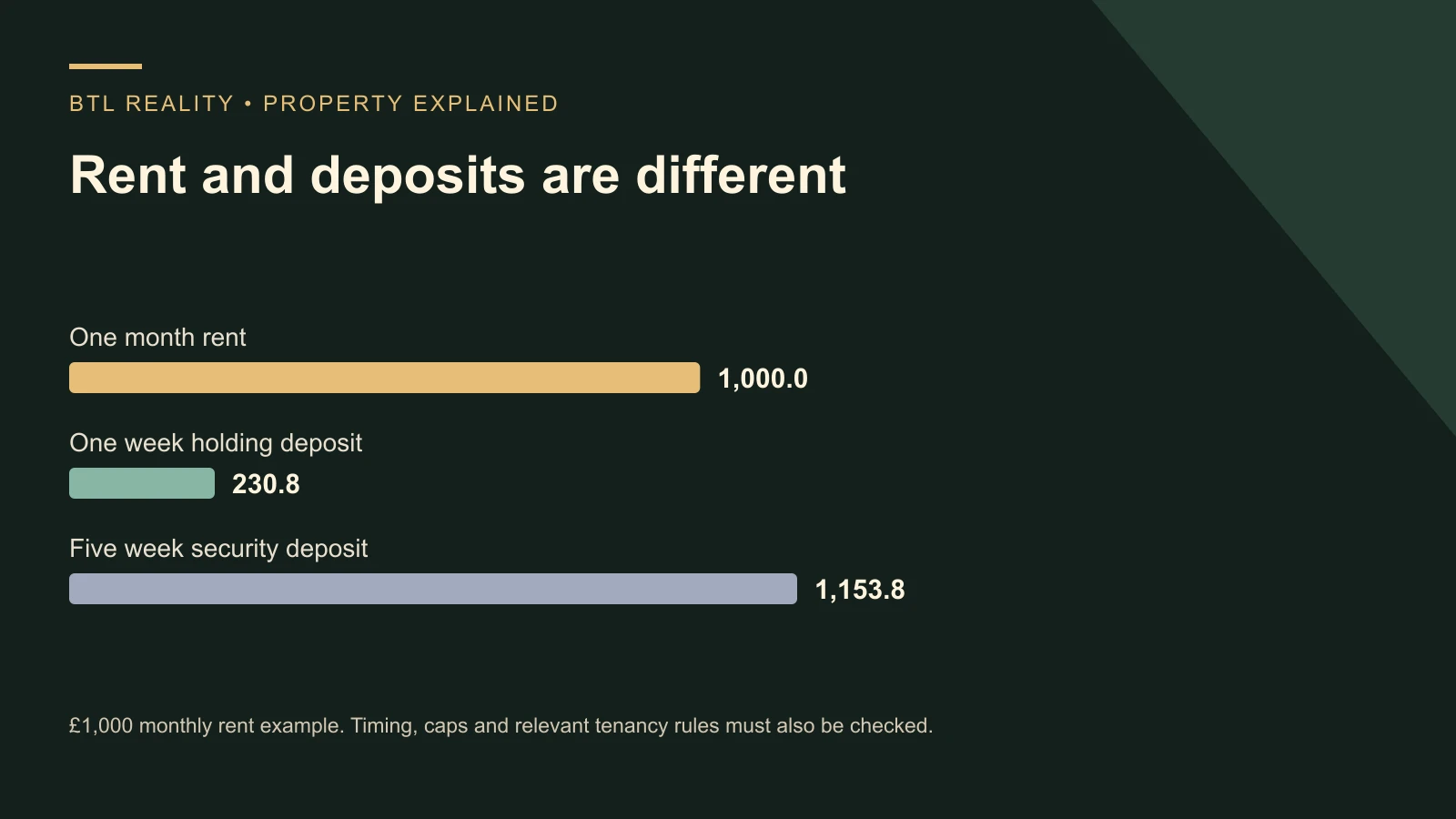
For £1,000 monthly rent, annual rent is £12,000. Dividing by fifty-two gives approximately £230.77 for one week. Dividing the monthly amount by four would give £250, which is not the same calculation. Use the annual-to-weekly method when applying a weekly limit.
Whether a holding deposit must be returned, retained or applied to another permitted payment depends on the circumstances and applicable rules. Record the purpose of the payment clearly. Do not take multiple overlapping sums without explaining what each is and how it will be handled.
How a tenancy deposit differs from rent
The tenancy deposit is security for permitted claims under the tenancy, subject to the legal framework and protection requirements. For annual rent below £50,000, the usual cap is five weeks’ rent; at £50,000 or more it is six weeks, as explained in the government guidance.
At £1,000 monthly rent, five weeks is approximately £1,153.85. That amount is not a substitute for six months’ rental receipts and cannot simply be spent to fund a mortgage payment. Proper protection and information requirements still apply.
Keep the accounting separate. The tenant should be able to see what was paid as a holding deposit, security deposit and rent. If a holding deposit is credited towards the first rent or deposit, show the credit so that the same amount is not collected twice.
Compare rent with weekly deposit amounts
Arithmetic only for an eligible Tenant Fees Act tenancy. Five weeks applies below £50,000 annual rent, six weeks from £50,000. Separate payment timing and protection rules apply.
The payment illustration uses monthly rent to calculate the weekly equivalent and the ordinary deposit limit. It is not a checkout, does not collect money and does not decide whether your tenancy falls within the rules. Check the agreement and applicable exceptions before taking payment.
A worked example of the cashflow change
Suppose a landlord previously expected £6,000 of rent at the start of a £1,000-per-month tenancy. That advance receipt made the bank balance look comfortable, but it represented six months of rent, not six months of profit. Mortgage and operating costs still needed to be paid throughout the period.
Under an ordinary new monthly tenancy following the current rules, a landlord should plan for the permitted first rental payment after signing and subsequent rent as it falls due. They should not build a purchase or refurbishment budget around receiving six months upfront.
If continuing outgoings are £700 monthly, one month’s rent leaves £300 before other adjustments and tax. A £3,000 urgent repair would equal ten months of that simple surplus. The solution is an adequate reserve and sound purchase economics, not an impermissible demand for advance rent.
A separate security deposit does not close that reserve gap. It has a different legal purpose. Money belonging in a deposit scheme is not the owner’s working-capital facility.
What about overseas applicants or people without conventional payslips?
Applicants have different circumstances: self-employment, savings, overseas employment, retirement or benefits. Assess the actual evidence through a lawful individual process. An unfamiliar income pattern is a reason to understand the facts, not automatically a reason to demand a prohibited advance.
The rental discrimination guidance is relevant where benefits or children are involved. A neutral-looking policy can still create problems if it is used to exclude an entire protected category. Any guarantor or affordability requirements should be considered carefully and applied lawfully.
Ask the referencing provider what evidence it can evaluate and what limitations its report has. A pass or fail generated from incomplete information does not explain the underlying risk. Keep decisions proportionate and avoid collecting private information that has no genuine role in assessing the tenancy.
Are there exceptions or different rules for old agreements?
The official guidance identifies exceptions, including specified local-authority homelessness arrangements and social or supported housing. These should not be assumed to apply to an ordinary private letting simply because the tenant receives support or benefits.
Transitional situations and agreements made before the new rules require separate review. Do not conclude that a historic payment was unlawful merely because a current article describes the new pre-tenancy limit. Equally, do not copy an old practice into a new agreement without checking what changed.
If an agent proposes an exception, ask them to identify the actual provision and explain why the facts fit it. A confident sentence in an email is not enough when the arrangement depends on a specific legal category.
Review your application and payment workflow
Map the process from enquiry to keys. Identify when referencing happens, when the agreement is signed, when each permitted payment is requested and how the deposit is protected. Then check that the emails, payment links and agent instructions follow that order.
Remove old wording that routinely asks for six months upfront or collects rent before signing. Make sure a payment page does not invite applicants to pay early just because it is convenient. The published process and the actual transactions should match.
Keep clear receipts and a ledger. If a payment arrives unexpectedly, do not assume that keeping it is harmless. Check the correct treatment promptly and communicate clearly with the payer. Small administrative mistakes are easier to resolve when the record is accurate.
What this changes about investment planning
The investment needs to work as a business with normal monthly receipts and a sensible cash reserve. The buy-to-let deal calculator can help examine the rent, financing and running costs. Add accessible contingency money rather than using a tenant’s advance as your contingency.
Our rental bidding guide covers above-advertised offers, while the arrears guide separates unpaid balances from the cash needed to keep a home running. They address different parts of the same operating plan.
If you want educational support assessing your first or next purchase, Starter Club is one route. The calculators remain free without membership. Questions about taking a particular payment should go to an appropriately qualified housing adviser.
Frequently asked questions
Can a landlord ask for six months’ rent upfront in 2026?
For an ordinary new covered assured tenancy in England, the current rules restrict pre-tenancy rent and do not allow that routine demand. The agreement must be signed before rent is taken, and the normal monthly-tenancy pre-start limit is one month. Check genuine exceptions separately.
Can rent be paid before the tenancy agreement is signed?
The government guidance prohibits asking for, encouraging or accepting rent before both parties sign for a covered arrangement. A permitted holding deposit is a different type of payment with separate rules. Do not describe rent as a holding deposit to avoid the timing restriction.
Is the first month’s rent the same as the tenancy deposit?
No. Rent pays for the tenancy period, while the security deposit is held for permitted claims and must be handled under the deposit rules. Keep their purposes, amounts and records distinct, including any holding-deposit credit.
How much is a five-week deposit on £1,000 monthly rent?
The arithmetic is £1,000 multiplied by twelve, divided by fifty-two, then multiplied by five: approximately £1,153.85. That illustrates the ordinary five-week cap. Eligibility, protection and information requirements still need checking for the particular tenancy.
Can I require more rent upfront because an applicant is self-employed?
Self-employment does not by itself remove the rent-in-advance restriction. Assess suitable evidence through a lawful process and check what your referencing provider can evaluate. Do not assume that a conventional monthly payslip is the only possible evidence of income.
Do these payment limits apply throughout the UK?
This guide concerns the specified English tenancy framework. Wales, Scotland and Northern Ireland have their own rules, and some English arrangements are excluded or exceptional. Establish jurisdiction, tenancy type and agreement dates before relying on a general example.