Do Landlords Need Annual PAT Testing in England?
October 20, 2026
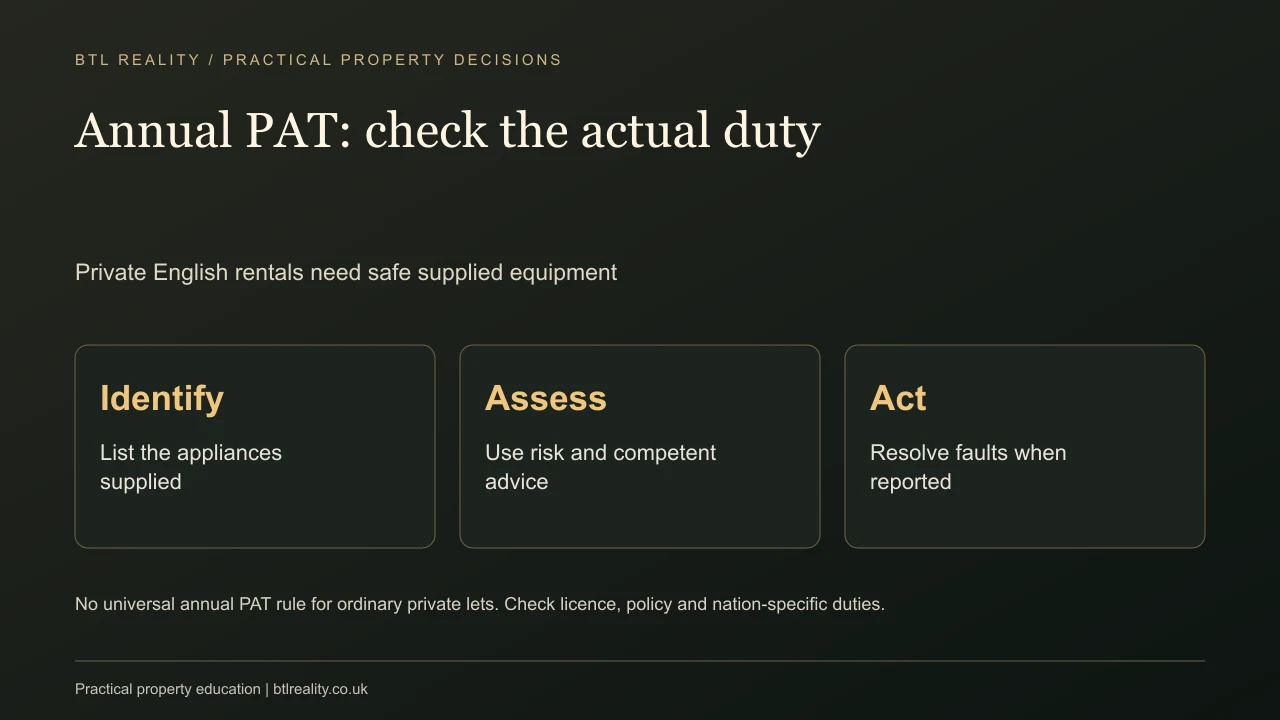
For an ordinary private rental in England, there is no universal rule saying every supplied appliance must have a PAT test every year. There is still a responsibility to provide safe electrical equipment and respond to problems. “No annual PAT rule” should not become an excuse for doing nothing.
The sensible approach is to identify what you supply, understand the applicable requirements and arrange inspection or testing according to the equipment and risk. A sticker alone is not a maintenance system.
This guide concerns private residential landlords in England and sources checked on 19 October 2026. Scotland has different rented-housing requirements. Social landlords in England have additional equipment-check duties, and an HMO or selective licence, contract or insurance policy may impose conditions that need checking separately.
What does HSE say about annual PAT testing?
HSE’s portable appliance testing answers explain that the law does not prescribe universal annual inspection or testing. The type of equipment, its use and the environment inform what is needed. Some defects can be found visually; other checks require appropriate competence and equipment.
That is not a conclusion that a damaged appliance is acceptable because the next paid visit is months away. If there is a safety concern, deal with it when it arises and use suitable professional help.
Be careful with broad internet summaries. The current government electrical-safety guidance distinguishes fixed-installation requirements from additional supplied-equipment requirements for social landlords. A statement written for social housing cannot simply be copied onto an ordinary private letting.
PAT and an EICR answer different questions
An Electrical Installation Condition Report concerns the fixed installation. Appliance inspection and testing concerns the equipment supplied. Passing one does not establish that everything in the other category is safe.
A washing machine can have a damaged cable even where the installation report is satisfactory. Conversely, a collection of appliance stickers does not replace the required inspection of the fixed electrical installation.
Use the EICR guide for English landlords for the installation process. Keep a separate record of the appliances you provide and the inspection or maintenance arrangements for them.
Ask the electrician or competent contractor to explain the scope of their work. “Electrical check” on a quotation is too vague if you expect both categories to be covered. Obtain an itemised record of what was actually inspected or tested.
Build an appliance register first
List the appliances provided as part of the letting, their locations, identifying details and any known age or purchase information. Keep instructions, repair records and safety information together. Do not rely on remembering which fridge belongs to you after a tenant changes.
Where ownership is uncertain, resolve it in the inventory and agreement rather than assuming every item in a cupboard is yours. A tenant’s own kettle is different from the microwave you supplied with the property.
| Equipment | Information to keep | Action prompt |
|---|---|---|
| Landlord-supplied fridge | Model, location, purchase and repair record | Review condition and competent advice |
| Washing machine with reported cable damage | Tenant report and device identity | Prompt safe response and professional assessment |
| Tenant-owned kettle | Ownership distinction where relevant | Do not label as your supplied equipment |
| New supplied microwave | Purchase details and instructions | Confirm safe supply and record inclusion |
The register should tell you what needs attention, who is responsible and what evidence will close the action. It is not useful if it lists a washing machine that was removed three tenancies ago.
Check the licence and policy conditions
A private landlord should read any applicable HMO or selective licence conditions. A local requirement to provide appliance evidence needs to be addressed on its own terms. General HSE advice does not cancel a specific condition affecting your property.
Also check the insurance policy and relevant contracts. If an agent says annual PAT is required, ask them to identify whether that statement comes from legislation, a licence condition, an insurer or their management package.
Those are different explanations. A service can be sensible or contractually included without being a universal statutory annual duty. The distinction lets you make an informed decision and obtain the right evidence.
If the licence wording is unclear, ask the council or a qualified adviser. Keep the written answer with the property record rather than relying on a telephone comment that nobody can later identify.
Use condition and competent advice to organise checks
Consider the actual equipment, how it is used and any signs of damage or problems. A schedule should be proportionate and informed, not copied from an office checklist or a sales leaflet.
Ask the competent person what their inspection or testing will cover, what the result means and what follow-up is needed. Retain any recommended interval and the reason for it, then act sooner if a new concern arises.
Do not attempt electrical tests or repairs because an online article describes them. A landlord’s practical task is to organise competent work and respond to reports, rather than improvising with equipment they do not understand.
When an appliance is removed from use, make the position clear to the tenant and arrange a suitable remedy. A failed item should not remain available simply because a replacement order has been placed.
Compare quotes on completed scope
Suppose one hypothetical contractor charges £35 attendance plus £4 per appliance for six items. The quoted total is £59. Another offers a £65 package covering those items and a written register update. The £6 difference needs to be assessed against the actual scope.
Now suppose a return visit costs £30 because the first quote did not include access to an item you had failed to list. The first total becomes £89, before any repair. An accurate register and clear booking can matter more than the smallest per-item rate.
These assumed prices are not a current PAT cost survey. Use actual quotations, identify any minimum charge and check whether the contractor is competent for the work required. A large number of cheap stickers is not the objective.
The quote comparison guide helps align scope and exclusions. For appliance checks, ask about the report, remedial recommendations, failed equipment and any return attendance.
Make tenant reporting easy
Give the tenant a clear route to report faults in supplied equipment and the information that will help identify the item. Ask for the location and symptoms observed safely. Do not ask them to dismantle a plug or demonstrate a fault by continuing to use something suspect.
Record when the report arrived, the advice obtained and the action taken. A response saying “PAT passed last year” is not an assessment of a new problem. The old record may help identify the appliance, but it does not resolve the report.
Where an appliance has been replaced, update the register and inventory. Retain the old history so future questions about a repair or incident can be understood without confusing two different machines.
Plan replacements without assuming every fault is a tenant cost
A supplied appliance can fail through age or ordinary use. Keep a replacement allowance in the maintenance budget rather than assuming every repair will come out of the deposit.
For an assumed £360 appliance replaced after six years, a simple cash planning allowance is £60 annually, or £5 monthly. This is only a budgeting method. It is not a safety inspection interval, a tax rule or evidence of a tenant’s liability.
Keep inspection costs and replacement saving separate so both are visible. If a repair restores safe, useful service, assess it against the appliance’s condition and the professional recommendation, rather than choosing solely on the age written in your budget.
Ask the right question when a package is offered
Instead of asking only whether PAT is “mandatory”, ask what duty or condition applies, which appliances are included, who will assess them and how defects are handled. You can then decide whether the proposed service meets the need.
A good arrangement produces safe equipment, clear records and a practical response to change. It should be possible to explain without overstating the law or suggesting that equipment stays safe until a sticker expires.
Your questions answered
Must every English private landlord arrange PAT annually?
There is no universal annual PAT requirement for an ordinary private letting. Safe supplied equipment still matters, and licence, insurance or contractual conditions must be checked.
Does an EICR include all my supplied appliances?
Do not assume so. The installation report and appliance inspection or testing cover different things. Ask the contractor to identify the exact scope and retain the records.
Can a council licence require appliance evidence?
Check the actual HMO or selective licence conditions and obtain clarification if needed. General advice about annual PAT does not cancel property-specific licence requirements.
Does a PAT sticker prove an appliance is safe forever?
No. A new fault or damage needs attention when it arises. An earlier result is part of the history, not a reason to ignore a current safety concern.
Should I test appliances belonging to the tenant?
Distinguish ownership and the applicable obligations. Do not automatically list a tenant-owned item as equipment you supplied. Obtain competent advice about any actual hazard.
Are the rules the same for Scotland or social housing?
No. This article is about private rentals in England. Scotland has separate housing standards, and English social landlords have additional supplied-equipment requirements in current government guidance.