Tenant Refuses a Gas Safety Check: What Should a Landlord Do?
October 19, 2026
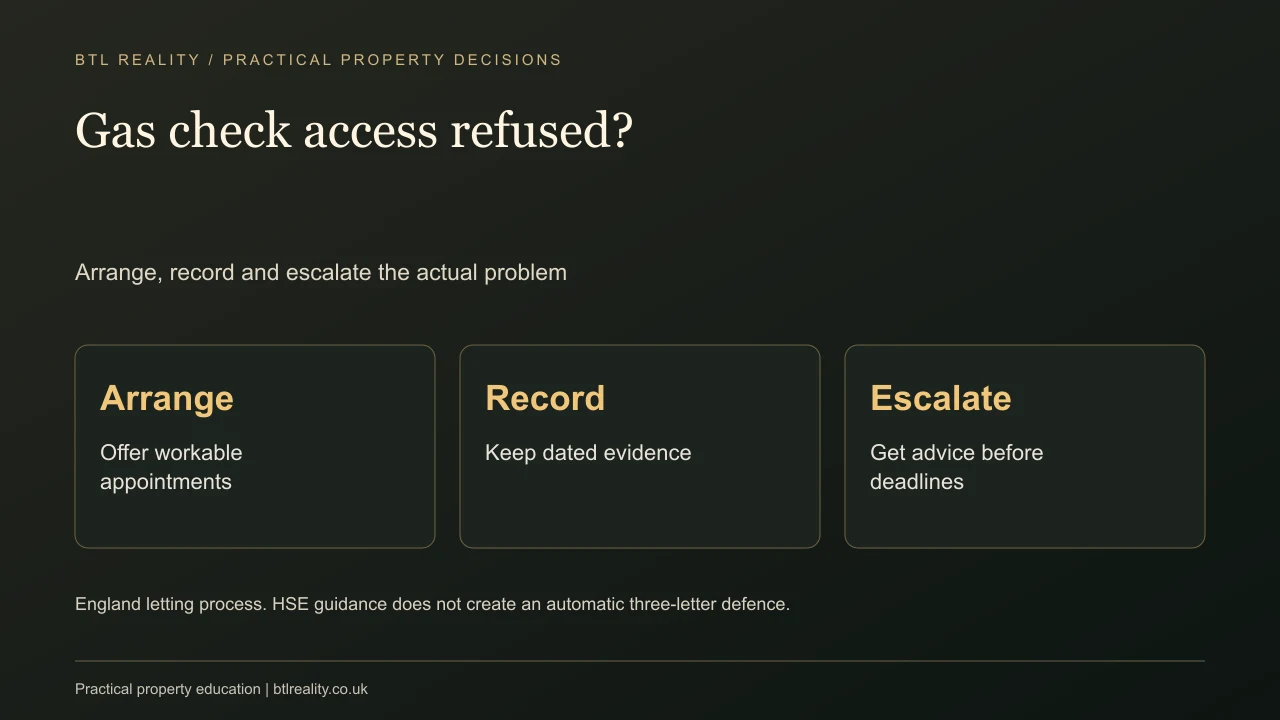
A tenant refusing a gas safety check creates two problems at once. You still need the check completed, and you need to respect the fact that this is somebody’s home. Turning up with a spare key and letting yourself in is not a sensible shortcut.
The practical response is to start early, offer workable appointments, keep a clear record and get proper advice if access remains blocked. An unanswered message is a reason to change the approach. It is not a reason to abandon the check.
This guide focuses on an ordinary private residential letting in England. The gas-safety guidance cited applies in Great Britain, but tenancy procedures differ between England, Wales and Scotland. It is checked against the sources available on 19 October 2026.
What does HSE actually say about refused access?
HSE’s advice on dealing with tenants says landlords must take reasonable steps to comply, keep correspondence, explain the safety purpose and give tenants an opportunity to arrange an appointment. Inspectors look at repeated attempts in their circumstances. A court ultimately decides whether the steps were reasonable. The gas regulations do not give a landlord power to force entry.
There is no official rule on that page saying three letters automatically discharge the duty. Counting messages can make a file look busy while leaving the actual obstacle unresolved. The useful question is whether each step made a completed visit more likely.
Find out what is preventing the appointment
Refusal is not always the same thing. A tenant may reject one inconvenient slot, distrust an unexpected contractor, need help communicating or refuse all access. Those situations call for different responses.
Start with a short, calm message that names the engineer or firm, explains the purpose and offers a way to confirm the booking. Ask for suitable times rather than repeatedly sending the same weekday appointment. If the concern is the contractor’s identity, provide a contact route the tenant can verify independently.
Record the reply accurately. “Cannot do Tuesday morning, available after four” is a scheduling issue. “Nobody will ever enter” is a continuing access problem. Do not describe the first as the second in your notes or in correspondence to a solicitor.
If language or disability is making the arrangements difficult, ask what communication or appointment arrangement would help. Avoid demanding medical information you do not need. An accessible booking process is usually more useful than a more threatening letter.
Build an access file that somebody else can follow
Keep one chronological record for the property. Save the booking request, delivery evidence where available, replies, cancellation reasons and contractor attendance notes. A screenshot without the date, address or surrounding message can be difficult to interpret months later.
For a missed visit, ask the engineer for a factual note. It should identify the date, time, address and what happened. “No answer after agreed appointment” is useful. Speculation about the tenant’s motives is not.
Store the last completed check and its due date alongside the attempt log. That makes the urgency visible to you, the agent and any adviser. Restrict access to the file to people who need it rather than forwarding tenant details around a large messaging group.
| Event | Record | Next useful action |
|---|---|---|
| 1 October: first invitation | Two appointment options and contact route | Ask tenant to confirm one |
| 5 October: work conflict | Tenant requests an afternoon | Arrange an afternoon with the engineer |
| 12 October: agreed visit missed | Engineer attendance note and tenant reply | Offer a further workable appointment |
| 19 October: all access refused | Exact written refusal and steps already taken | Obtain advice promptly, before the due date |
The dates matter less than the response to what you learn. If the tenant gave a perfectly workable alternative and you ignored it, a long list of other messages will not make that omission disappear.
Write to solve the problem
A useful access request has a clear purpose, a proposed appointment or booking choice, a contact method and an explanation of why access is needed. Keep it specific to the safety visit. Mixing in arguments about the rent, a pet or an unrelated complaint makes the request harder to resolve.
You might write: “We need to arrange the property’s gas safety check. The proposed visit is [date and time] with [firm]. Please confirm, or contact [details] with suitable alternatives so we can arrange access before [due date]. If you have concerns about the visit, please tell us so we can address them.” Fill in the facts accurately.
That is an example of clear communication, not a formal legal notice template. If a formal notice or court application is needed, have it prepared or checked for the actual tenancy and circumstances. The wording of your tenancy agreement also needs to be considered.
Do not promise a court outcome, state that silence counts as consent or suggest the tenant has waived safety protection by refusing. Your aim is an appointment and a reliable record of the efforts to obtain one.
Separate routine access from an immediate safety concern
An annual appointment dispute and a report of a possible gas emergency are different situations. If somebody reports a smell of gas, a carbon monoxide alarm or symptoms suggesting exposure, direct them to the appropriate emergency service immediately and follow its instructions. Do not continue a routine email sequence while waiting for the situation to develop.
Do not ask a tenant to diagnose equipment, reconnect an appliance or keep using something an engineer has made unsafe. HSE’s landlord gas-safety guide explains the need for a Gas Safe registered engineer and proper action on defects. An access problem does not turn the landlord into a gas engineer.
For routine appointments, check the contractual access arrangements and obtain legal advice about continuing refusal. Emergency decisions must respond to the actual risk and professional instructions, rather than being used as a pretext to enter for an ordinary overdue check.
What if the certificate is nearly due or already overdue?
Act promptly. Give your adviser the complete file, the due date, the last record, the tenancy agreement and the current access position. An organised summary makes it easier to assess the next lawful step than a bundle of disconnected messages.
Do not alter dates, describe an incomplete visit as a completed check or assume the tenant’s refusal extends the deadline. Continue trying to secure access while advice is obtained. If an agent manages the property, agree who is making each contact and when the issue is escalated.
Our landlord rules guide helps place this task within the wider compliance calendar. It should sit alongside other deadlines, with a named person responsible, rather than depending on somebody noticing an expiring attachment.
Budget for the friction without turning it into a penalty
Repeated visits can cost money. That is worth planning for, but it is a separate question from whether any cost may lawfully be recovered from a tenant. Do not add an invented “refusal fine” to the rent account.
Suppose, purely as an illustration, a booked inspection costs £90 and two missed visits cost £45 each under your contractor’s terms. Your outlay is £180: £90 plus £45 plus £45. The extra cost is £90. Those assumed prices are not a market survey and the arithmetic does not establish tenant liability.
Use the rental maintenance budget guide to leave room for administration and failed appointments as well as the headline inspection price. If your management agreement promises compliance handling, check whether repeat attendances and legal escalation are included or charged separately.
Give an agent a clear escalation instruction
“The agent deals with it” is too vague when a deadline is approaching. Ask for the date of the first booking, the current tenant response, the evidence held and the next action. Agree a point at which the agent must notify you rather than continue sending routine reminders.
Also ask who receives the completed record and who checks any remedial work has been addressed. Access is only one stage. An engineer attending does not prove the inspection was completed or that a defect was resolved.
For a remote landlord, the same process needs to work without a last-minute flight to the property. The guide to managing a UK rental from abroad explains how to make responsibility and reporting visible. A short, accurate update is far more valuable than reassurance with no dates attached.
Your questions answered
Can I use my spare key if the tenant refuses the gas safety check?
Do not treat ownership of a key as permission to enter. HSE says the gas regulations do not give a power to force entry. Get advice about the lawful access route for the tenancy and circumstances.
Are three access letters enough to protect a landlord?
There is no automatic three-letter rule in HSE guidance. The quality and circumstances of the efforts matter, including whether suitable alternatives were offered and followed up.
Does tenant refusal extend the gas safety deadline?
Do not assume it does. Keep trying to obtain access, retain accurate evidence and obtain advice promptly if the deadline is approaching or has passed.
What should I record after a missed appointment?
Record the agreed date, attendance time, contractor details, what happened, the tenant response and the next proposed step. Keep the original correspondence and attendance note.
Can I charge the tenant for a missed gas safety visit?
Do not assume the contractor invoice automatically becomes a lawful tenant charge. Recovery depends on the legal basis and circumstances. Check before adding any amount to the account.
What if the tenant reports a gas smell while refusing access?
Treat a potential emergency urgently and direct them to the appropriate gas emergency service. Follow professional instructions rather than handling it as an ordinary booking dispute.