Does a Landlord Need to Pay the ICO Data Protection Fee?
October 22, 2026
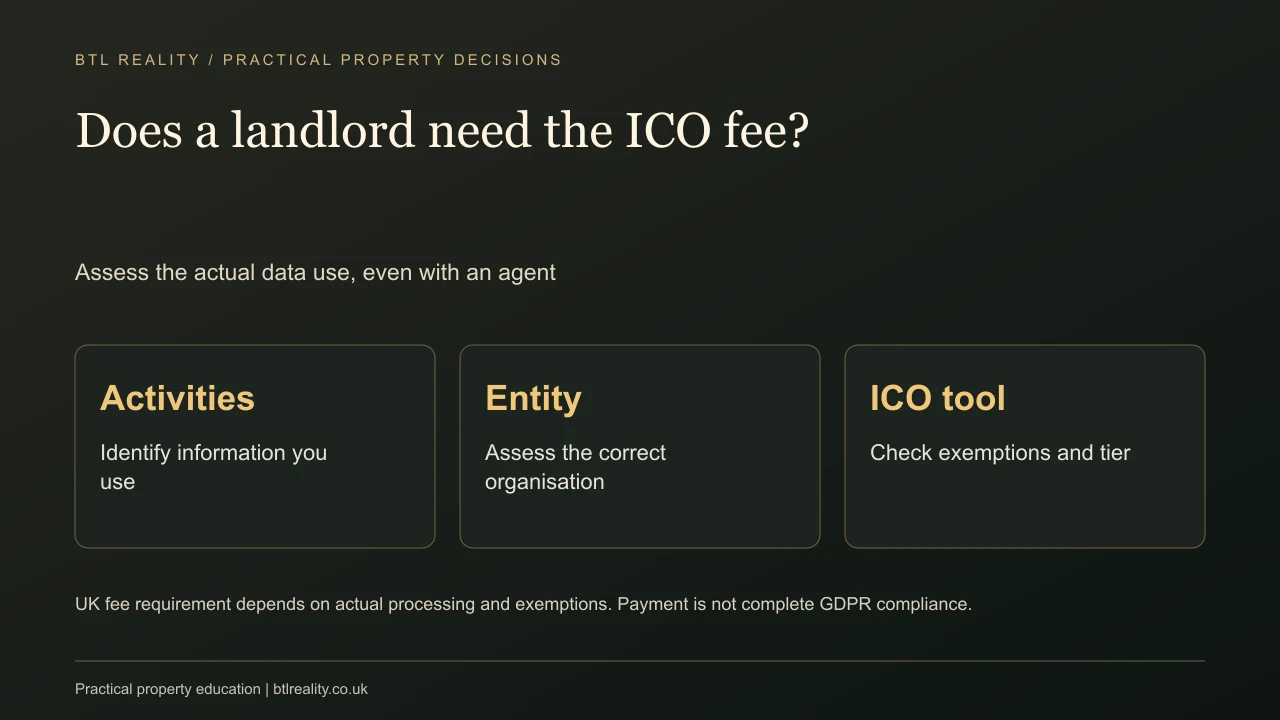
Using a letting agent does not automatically answer whether a landlord must pay the ICO data protection fee. The answer depends on what personal information you actually use, your role and whether an exemption applies.
If you receive tenancy agreements, choose applicants, obtain references or message tenants electronically, those activities need to be considered. Calling the service “fully managed” is not enough to describe what happens to the data.
This guide concerns the UK data protection fee, using ICO information checked on 19 October 2026. It explains a practical self-assessment process rather than declaring every landlord exempt or every landlord liable. The ICO’s own tool and advice should resolve your particular circumstances.
Start with the ICO’s actual questions
The ICO property-services question specifically includes landlords. Its examples cover tenancy agreements, referencing, applicant decisions, property-management information, electronic tenant communications and CCTV. These are activities to consider when completing the fee assessment.
The ICO fee FAQs explain that controllers pay unless an exemption applies and that the relevant fee depends on the organisation. Do not use an old forum answer about a £40 fee or a supposed landlord exemption as a substitute for the current assessment.
Complete the tool based on your real activity, not the simplest description of your business. If you are uncertain about a question, ask the ICO rather than selecting the answer that produces the smallest bill.
Map the information you actually receive
Look at the last completed letting and a normal month of management. What did you see, store, use or decide? Include email attachments, messaging apps, shared drives and documents inside the agent’s portal.
You may not undertake the credit check yourself but still receive the report and decide whether the applicant can rent. You may receive only a limited summary, or you may receive extensive identity and financial documents. Those are different arrangements.
List the activity and purpose. “Applicant report used to decide whether to proceed” is more informative than “agent handles data”. It gives you a factual basis for the self-assessment and any advice you request.
| Arrangement | Question to investigate | Useful evidence |
|---|---|---|
| Agent sends rent statement only | What other personal information is used? | Actual statement and management process |
| Landlord approves applicants | What applicant information informs the decision? | Workflow and report fields |
| Landlord messages tenants | What information is held and why? | Communication process |
| Rental has CCTV | Who determines the surveillance use? | System purpose and control |
The important point is completeness. Do not omit a self-managed property because the rest of the portfolio uses an agent. The assessment should reflect the organisation’s relevant processing as a whole.
Understand the agent relationship
Ask the agent what they do independently, what they do on your instructions and what information they disclose to you. The legal roles depend on the facts, not just the label used in a marketing brochure.
The agent paying its own fee does not automatically cover every separate landlord organisation. Likewise, the mere presence of your name on an agency agreement does not by itself resolve the whole question. You need to understand the relevant processing and exemptions.
If the agent says you are exempt, ask which current ICO guidance and actual activities support that conclusion. A written explanation you can test against the self-assessment is more useful than “our other landlords don’t pay”.
For a landlord living abroad, include the information accessed from overseas in the review. The remote management guide helps identify which decisions remain with you even when day-to-day work is delegated.
Assess the correct person or organisation
Check whether the relevant activity is carried out by you personally, a partnership, a company or another organisation. The property ownership structure and the data-processing arrangement need to be understood together.
Do not assume one fee is required for each property, or that a registration for an unrelated business automatically answers the position of a property company. Ask the ICO where the organisational boundary is unclear.
Keep the name and contact details accurate in the records. If an old company name appears on the registration while a different entity now makes the decisions, investigate rather than leaving the discrepancy for renewal.
The company versus personal-name guide provides wider ownership context. It does not replace determining the actual data role or fee obligation.
Use current fee information
The current ICO FAQ states that fees range from £52 to £3,763 across the tiers. That range is not a statement that every landlord pays £52. Use the current tool to determine the applicable tier and any exemption.
For illustration only, if a relevant annual fee were £52, that is about £4.33 a month when divided by twelve. If it related to one organisation with four properties, dividing the budget figure equally would be £13 per property annually. This is cost allocation, not a rule requiring four registrations.
The distinction matters when an intermediary sells a “per property data licence”. Ask what official fee is being paid, to whom, for which organisation, and what separate service charge the intermediary adds.
Read any proposed paid assistance as a service contract. A third party may offer administration, but do not confuse its price with the statutory fee or assume it can guarantee complete data protection compliance.
Check official correspondence before paying
If you receive a letter or email about registration, use the ICO website independently to verify the requirement and payment route. Do not send identity information or money to an unfamiliar intermediary simply because the message uses regulatory language.
Keep a copy of the genuine assessment outcome and any clarification. Where payment is required, record the registration details and renewal date. A bank transfer without an identifiable organisation or renewal record is not a complete administrative file.
If you believe a fee is not required, retain the factual basis and revisit it when your activity changes. An assessment made before you started messaging tenants or reviewing applications may no longer describe the business.
The aim is neither to ignore official correspondence nor to pay every invoice that looks official. Establish the requirement through the actual regulator.
Payment is one task, not the whole privacy process
Paying the fee does not establish that every use of tenant information is lawful or secure. You still need a sensible arrangement for collection, access, sharing and retention according to the applicable rules.
For example, an applicant’s report should not be forwarded to a refurbishment contractor who only needs an appointment time. A tradesperson can receive the contact details necessary for an agreed visit without receiving the tenant’s financial history.
Keep decisions about information use deliberate. A fully managed service may reduce the amount you need to receive, but make that reduction real rather than storing every attachment “just in case”.
Do not respond to the fee question by deleting records you are required to retain. Assess each category and obligation properly. The fee decision and the retention decision are related administrative issues, but they are not the same test.
Put a review point in the property system
Review the assessment when you change agent, ownership entity, applicant selection process or use of technology. A new CCTV system or tenant portal can change the activities you need to describe.
Ask a named person to monitor renewals and keep the contact email current. If an agent’s former employee is the only person receiving correspondence, the system is vulnerable even where the original payment was correct.
The landlord rules overview helps place this alongside other recurring responsibilities. A short documented assessment, accurate registration where required and a monitored review date make the fee question manageable without inventing a blanket rule for every landlord.
Your questions answered
Does every landlord have to pay the ICO fee?
The answer depends on whether you are a controller and whether an exemption applies. Complete the current ICO self-assessment using the actual activities rather than assuming a universal landlord rule.
Does my agent’s registration cover me?
Do not assume it does. Establish the separate organisations, their roles and what information you receive or use. The agent’s own fee does not automatically resolve your position.
Am I exempt if I only receive rent statements?
That limited arrangement needs to be assessed alongside all your actual processing. If you also choose applicants, receive agreements, message tenants or process other property information, include those activities.
Is the fee charged per rental property?
Do not treat it as an automatic per-property licence. Assess the relevant person or organisation and applicable tier. The four-property example is only a way of allocating a hypothetical annual cost.
Does paying the ICO fee mean I comply with GDPR?
No. It addresses the fee obligation. Collection, lawful use, security, sharing, retention and other applicable data protection responsibilities remain separate considerations.
When should I reassess the requirement?
Review it when your processing or organisation changes, such as a new agent, applicant workflow, messaging arrangement or CCTV system, and keep any required registration and renewal details accurate.