Why Does Labour Hate Landlords? Look at the Policies
October 3, 2026
“Why does Labour hate landlords?” is an understandable expression of frustration, but it is not a fact that can be established simply by listing regulations. What we can examine is the policy: what the government says it wants to achieve, what landlords must now do and how the changes affect the economics of providing a rental home.
My view is that the cumulative pressure on landlords deserves serious discussion. Borrowing, tax, repairs and administration can all reduce the reward for the capital and work involved. That does not mean every reform is pointless, or that a safe home and fair treatment are unreasonable things for a tenant to expect.
This article focuses on England’s rental reforms as at October 2026. It separates my investment judgement from the law and the government’s stated reasons. If you want a decision about a particular property, the numbers still need to work independently of your political preference.
What Labour says it is trying to achieve
The government’s Renters’ Rights roadmap describes aims including greater security for tenants, better-quality homes and stronger action against landlords who break the rules. It also argues that responsible landlords should benefit from clearer standards and action against competitors who cut corners.
Those are stated policy aims, not proof that every implementation choice will achieve them. It is reasonable to test whether the rules are proportionate, whether councils and courts can operate them effectively and whether the costs change the supply of rental housing.
The more useful disagreement is about design and consequences. If a proposal increases administration without improving conditions, that is a criticism that can be examined. Saying a politician secretly hates a group is a claim about motive that is much harder to substantiate and does not help assess a deal.
Why landlords feel under pressure
For a leveraged investor, borrowing costs can dwarf a new administrative fee. In my earlier landlord database discussion, I explained the arithmetic of a three-percentage-point rate difference on roughly £2 million of debt: £60,000 a year of additional interest. That was the portfolio context behind my concern, not a claim that a database fee alone made property unviable.
There are also repairs, insurance, management, licensing where applicable and the cost of obtaining professional advice. Some expenditure is irregular, which makes it easy to underestimate if the last few months happened to be quiet.
Tax treatment can create another difference between accounting figures and spendable cash. Ownership structure and personal circumstances matter, so I would involve an accountant rather than assume a headline yield tells the whole story. A policy debate can be emotionally charged while the actual business problem is a thin margin.
Not every pressure began with this government
Landlord regulation, tax rules and housing shortages did not begin in 2024. It is important to date a change correctly and distinguish government policy from interest-rate decisions, lender pricing, local licensing and wider economic conditions.
For example, an investor’s fixed mortgage rate is not simply set by the prime minister. Funding markets, lenders’ margins and risk assessment matter. Our mortgage-rate explainer describes why a mortgage quote can change even when Bank Rate does not.
This distinction improves accountability. You can disagree with a specific tax or tenancy policy more clearly when you identify the actual decision and its effect. Attributing every cost increase to one party may feel satisfying, but it produces a weaker investment analysis.
Which current policies most affect day-to-day letting?
The main England private-tenancy reforms began on 1 May 2026. Covered tenancies became periodic, new section 21 notices ended, rent reviews moved to the revised statutory process and rules changed around bidding, advance rent, pets and discrimination.
The official landlord overview explains the current framework. Our policy hub connects the individual questions, including what is already live and what is coming later.
The practical response should be specific. If you are worried about possession, review the applicable grounds and your evidence. If you are worried about income, assess the rent-review process and cash reserve. If you are worried about administration, identify who maintains the records. “Everything is against us” is too vague to produce an action plan.
Does stronger tenant protection necessarily mean worse investing?
Not necessarily. A rental business needs a tenant who can live safely, communicate problems and sustain the rent. Good maintenance and clear records can protect both parties. A rule that reduces uncertainty or prevents dangerous practices may have benefits alongside its cost.
But benefits do not make every cost disappear. More work can reduce the return, and delayed resolution of a genuine dispute can create serious pressure. The right question is how the particular measure works in practice and whether the property can support its obligations at the achievable rent.
I would judge the investment after including those obligations. Buying on the assumption that maintenance, documentation or tenant protections can be ignored is not buying well. It is leaving costs and responsibilities out of the calculation.
A simple example of cumulative pressure
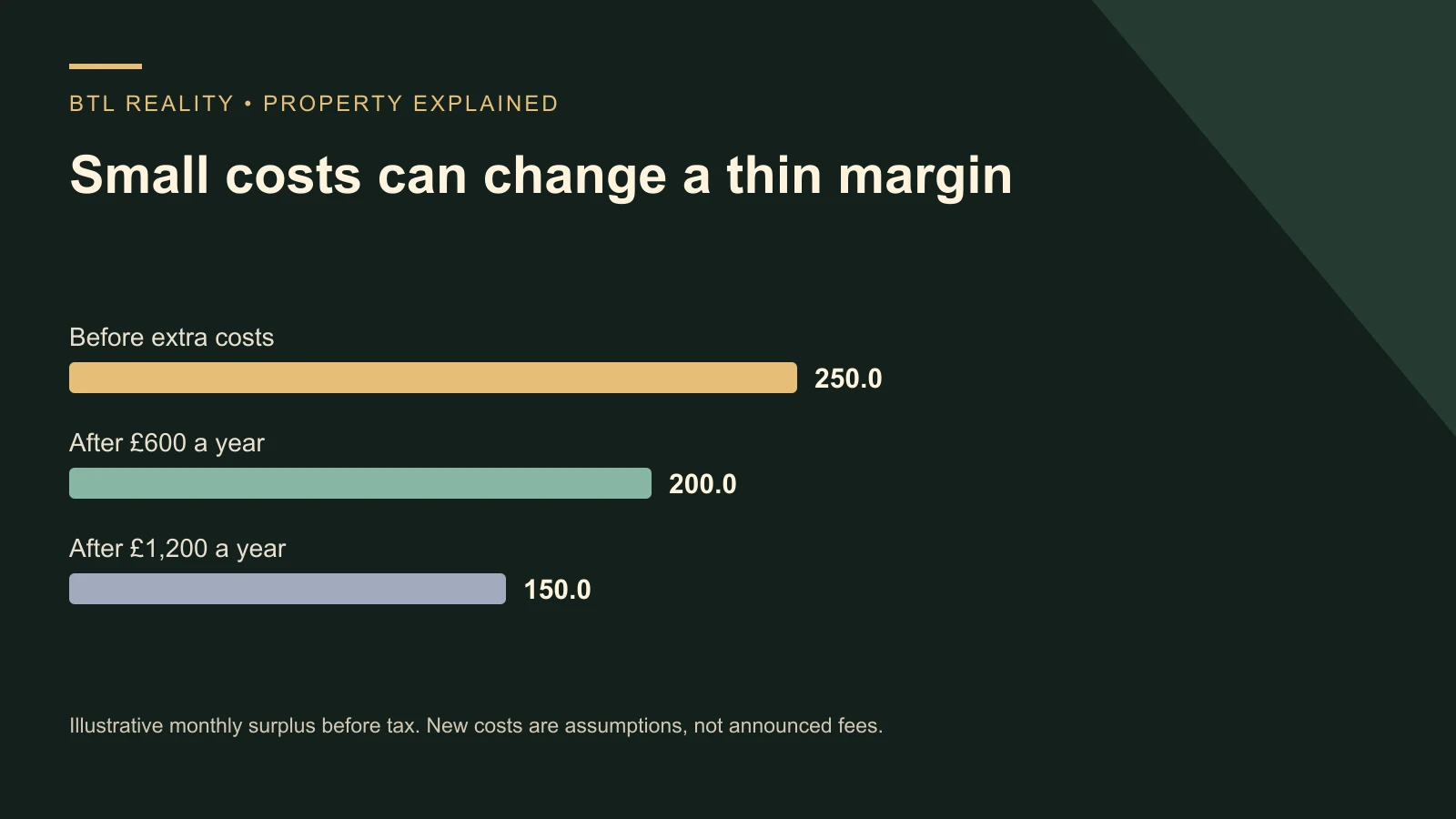
Imagine a £150,000 rental with a £112,500 interest-only mortgage. At an illustrative 4% rate, annual interest is £4,500. At 6%, it is £6,750, an increase of £2,250. Suppose rent is £12,000 annually and non-finance running costs total £3,000.
The first case leaves £4,500 before tax and capital expenditure. The second leaves £2,250. Add a further illustrative £600 of annual operating costs and the latter falls to £1,650. The rent has not changed, but the available margin has reduced substantially.
These are deliberately simple assumptions, not current mortgage quotes or typical returns. They show why evaluating each change in isolation misses the cumulative effect. They also show why an investor might negotiate a lower purchase price, retain more cash or reject a deal without concluding that every rental is doomed.
Test an extra annual cost
Before tax. The extra cost is your assumption, not an announced government charge.
Use the buy-to-let deal calculator to test your own costs. A good model should survive you entering the bills you would rather not have to pay.
Will landlords simply pass every cost to tenants?
No landlord has unlimited pricing power. Rent depends on local demand, competing homes, household incomes, condition and the legal process. If an owner’s costs rise by £200, that does not prove an extra £200 of rent is achievable or lawful.
Across a market, costs can affect investment decisions and the willingness to provide rental homes. Some owners may sell, others may accept lower returns, and some buyers may purchase at prices that make the revised numbers work. The outcome depends on what happens to the properties, including whether they remain rented.
It is therefore reasonable to investigate supply effects, but not to assume every landlord sale removes a rental home or every regulation automatically produces a particular rent rise. The rent-control guide explains why design and geography matter.
How I would make a decision without political guesswork
I would start with the income the actual property can support today. Then I would test financing, maintenance, management, tax with an adviser, future works and a period without rent. I would also consider my time and the return available from other uses of the money.
I would keep three lists: duties already in force, announced changes with a timetable, and proposals that need monitoring. The landlord database belongs on that timetable, with its announced regional rollout. A rumour without a confirmed policy should not quietly become a fixed cost in a forecast.
If the investment only works after ignoring the new rules, it does not work on a reliable basis. If it still produces an acceptable return with a useful reserve, the existence of political criticism does not automatically make it a bad purchase. That is the distinction I care about.
Starter Club is designed to help people build a practical property roadmap and discuss these decisions through education and group support. It is not a substitute for a housing solicitor, tax adviser or your own assessment of risk. Start with the free calculators if you need to understand your figures first.
Frequently asked questions
Does Labour actually hate landlords?
That is a claim about motive, not an established fact. The government says its reforms aim to improve security, standards and enforcement. Landlords can reasonably challenge the cost or effectiveness of those measures without assuming every policymaker shares an unprovable personal attitude.
Is Labour trying to ban private landlords?
The reforms discussed here regulate private renting rather than banning private ownership or all letting. They change duties and processes, which may affect returns and decisions. Read the actual rule and its scope before treating a dramatic description as a statement of law.
Are all the new landlord costs caused by Labour?
No. Some rules predate the current government, and costs also respond to interest rates, lenders, insurers, repairs and local conditions. Assign each cost to its actual cause and date. That makes both criticism and investment planning more accurate.
Will the new laws force every landlord to sell?
No universal conclusion follows. Landlords have different debt, rents, costs, cash reserves and objectives. Some properties may become unattractive while others remain viable. Selling also involves costs and potential tax, so compare realistic alternatives rather than reacting to one headline.
Can a landlord refuse to follow rules they disagree with?
Disagreement does not remove an applicable legal duty. Landlords can respond to consultations, seek advice and reassess their business, but should continue meeting current requirements. Ignoring a rule can create a much larger problem than the cost that prompted the objection.
What is the most useful way to respond as an investor?
Translate each policy into an operational task or a financial assumption. Update documents, processes and reserves where needed, and obtain specialist advice on uncertain points. Judge the property on sustainable after-cost returns rather than on whether the political debate feels reassuring.