What Is the Renters’ Rights Act? The Former Bill Explained
October 3, 2026
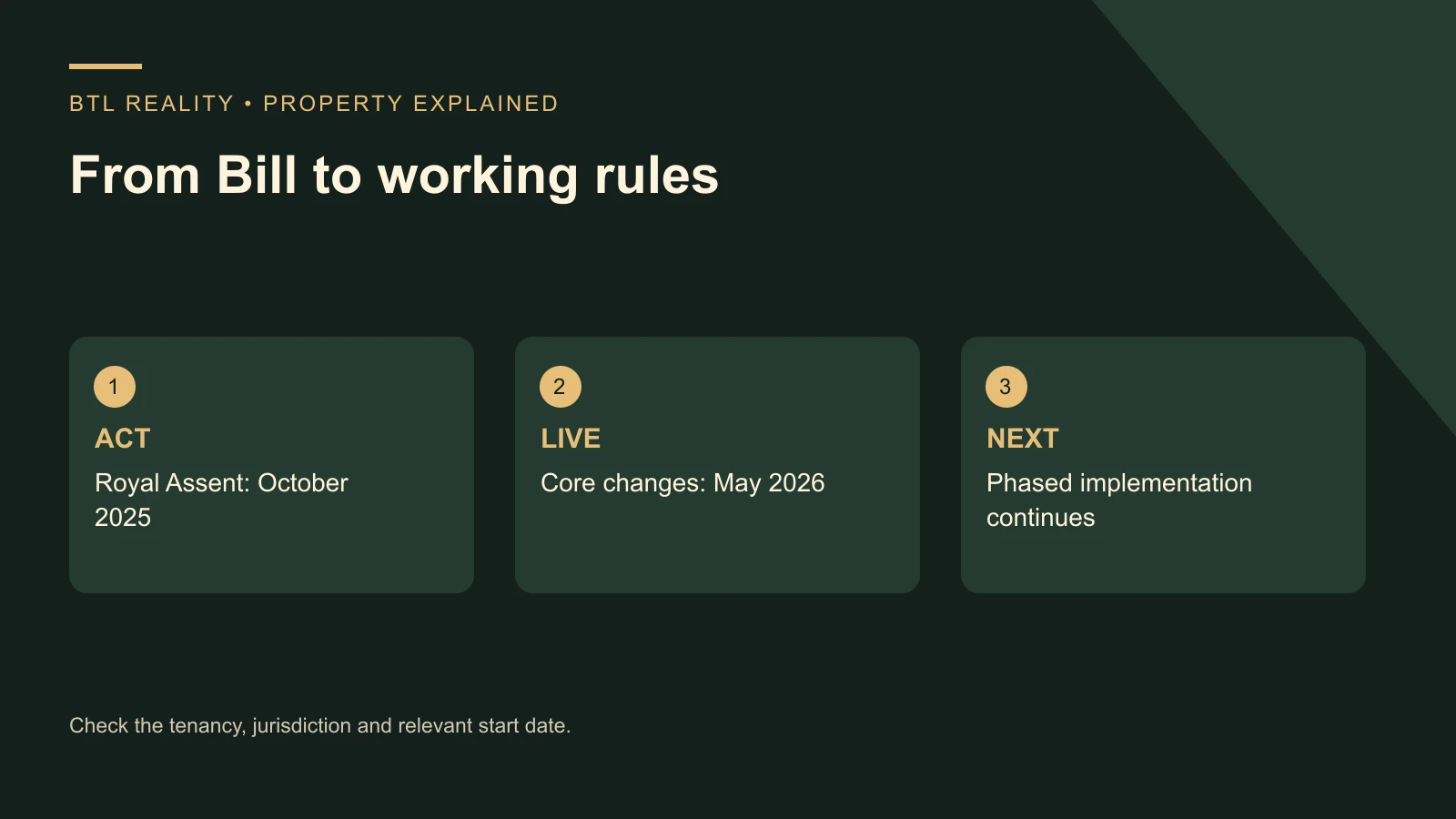
The Renters’ Rights Act is the law that changed how most private assured tenancies work in England. It ended the ability to serve new section 21 notices, moved covered tenancies onto a rolling basis and introduced changes to rent reviews, advertising, tenant selection and enforcement. Its first main phase began on 1 May 2026.
People still search for the “Renters’ Rights Bill”, but the Bill received Royal Assent on 27 October 2025. The accurate name is now the Renters’ Rights Act 2025. The difference matters because a landlord reading an old “what might happen” article could miss a requirement already in force.
For me, the practical question is what changes in the way you run a rental. A law does not need to make property impossible to make old habits expensive. The agreement, the advert, the rent-review process and the records behind a decision all deserve a fresh look.
Who does the Act affect?
This guide focuses on England’s private assured tenancies. The official landlord overview explains the principal changes. Housing is not governed by one identical system across the UK, so do not apply an England possession notice to a property in Wales or assume Scotland’s rent policy describes England.
Even within England, tenancy type matters. Resident-landlord arrangements, holiday lets, certain student accommodation and other excluded arrangements do not simply become the same tenancy because somebody uses the word “rental”. The assured tenancy guidance sets out the scope and exclusions.
If you are unsure what arrangement you have, establish that first with a qualified adviser. Renaming a tenancy, writing “licence” at the top or advertising a home as a short stay does not necessarily change the legal substance. A strategy should fit the real use of the property.
Fixed terms have given way to rolling tenancies
Covered assured shorthold tenancies became assured periodic tenancies on 1 May 2026. New covered tenancies run periodically rather than having an enforceable fixed end date. Existing landlords did not need every tenant to sign a replacement agreement for that statutory change to occur.
That does not mean the original paperwork is irrelevant. It still records useful terms, payments and obligations, subject to the law. What changes is the assumption that a date printed in an old agreement automatically delivers an empty property on that day.
A tenant generally has a route to end the tenancy with two months’ notice, subject to the applicable rules and any agreed shorter period. For the landlord, a rolling tenancy is not a promise of permanent occupancy. It is a reason to plan for turnover without relying on a fixed-term rent commitment as your only protection.
Section 21 has ended, but possession grounds remain
Section 21 was the route commonly described as “no-fault eviction”. Landlords cannot serve new section 21 notices for these tenancies from 1 May 2026. A landlord seeking possession now needs a valid legal ground and the proper section 8 procedure.
Grounds exist for situations including selling, moving in, qualifying arrears and antisocial behaviour. Conditions and notice periods differ. If the tenant does not leave after a valid notice, the landlord may need a court possession order and lawful enforcement. A notice is not permission to change the locks.
Our guide to Section 21’s abolition explains the practical transition. For selling, the Ground 1A guide covers the protected period and why reletting after using a sale ground requires particular care.
Rent can still rise, through a controlled process
The Act did not impose a single national percentage cap on ordinary private assured rents in England. It changed the timing and process. Increases generally use section 13 and Form 4A, with at least two months’ notice, no more than one increase a year and no increase in the first year of a new tenancy.
The tenant can challenge a proposed increase above open market rent. That makes comparable evidence valuable. The amount needed to cover your mortgage is not the same as what a similar home would reasonably rent for.
Suppose the current rent is £900 and you think £975 is justified. That is an 8.33% increase, or £900 extra gross rent over twelve full months. It is not automatically unlawful because the percentage sounds large, and it is not automatically lawful because costs have risen. The market evidence and correct process still decide the issue.
If the increase starts partway through the year, the first year’s additional cash is smaller. Our rent-increase guide includes a calculator so you can separate the headline annual uplift from money actually received during the period you are budgeting for.
New letting rules affect the advert and payment process
Landlords and agents must state an asking rent and cannot invite, encourage or accept an offer above it for covered England tenancies. A tenant volunteering more does not turn the letting into a permitted bidding contest. See the official rental-bidding guidance.
Rent in advance is also restricted. Before both parties have signed, asking for or accepting rent is prohibited. During the period after signing but before the tenancy starts, the usual limit is one month’s rent for monthly arrangements, with different detail for other rent periods and exceptions. Holding and tenancy deposits have their own rules.
This is a systems issue. If the agent’s payment request still asks a new applicant for six months’ rent to secure the property, changing the final agreement alone has not fixed the process. Check every stage between the listing and handing over the keys.
Pets, benefits and children need fair decisions
Tenants can request permission to keep a pet. Landlords need to consider the request and cannot refuse without a fair reason. Written requests, response deadlines, additional information and the property’s circumstances all matter. This is neither a blanket permission for every animal nor a blanket right for the landlord to say no.
The Act also prohibits discrimination against applicants or tenants because they receive benefits or have children, subject to the relevant exceptions. Fair affordability assessments remain important, but a blanket “no benefits” instruction is not the same thing as checking whether a particular household can pay the rent.
See our separate guides to pet requests and benefits and children. Keeping those decisions separate helps avoid turning a general impression of an applicant into a rule you cannot justify.
What should already be in the property file?
For qualifying existing written tenancies, landlords needed to give each named tenant the government’s Information Sheet by 31 May 2026. Existing entirely oral arrangements required written key terms instead. New covered tenancies require the prescribed information at the appropriate point before agreement.
The written-information guidance is the starting point. Check what was actually delivered and when. A note saying “agent dealt with it” is weaker evidence than the document and delivery record.
Also retain the agreement, deposit documentation, safety certificates, repair history and relevant communications. Organise them so you can answer a specific question quickly. The aim is a usable record, not collecting unnecessary personal information about tenants.
Your preparation checklist
Tick the records you have checked. This is a working list, not a compliance certificate. Selections stay in this page only.
What is coming later?
The database, ombudsman and private-sector housing-standard reforms have separate implementation stages. The September 2026 announcement gives the landlord-register launch date as 15 December 2026, starting in the West Midlands. The published roadmap expects mandatory private landlord ombudsman membership in 2028.
Do not assume every future reform is active just because it appears in the same Act. Equally, do not postpone the May 2026 duties until the database arrives. Our landlord policy hub separates live requirements, announced timetables and future policy.
How I would assess a rental after the changes
I would still begin with the particular home, tenant demand, purchase price and finance. Then I would include the cost and work of operating it properly. A gross yield that looks impressive before management, maintenance, voids and administration does not answer whether it is a sound investment.
Use the free buy-to-let deal calculator with cautious assumptions and a separate emergency reserve. If the figures only work when nobody leaves, nothing breaks and every rent increase happens immediately, the problem is the plan’s fragility.
Starter Club can help with the educational planning and accountability side. Legal notices, disputes and compliance decisions should go to a suitably qualified professional. Good property education includes recognising where specialist advice is needed.
Frequently asked questions
What is the Renters’ Rights Bill in simple terms?
It was the proposed legislation that became the Renters’ Rights Act 2025. It reforms private renting, including tenancy structure, possession, rent reviews and enforcement. Its main England private-tenancy changes started on 1 May 2026, with other measures following in phases.
Does the Act mean landlords cannot evict tenants?
No. It removes new section 21 notices for covered tenancies, but landlords can seek possession on valid statutory grounds using the correct process. Whether a ground applies depends on the facts, evidence and legal requirements. Court proceedings may be needed if the tenant remains.
Do existing tenants need to sign a new agreement?
The statutory conversion did not require a replacement signature for every existing assured shorthold tenancy. Existing written terms still need to be read in light of the law, and landlords had information-delivery duties. Check the actual tenancy before replacing documents or changing terms.
Does the Renters’ Rights Act apply to Scotland?
The England assured-tenancy reforms described here are not Scotland’s tenancy regime. Scotland has separate legislation and rent-policy arrangements. Some provisions of the wider Act have other geographical applications, so check the scope of the particular provision instead of relying on the Act’s name alone.
Is there a maximum percentage rent increase in England?
The ordinary assured-tenancy process is not a fixed national percentage cap. Frequency, notice and the open-market-rent challenge process matter. A large increase may be challenged, and a small increase can still be procedurally invalid. Use current official guidance for the particular tenancy.
What should a small landlord check first?
Start with safety, tenancy type, required information, deposit records and any live notice or deadline. Then review adverts, payment requests and agent instructions. A small portfolio still needs a reliable process; the number of properties does not remove the applicable duties.