EICR Rules for Landlords: How Often, What Fails and What Next?
October 4, 2026
For a typical private rented home in England, electrical inspection and testing must be carried out by a qualified person at least every five years, or sooner when the report requires it. The EICR is the written assessment. Receiving an unsatisfactory report creates work to do, not a document to file and forget.
For an investor, the practical challenge is to connect safety, access, repairs, evidence and cash. A cheap inspection quote is only one part of that process. This guide explains the key rules, the meaning of the common report codes and a simple way to budget. It covers England; requirements elsewhere in the UK need separate checks.
The key EICR rules in England
The government's electrical-safety guidance requires a qualified inspection, a report and appropriate follow-up. Give the report to an existing tenant within 28 days, to a new tenant before occupation, and to the council within seven days if requested. Required remedial or investigative work must be completed within 28 days, or sooner if specified. After completion, provide the required report and written confirmation to the tenant and council within 28 days.
Read the deadline and recommendations on the actual report. Five years is an upper interval for the routine duty, not a promise that the installation will remain safe without attention until then. A new defect, damage or an urgent finding needs an appropriate response when it arises.
The 2025 extension of the regulations to social housing also introduced social-landlord equipment checks. Do not copy those provisions into a private-landlord checklist without checking scope. Private landlords still need safe supplied appliances, as explained in the government's general safety responsibilities. An EICR is not a universal certificate covering everything in the home.
What do C1, C2, C3 and FI mean?
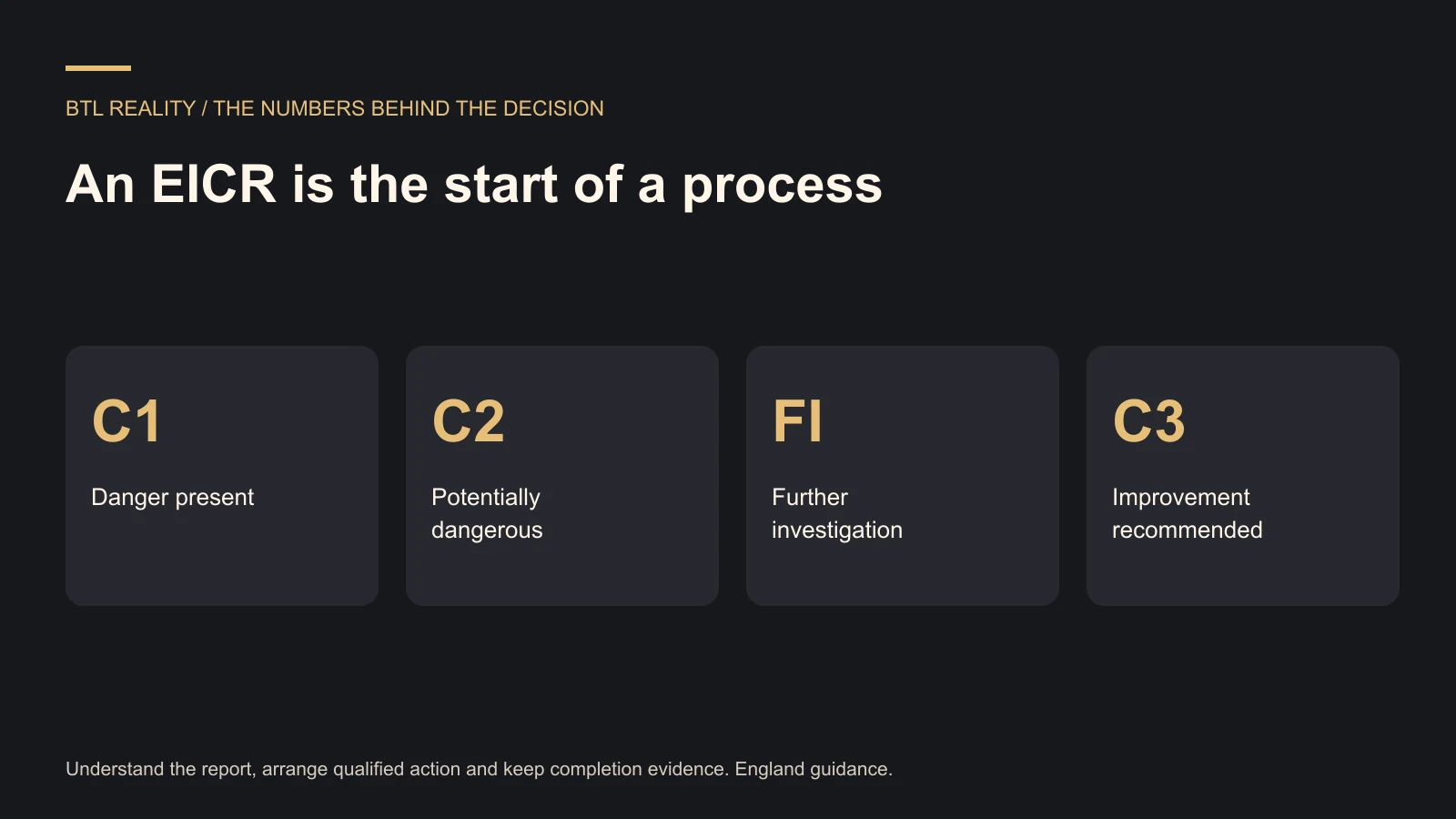
Electrical Safety First's landlord guidance explains the classification system. C1 indicates danger present, C2 a potentially dangerous condition, C3 an improvement recommendation and FI a need for further investigation. C1 and C2 require action; FI must be investigated. C3 alone does not make the report unsatisfactory, although the recommendation still deserves consideration.
Do not use a blog to overrule an electrician's assessment. Ask the inspector to explain the observations, the immediate safety position and what evidence will confirm completion. If the wording is unclear, resolve that uncertainty promptly with a competent professional. Comparing quotations must not delay urgent safety work.
The useful distinction for your property file is between a problem identified, a job instructed and a job completed with suitable evidence. Those are three different states. A paid invoice may show that money changed hands without explaining whether every observation on the report has been addressed.
Before buying: ask for more than “electrics are fine”
Request the existing report and supporting remedial documentation early in the transaction. Check the address, inspection date, overall assessment and next inspection recommendation. If the seller gives you only a quotation or a screenshot of the first page, request the full document and ask your conveyancer about outstanding issues.
Avoid assuming that a recently decorated property has recently tested wiring. Fresh paint, new flooring and attractive sockets do not establish the condition of the installation behind them. Equally, the age of a house does not tell you the outcome of a competent inspection. You need evidence about this property.
If inspection before exchange is appropriate, agree access through the proper channels. Ask what the inspection covers and whether there are limitations that need follow-up. An inaccessible area or incomplete record is a question to resolve in the buying process, not a reason to enter a zero in the refurbishment budget.
How to compare inspection and remedial quotes
Give each contractor the same information: property size, occupation, known installation details, existing reports and access arrangements. Ask whether the price includes VAT, the full report, any agreed return visit and certification for remedial work. Confirm who will carry out the work and their relevant competence.
For remedial quotations, ask for the work to be mapped to the report's observations. Separate essential action from optional improvements and from unrelated upgrades you might choose during refurbishment. That makes it easier to compare scope without treating the cheapest total as automatically the best offer.
Record exclusions. Making good plaster, moving stored items or dealing with a specialist supply issue may sit outside a headline electrical quote. A transparent scope reduces the chance of discovering these costs after the property is empty and the mortgage has started. It also helps you avoid authorising the same task twice through different contractors.
If a tenant asks to install an electric-vehicle charger, the guide to EV charger requests and landlord permissions separates electrical work, property permissions and the England consultation announced on 21 October 2026. The proposed consent process is separate from your existing electrical-safety duties.
A worked electrical-safety budget
Imagine a £250 inspection, £750 of specified remedial work and £100 for agreed completion documentation or a return visit. That produces a £1,100 cash requirement. These are invented planning figures, not market averages or a quotation for your home. The actual scope could be much smaller or much larger.
If you spread that amount across five years for investment comparison, the equivalent is £18.33 a month. You still need the £1,100 when the work is payable. If your property leaves £200 a month before tax, the initial bill uses five and a half months of that surplus. That is why an operating reserve matters.
Now change the remedial allowance to £2,000. The total becomes £2,350, or £39.17 a month over five years. A deal that works only when every safety and maintenance allowance is close to zero is not properly underwritten. The tool lets you explore this without suggesting that saving monthly removes an immediate duty.
Build your electrical-safety budget
These are example figures, not market prices or technical advice. A monthly equivalent does not defer urgent work or alter the inspection date required by a report.
JavaScript is required to change the results. The figures above show the default worked example.
Make the inspection easy to complete properly
Agree arrangements with the tenant respectfully and give clear information about the appointment. Explain who is attending, how long they expect to need and whether interruption to the electricity supply is anticipated. Ask about practical access requirements rather than assuming that a weekday daytime slot is convenient.
Keep communications and appointment records. If access is difficult, get advice on the lawful next steps and document your efforts. Do not force entry or treat an unanswered message as consent. A good record shows what was attempted and helps the agent, contractor and landlord work from the same facts.
After the appointment, confirm the outcome with the contractor before assuming the job is closed. Diarise any required work and assign someone to chase it. Calendar reminders are useful, but a reminder without a named owner can still leave everyone believing that someone else has dealt with the problem.
Build one property safety file
Keep the report, follow-up certificates, quotes, invoices and evidence of delivery together. Use clear filenames that include the address, date and document type. Retain the original documents rather than just copying a “pass” date into a spreadsheet. A future inspector or managing agent may need the detail.
Add a short action log: issue, responsible person, due date, current position and completion evidence. Review open items when you receive the monthly management statement. That connects property operations to your financial review and makes unfinished work more visible than leaving it inside a contractor's email thread.
This is also useful when changing agents or selling. An organised history helps the next person understand the property. It does not guarantee a transaction, remove defects or replace the relevant certificates. It simply reduces avoidable confusion and helps you respond with evidence instead of memory.
Put safety into the investment plan
The right sequence is to identify essential work, obtain a credible scope, budget the cash and then assess the deal. Do not buy first and hope that a future rent increase will pay for work needed before letting. Use the buy-to-let deal calculator to include the upfront amount alongside purchase costs and refurbishment.
Our landlord rules hub connects the wider obligations. If you want help learning how to assess a property as a complete business decision, Starter Club is one route. Electrical assessment and certification should always remain with appropriately qualified professionals.
Frequently asked questions
How often does a landlord need an EICR?
For an ordinary covered private rental in England, inspection is at least every five years, with an earlier date where required by the report. Check the recommendation on your own document and respond to defects between inspections. Do not use the calendar date as a reason to ignore a reported problem.
Does an unsatisfactory EICR mean a full rewire?
Not automatically. The observations determine what needs investigation or repair. Ask the qualified inspector to explain the scope and obtain suitable quotations. The word “unsatisfactory” alone does not tell you whether the work is a limited repair or a much more substantial project.
Does a C3 observation fail an EICR?
C3 means improvement is recommended. It does not, by itself, make the assessment unsatisfactory. Ask the inspector to explain the recommendation and consider it in the maintenance plan. Keep optional improvements clearly distinguished from urgent or required work when comparing quotations.
Is an EICR the same as testing portable appliances?
No. The installation report and checks on appliances serve different purposes. A private landlord should not assume that an EICR proves every supplied appliance is safe. Describe the items and tenancy arrangements to the relevant professional so the required scope is understood.
Can I budget a fixed amount for every property's EICR work?
A general reserve is useful, but it is not a reliable quotation. Property size, installation condition, access and the findings affect cost. Use actual inspection and contractor evidence for a purchase decision, then retain contingency for issues not resolved by the initial information.
What should my letting agent keep on file?
The complete report, relevant completion certificates, delivery records, future dates and an action log for anything outstanding. Keep your own copies too. If the agency changes, the property should not lose its safety history simply because access to one management portal ends.