Buy-to-Let Viewing Checklist: 20 Questions Before You Offer
October 19, 2026
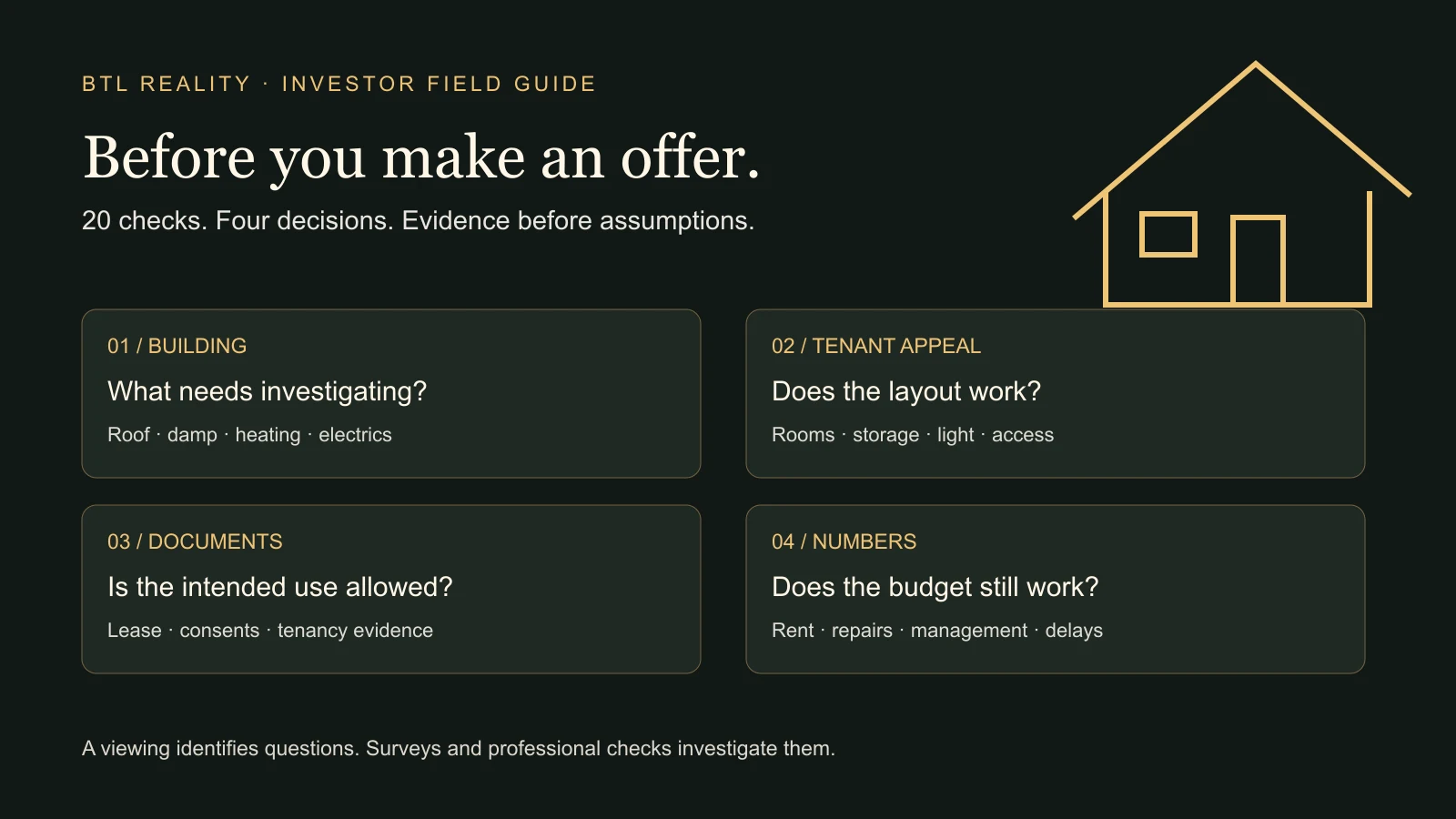
An investment viewing should leave you with evidence, questions and a better budget. If you leave with nothing except a feeling that the property is a bargain, there is more work to do. A good buy-to-let viewing checklist helps you notice the things that photographs and headline yields leave out: awkward access, poor storage, ageing components, weak rental evidence and restrictions on how the building can be used.
The checklist below is designed for an initial viewing of a conventional rental house or flat. It will not replace a survey, legal enquiries or a qualified safety inspection. Its job is to help you decide what to investigate, who should investigate it and whether the property still deserves your time. The purchase and tenancy rules differ across the UK, so ask the professionals working on the purchase which requirements apply locally.
Before the viewing: set your brief
Write down the kind of tenant the property needs to serve and the financial limits it must meet. A two-bedroom flat aimed at working sharers needs a different assessment from a family house with a garden. Consider transport, parking, storage, usable room sizes and who will manage the property. Avoid assuming that anything you would personally tolerate will be acceptable to a paying tenant.
Bring the listing, floor plan, a tape measure and a place to record answers. Ask permission before taking photographs. Record the address, date and the name of the person giving each important answer. A statement such as “the roof was done recently” is a starting point for an enquiry, not an item you can safely mark as verified. Ask what was done, when it was done and whether there are invoices or guarantees.
Twenty checks, grouped by the decision they affect
The building and likely works
- Roof and rainwater goods. Look from a safe position for slipped coverings, staining, overflowing gutters and obvious damage. Note the location and ask a surveyor what requires closer investigation. Do not climb onto a roof or infer a repair cost from a photograph.
- Damp and ventilation. Record musty smells, condensation, staining and fresh isolated decoration. Ask when problems occur and what has been investigated. Similar symptoms can have different causes, so buying a dehumidifier is not a diagnosis.
- Heating and hot water. Identify the system, visible condition and available service records. Ask a qualified contractor to investigate performance or safety concerns. An old boiler is a budget question even if it happens to be working during the viewing.
- Windows and doors. Check accessible opening, visible seals, glazing condition and security. Separate a minor adjustment from a replacement programme. Ask who is responsible for external components when viewing a leasehold flat.
- Electrical installation. Ask for relevant inspection records and note obvious damaged fittings. A tidy consumer unit does not prove an installation is safe. Build professional checks into the purchase process.
Whether the layout works for the intended letting
- Usable bedrooms. Measure where ordinary furniture would go, including the space needed to open doors and drawers. A room labelled as a bedroom on a floor plan is not proof that every proposed letting arrangement is lawful or practical.
- Kitchen and bathroom condition. Distinguish cosmetic preferences from defective, unsafe or worn components. Durable fittings can be more useful than an expensive finish. Ask what genuinely needs replacing before the first tenancy.
- Storage and circulation. Consider coats, cleaning equipment, bins and ordinary household belongings. Walk the route between rooms. A property that photographs well can still feel awkward when two people use it at once.
- Noise, light and privacy. Notice adjoining uses, traffic, overlooked windows and the aspect of the main rooms. If the decision depends on quiet evenings, a midday viewing provides incomplete evidence.
- Access and outside space. Inspect the practical route from the street, parking arrangements and garden maintenance burden. Ask who owns or maintains shared paths. Do not assume a space belongs to the flat because the seller uses it.
Tenure, permissions and documents
- Tenure. Establish whether the property is freehold or leasehold. For a leasehold purchase, request the lease details and ask your conveyancer to review the remaining term, restrictions and obligations.
- Service charges and planned works. Ask for current demands, recent accounts and information about proposed major works. The amount paid last year may not describe the next owner's exposure.
- Letting restrictions and licensing. Explain the intended use accurately to your solicitor, lender and local authority where necessary. A normal residential appearance does not establish that every proposed rental arrangement is permitted.
- Alterations and consents. Ask what has changed and what documentation is available. A converted loft or removed wall needs appropriate investigation. An estate agent's reassurance is not a substitute for the relevant records.
- Existing tenancy evidence. If somebody already lives there, request the tenancy documents and rent records through the proper purchase process. Respect the occupier's privacy and access rights. Do not photograph their documents or belongings unnecessarily.
Rent, costs and practical operation
- Achievable rent. Ask for comparable evidence that matches the property's condition, location and letting basis. Distinguish an advertised asking rent from rent supported by an agreed tenancy or other reliable evidence.
- Likely first-let work. Make a room-by-room list of cleaning, repairs and preparation. Separate essential work from optional improvements. Obtain quotations before treating the total as a firm purchase assumption.
- Management arrangements. Ask a local agent how they would manage the property and request a complete fee schedule. Check who handles emergencies and whether the proposed service includes the tasks you expect.
- Holding costs. Identify the costs that continue before a tenant starts paying. Include finance, insurance and applicable bills in the model, with a realistic allowance for delays.
- A second visit and unresolved questions. List what could change the decision and arrange the right follow-up. A second visit with a surveyor or contractor can be more valuable than another hour adjusting the yield calculation.
Use the interactive evidence checklist
Mark a check as complete only when you have recorded a useful observation or obtained the evidence it needs. The counter measures your progress through the checklist. It is not a safety certificate, mortgage approval or investment score. A single unresolved structural or legal issue can matter more than nineteen completed boxes.
Your viewing evidence tracker
Tick an item when you have recorded your observation or obtained its evidence. An unchecked item remains a question, not a failed investment.
Progress only, not a quality or safety score. Your selections are not saved or transmitted.
Keep your own written notes after the viewing. This page does not save your selections or send them to BTL Reality. If you need to share a concern with a professional, provide the actual photograph, document or observation rather than the checklist percentage. Clear evidence helps them give a meaningful answer.
Turn observations into a revised budget
Imagine a property initially modelled with £6,000 of preparation work. The viewing identifies a possible heating replacement, damaged flooring and an unresolved roof concern. Do not simply add an arbitrary contingency and declare the deal safe. Create three lines: confirmed work with a quotation, work requiring a quotation, and issues whose scope is not yet known.
If confirmed preparation increases to £9,000, the extra £3,000 reduces the cash left for reserves or another purchase. An unresolved roof issue may require a different decision entirely. Use the buy-to-let deal calculator to update the known costs, then test a separate downside case. Our guide to building a refurbishment budget explains how to separate essential work, optional improvements and contingency.
A useful lesson from Mark's projects
In Mark's published Rugby and Kettering project discussions, the work was assessed against what the property needed, rather than an assumption that every investment required an expensive transformation. Those were historical examples and forecasts, not evidence that the same returns are available today. The practical connection is straightforward: look closely before deciding what to spend.
Read what makes a good buy-to-let property to connect the viewing with the wider investment decision. If you want support turning your research into a first or next purchase plan, Starter Club explains the available support and current membership terms.
When a viewing raises a specific question
Use the initial viewing to identify the issue, then take the relevant evidence to the right professional before relying on a budget or committing to the purchase.
Access and intended use
An awkward approach road needs more than a visual check: our guide to buying a rental on an unadopted road separates access rights from maintenance contributions. For a freehold house, restrictive covenants and renting explains why the title still needs checking against your intended letting.
Condition that an ordinary viewing cannot settle
If the drainage evidence is incomplete, the rental CCTV drain-survey guide helps distinguish a legal search from a physical inspection of the pipes. Before pricing work on suspect materials, the asbestos survey guide for rental buyers explains how to match the investigation to the refurbishment you intend.
Outside and location-specific findings
Where the garden raises a plant concern, the Japanese knotweed buying guide focuses on professional identification, the management plan and lender response. For a former mining area, the coal-mining report guide helps turn a report finding into questions about this property and the proposed works.
Alterations and agreements attached to the property
If an extension sits near a sewer and paperwork is missing, the missing build-over agreement guide sets out what to establish before exchange. If the roof has panels owned by another business, the leased solar-panel purchase checks separates equipment ownership, the roof lease and the claimed financial benefit.
Questions readers ask
Can I use the viewing instead of a survey?
No. A viewing is an opportunity to identify questions. A professional survey investigates condition within its agreed scope. RICS explains the difference between a survey and a mortgage valuation; a lender's valuation is not a detailed condition report for the buyer.
Should I offer before every question is answered?
The appropriate sequence depends on the transaction and local legal process. Tell your solicitor and broker what remains unresolved before making commitments. At auction in particular, do not assume the normal private-sale sequence or a later opportunity to withdraw applies.
What is the most useful thing to bring home?
A short list of decision-changing unknowns, each with a named person responsible for checking it. That turns the viewing into a practical next step instead of a collection of attractive photographs.