How Much Should You Spend Refurbishing a Buy-to-Let?
October 8, 2026

By Mark Parham
BTL Reality · Practical property education
Spend what is needed to make the buy-to-let safe, compliant, durable and suitable for the people likely to rent it. Then assess optional upgrades against their full cost, credible rent or value benefits and the extra time before income begins. There is no universal refurbishment percentage that makes every deal work.
A £5,000 refresh and a £25,000 renovation can both be sensible in the right property. The mistake is choosing the budget before understanding the building, or assuming every extra pound spent will produce a matching increase in value.
Divide the work into three lists
Essential
Safety, legal requirements, structural issues and defects that prevent appropriate letting. Confirm the requirements with qualified professionals.
Commercially useful
Durable improvements supported by the property’s condition and local rental evidence, such as replacing a failing kitchen.
Optional
Higher specifications or cosmetic choices whose extra benefit needs justification. Attractive does not automatically mean profitable.
The first list is not a place to cut corners. If the project cannot afford essential work, the acquisition price or entire investment may be wrong. The third list is where a rent-uplift or value comparison becomes especially useful.
Ask the surveyor and relevant trades to investigate the condition before finalising the scope. Electrical, heating, damp and structural questions can change the project materially. A viewing-based allowance is a starting estimate, not an assurance that hidden problems are absent.
Budget for the whole programme
Write down labour, materials, disposal, professional input, compliance checks, project management and applicable VAT. Identify what each quote includes and excludes. A cheap headline can become expensive if preparation, waste removal or finishing has been left out.
Add holding costs for the period before rent starts, financing costs where relevant and a contingency appropriate to the uncertainty. Keep the post-completion operating reserve separate. Spending the rental reserve to finish the kitchen leaves you exposed on the first day of ownership.
Our buy-to-let costs guide helps connect works to the purchase budget. The empty-property cost guide shows why a delay affects both cash needed during the project and the income received across the year.
My Kettering example: test the marginal upgrade
In my historical Rugby and Kettering walkthroughs, I discussed a lighter refresh for a Kettering property versus a much more substantial programme. The rent estimates under discussion were around £775 and £800 a month.
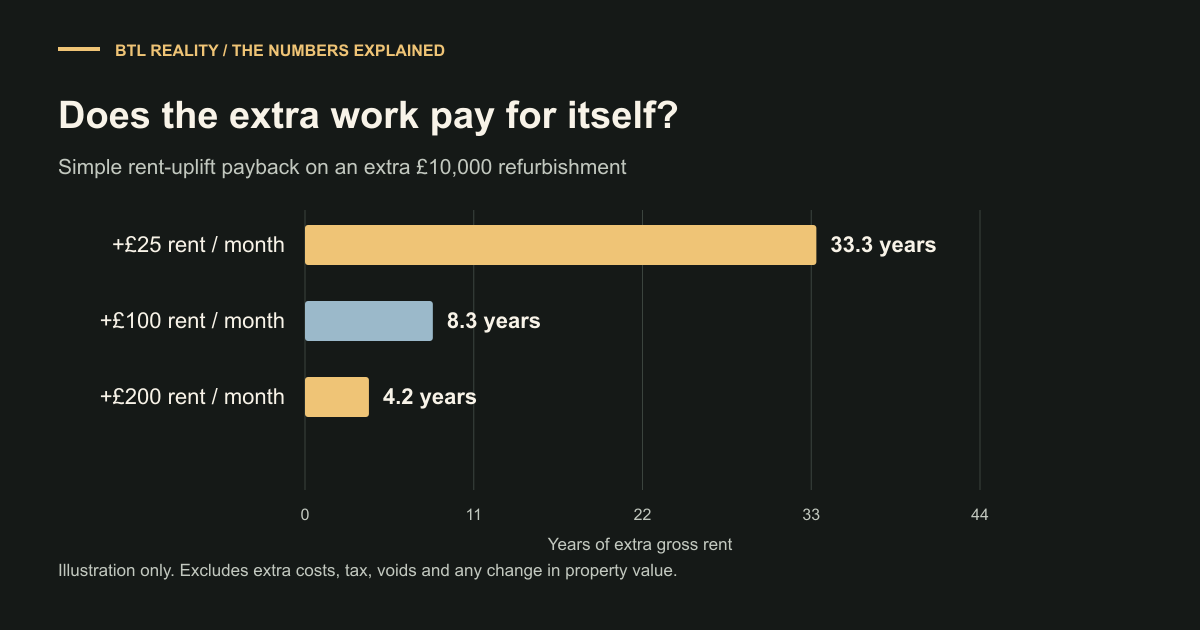
Those were estimates at the time, not a current letting valuation or verified achieved return. They still raise a useful question: if an extra £10,000 of work produces only £25 more rent each month, what is the commercial justification?
That uplift is £300 a year before any extra costs or tax. Simple recovery of the £10,000 through that extra gross rent would take about 33.3 years. A valuation improvement or reduced future maintenance might change the decision, but each needs separate evidence. The £25 uplift alone is a weak explanation for spending another £10,000.
TRY YOUR OWN ASSUMPTIONS
Test the extra refurbishment spend
Compare the extra work with the extra rent it might support. This is a simple payback check, not a complete investment return.
Move a slider to explore the model.
Assumes the uplift is achieved every month. Excludes voids, management, maintenance, tax, financing changes, discounting and any change in property value. Essential safety and legal work must not be judged only by rent payback. Inputs stay on this page. Figures stay on this page and are not submitted or saved.
Enable JavaScript to use the sliders. The default worked example remains readable below.
Extra £10,000: how much rent uplift changes the payback
Do not confuse a rent uplift with a valuation uplift
A £10,000 kitchen may make a property easier to let without adding £10,000 to its sale value. Conversely, resolving a serious defect might protect value even if rent barely changes. These are different benefits and should be described honestly.
For a refinance strategy, obtain comparable sales evidence for the intended finished condition and discuss the lender’s valuation basis with a broker. An estate agent’s optimistic appraisal is not a guaranteed mortgage valuation. If the lower valuation still leaves substantial cash in the deal, make sure you can hold it.
Use the property refinance calculator to test several values. Keep the refurbishment decision workable without the most flattering assumption. Borrowing more against a higher valuation also increases debt and may affect ongoing cashflow.
Choose a specification for the intended home
Think about durability, cleaning, replacement and availability of parts. A sensible rental specification should suit the local market and the household likely to live there. It does not need to imitate a luxury show home to be attractive and well cared for.
Compare similar rental properties at different specifications. Ask agents what is actually limiting demand: condition, layout, storage, heating, parking or simply price. If the market does not reward an expensive finish, spending on the fundamentals may create a better home and a more resilient investment.
Standardising some components across a portfolio can simplify maintenance, but avoid forcing the same solution into every building. A period house, a compact flat and a family semi may need different practical decisions.
Make contingency specific
A percentage contingency is useful for early planning, but list the uncertainties behind it. An untested electrical installation is a different risk from not having chosen the paint colour. Mark each uncertain item with an investigation, provisional allowance and decision date.
In the Rugby discussion, the historical renovation allowance moved from roughly £10,000 towards £12,000 as electrical uncertainty was considered, with the possibility of more work. I would take that as a lesson about investigating unknowns, not as a current renovation price guide.
Ask what happens if the cost rises by £5,000 or completion slips four weeks. Identify the cash source before the project begins. A contingency only exists if the money is accessible and has not already been allocated elsewhere.
Use a written scope and staged decisions
- Describe the finish. Specify the work and materials clearly enough for comparable quotes.
- Agree responsibility. Record who orders, supervises, checks and signs off each part.
- Track changes. Get the cost and timing effect of a variation before authorising it.
- Inspect progress. Use appropriate professional checks, particularly for safety-critical work.
- Keep the letting date realistic. Avoid promising a finished home before the programme supports it.
- Retain the records. Store invoices, certificates, warranties and before-and-after evidence.
A beautiful final photograph is not enough to evaluate the project. Compare the original scope, final spend, actual completion date and supported rent. That tells you whether the investment improved, and why.
When the right budget means walking away
Some deals only appear attractive because the works allowance is too small. If proper investigation reveals costs the project cannot support, renegotiate on evidence or reject it. The aim is to buy a viable investment, not defend the first spreadsheet.
Our refurbishment mistakes guide expands on common planning errors. Use it alongside the numbers here to check whether your proposed programme is practical as well as profitable on paper.
Build the works into the deal from day one
If you want help finding a property against an agreed brief, explore Done For You property sourcing. The acquisition, works and financing assumptions should fit together before you commit.
Should every refurbishment have a short rent payback?
No. Essential work and improvements that protect the building have other purposes. Use payback to challenge optional spending, not to justify avoiding safety or legal obligations.
Are the example costs current trade quotes?
No. The case-study figures are historical estimates and the calculator is illustrative. Obtain property-specific quotations and current professional advice.
Prepared using information checked on 30 September 2026. Check the linked product pages for current availability and terms. This is general property education, not personal financial, mortgage, tax or legal advice. Models and examples are illustrative. Property values and income can fall, and outcomes are not guaranteed.