Can a Freehold Restrictive Covenant Stop You Letting a House?
October 20, 2026
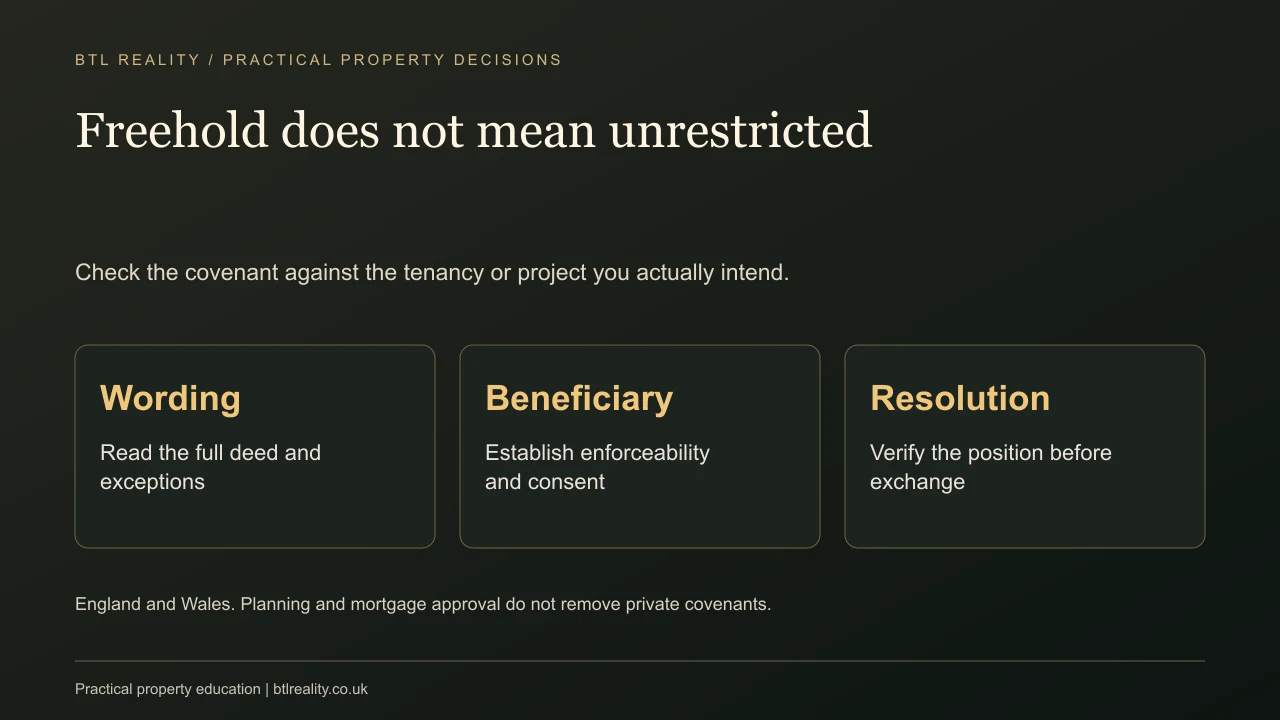
Buying a freehold house removes some leasehold questions, but it does not mean the title is free of restrictions. An old transfer or conveyance may contain a covenant affecting how the property can be used. For a buy-to-let buyer, that can matter before the first tenant moves in.
The useful question is whether the actual wording restricts the letting you intend, and whether an enforceable obligation needs resolving. A casual reading of one sentence is not enough. This guide concerns England and Wales, with primary guidance checked on 19 October 2026.
What is a restrictive covenant?
A restrictive covenant is a private legal restriction affecting land or buildings. It may concern building work, the use of a property or other activities. The Upper Tribunal’s guidance on restrictive covenants explains the distinction between these arrangements and the planning system.
A title can also contain positive obligations requiring an owner to do something. Those are not interchangeable with restrictive covenants, and the available legal routes differ. Ask the conveyancer to classify the relevant entry and explain its effect rather than put every obligation under one heading.
For the buyer, the first task is to obtain the full document referred to in the register. A brief register entry may point to an older transfer containing the operative wording and plan. Do not assume a summary supplied by the seller captures every qualification, exception or consent mechanism.
Does a private-dwelling clause prevent letting?
Not every covenant referring to a private dwelling is a blanket ban on ordinary residential letting. Equally, do not assume that renting to a single household is always permitted. The wording, context and applicable law need interpretation by the conveyancer.
Tell them the exact plan: a long-term single let, letting rooms, an HMO, short stays or some combination. The same wording may raise different issues for different uses. An answer about a family home does not necessarily establish acceptance of a more intensive letting strategy.
Ask whether there is an express letting restriction or a requirement for consent. Check whether the restriction applies to the entire property, particular land or a particular period. If a consent was obtained by the seller, establish whether it covers your use and continues to be effective after sale.
The buy-to-let viewing checklist can capture what the property appears capable of doing. The legal report then needs to confirm whether that planned use is permitted. A spare bedroom and suitable layout do not settle the title position.
Planning, licensing and mortgage consent are separate
A planning permission does not automatically remove a private covenant. The tribunal’s guidance makes that separation explicit. You can therefore have a scheme that is acceptable in planning terms but still needs a private title restriction addressed.
A property licence or a lender’s agreement to buy-to-let borrowing answers another question again. Do not treat either as proof that a covenant has been waived. Your broker, conveyancer and planning or licensing advisers need a consistent description of the proposed use.
For an HMO project, read the HMO planning and Article 4 guide for the public-law planning side. Then check title restrictions separately. A decision to proceed should account for every required permission rather than rely on whichever approval arrives first.
Also examine existing alterations or letting history. The fact that previous owners let the property, or that neighbours do the same, is evidence to discuss with the solicitor. It is not an automatic legal conclusion that the restriction has ceased to matter.
Identify who can enforce or give consent
Ask the conveyancer to investigate who has the benefit of the covenant and whether that benefit remains enforceable. The beneficiary may not be the person currently named in a historic sales document. The land benefiting from a covenant and later ownership changes can be relevant.
Do not assume age makes the covenant obsolete. Nor should you assume that a beneficiary can be identified and persuaded to sign a release for a standard fee. The evidence and legal analysis need to establish what rights exist before you negotiate a solution.
Where a public body is involved, check its actual process. Homes England’s consent and discharge guidance, for example, identifies routes to seek permissions or a variation or release of a restrictive covenant where it can deal with the relevant interest. That is a specific example, not a service for every property covenant.
Ask whether any consent is one-off, personal, conditional or capable of benefiting future owners. A document allowing one specified use or one owner’s occupation might not deliver the unrestricted position a future buyer expects. The solicitor should explain exactly what a proposed solution achieves.
Do not contact a beneficiary before discussing the options
If a possible defect is found, ask the conveyancer how to investigate and resolve it. Contacting a beneficiary may be appropriate for a negotiated consent or release. It can also affect the availability or terms of a contemplated indemnity policy.
That is not a reason to withhold facts from advisers or the lender. Provide the full history, including contact already made and any complaints or notices. The solution needs to reflect the real position rather than a policy application based on incomplete information.
If insurance is proposed, ask what risk it covers, who benefits, the monetary limit and relevant exclusions. A title indemnity policy does not change the covenant’s wording or provide a general licence to pursue any future use. Your conveyancer and lender must assess whether it addresses the particular issue.
A worked example: a delay changes the cash requirement
Assume a £160,000 rental would bring in £1,000 a month, with £550 mortgage interest and £250 other monthly costs. Ordinary forecast surplus is £200 before tax. Now assume that a covenant issue needs resolving before the intended letting can begin.
For illustration, resolution takes three additional months after completion. The property remains unlet during that period, costs continue at £800 a month and additional legal and consent work costs £1,500. These are planning assumptions, not a quote, typical timetable or suggestion that completion should occur with the issue unresolved.
| Illustrative item | Calculation | Amount |
|---|---|---|
| Ordinary monthly surplus if let | £1,000 minus £550 minus £250 | £200 |
| Cash paid during additional unlet period | 3 times £800 | £2,400 |
| Extra legal and consent work | Assumed quotation | £1,500 |
| Cash needed for those two items | £2,400 plus £1,500 | £3,900 |
There is also rent not received during the delay. Do not add the full missed rent to the £2,400 holding-cost line and call that the same cash payment. For a full-year comparison, model income and expenses over the actual occupied and unoccupied months.
Use the Buy-to-Let Deal Analyser for the normal letting case, then a separate forecast for delay and professional costs. The better practical route may be resolving the issue before exchange or choosing another property, rather than simply finding more cash.
Could the covenant be released or modified?
A negotiated consent, variation or release may be possible if the appropriate parties agree. Ask about the price, legal costs, lender involvement, documents and registration steps. Keep an agreed solution separate from one that has only been requested.
There is also a statutory route to apply to the Upper Tribunal for discharge or modification of qualifying restrictive covenants. The tribunal guidance explains the procedure and its limits. Success is not automatic, and it cannot be treated as a quick administrative cure for every restriction or positive obligation.
Before relying on that route, obtain specialist advice on eligibility, evidence, opposition, cost and timing. A buyer seeking a straightforward rental may not want to acquire an unresolved legal project. The possible route is relevant to the decision, but it is not the same as a completed outcome.
Set a clear condition for proceeding
Before exchange, ask for a report setting out the covenant, intended use, enforceability assessment and any necessary consent or remedy. Obtain the required lender response and establish who is responsible for the remaining steps and costs.
If the title permits the intended letting, keep that explanation and supporting documents for your records. If it needs a remedy, verify the completed position. If the investment depends on an uncertain interpretation or future application, be honest about whether that fits your strategy.
A freehold house can be an excellent rental, but tenure alone does not prove that every use is allowed. Start with the documents and the actual plan. Then decide whether the purchase price, obligations and practical route to letting work together.
Frequently asked questions
Can a restrictive covenant stop me renting out a freehold house?
Potentially, depending on its wording and enforceability. Ask your conveyancer to assess the actual restriction against the intended tenancy. Freehold ownership, a buy-to-let mortgage and an existing licence do not by themselves remove a private covenant.
Does a private-dwelling covenant automatically ban a normal tenancy?
Do not assume either outcome from that phrase alone. The full drafting and legal context matter. Explain whether you intend a single household, rooms, an HMO or short stays so the advice relates to the actual proposed use.
Does planning permission override a restrictive covenant?
No. Planning control and private covenants are separate. A permitted development or planning approval does not automatically authorise a breach of private title restrictions. Check both before relying on a proposed conversion or change of use.
Can I ignore an old covenant because other houses are rented?
Not safely on that evidence alone. Age and neighbouring use may be relevant to the solicitor’s investigation, but neither automatically removes enforceability. Obtain an assessment based on the title, beneficiary and circumstances of this property.
Will covenant indemnity insurance give permission to let?
It does not rewrite the covenant or provide general consent. The policy may cover specified financial consequences, subject to terms and exclusions. Your conveyancer and lender need to assess whether it is an appropriate response to the particular risk.
Should I ask the beneficiary for consent myself?
Speak to your conveyancer first. A negotiated consent may be the right route, but contact can affect other options such as proposed indemnity cover. Give the adviser a complete account of any contact or complaint already made.