Buying a Rental With No Build-Over Agreement: What Next?
October 20, 2026
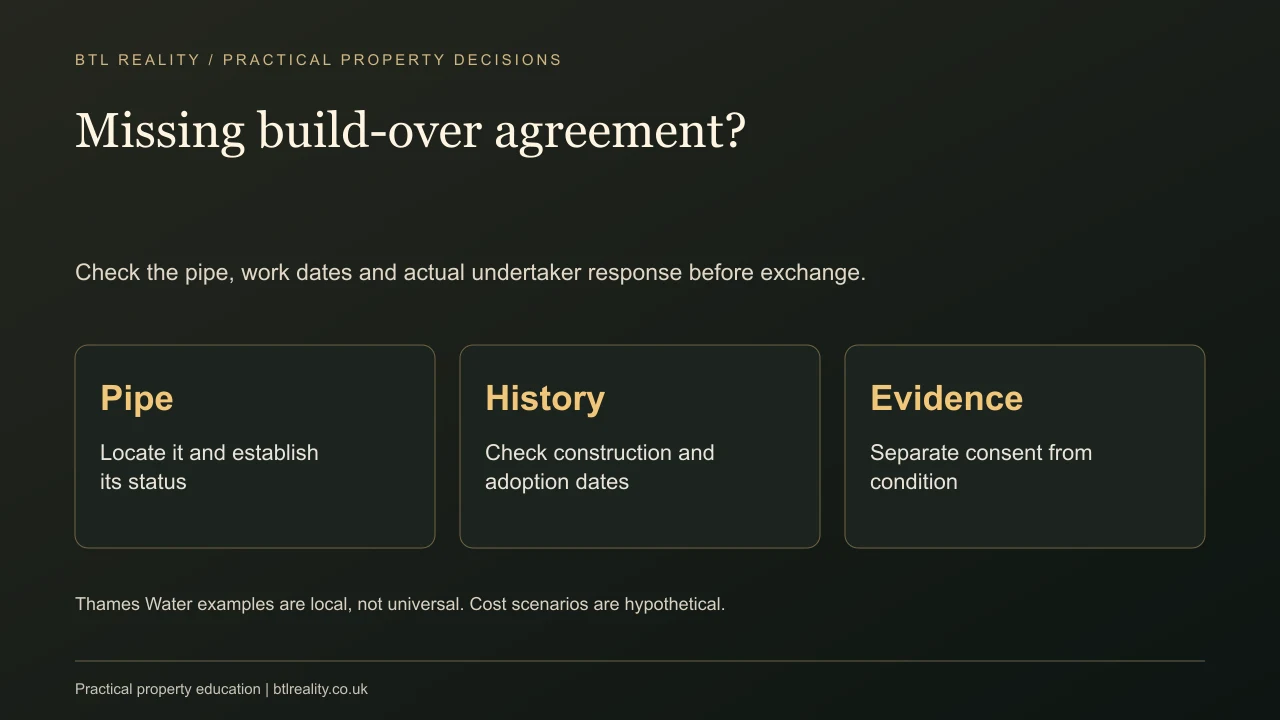
The rental’s rear extension provides a useful kitchen, but a drainage search shows a public sewer beneath or close to it. The seller cannot produce a build-over agreement. Before deciding it is either harmless or a reason to abandon the purchase, establish the pipe, dates and documents.
The answer can depend on when the works were done, the sewer’s status and the relevant undertaker’s requirements. This guide concerns buying in England and Wales, using Thames Water as a primary example checked on 19 October 2026. Ask the property’s own sewerage undertaker and your conveyancer about the actual case.
Understand what a build-over agreement does
Thames Water describes a build-over agreement as a contract protecting the sewer and the provider’s ability to maintain it. Its guidance also states that planning permission does not grant permission to build over a sewer or drain.
That is why a planning decision alone may not answer the query raised in conveyancing. Building-regulations approval is another separate matter. Ask the solicitor to identify which evidence is needed rather than treat several different approvals as one interchangeable certificate.
A missing document is not itself a physical diagnosis. The extension may need further legal investigation, condition assessment or both. The useful objective is to establish the actual position, not to buy a policy before anyone has identified the risk it is supposed to cover.
Identify the pipe and its relationship to the building
Ask for the drainage search, relevant plans, extension drawings and any camera survey. Establish whether the pipe is a private drain, a public lateral drain or a public sewer. Check where it runs relative to the foundations and internal layout.
Thames Water’s published guidance uses proximity tests for its application process, including building within three metres of a public sewer or one metre of a public lateral drain. Those examples are not a reason to assume that any drawing at that distance proves an historic breach at every UK property.
Maps have limitations, and a recorded line may need locating on site. Ask the appropriate specialist whether further inspection is required. The conveyancer needs a reliable factual basis for legal advice, while the surveyor needs to understand the physical arrangement rather than guess from a sketch.
If a manhole or inspection chamber is inside the extension, highlight that specifically. Access and maintenance arrangements can be important. Do not conceal a chamber beneath flooring or assume the water company’s access rights have ceased because a room has been built around it.
Check the construction and adoption history
Request evidence of the extension’s construction date and any later alterations. Compare planning and building-control records with the seller’s account. An approximate statement that it was done years ago is not enough where the sequence affects the analysis.
Thames Water’s sewer-ownership guidance explains the 2011 transfer of relevant private sewers and lateral drains. That history can matter when investigating an older extension. It does not create a universal rule that every pre-2011 build is acceptable or every later one is unacceptable.
Ask the conveyancer to apply the actual dates, pipe status and undertaker’s position. There may be records of consent, consultation or arrangements that the seller no longer has. Equally, a historic completion certificate may not settle the current query without further explanation.
The missing building-regulations guide covers a related but separate issue. Where both arise, keep each investigation and proposed remedy tied to the correct approval system.
Find out what the search has and has not established
A records search can identify mapped infrastructure and relevant recorded information. The Thames Water CON29DW sample shows questions concerning sewer maps and recorded building consultation. It is not a guarantee that every pipe beneath a house is in good condition.
Ask whether a targeted CCTV survey or other inspection is needed for the physical question. A camera can provide useful condition evidence within its accessible scope, but it does not retrospectively grant consent. Legal paperwork and physical inspection answer different parts of the purchase problem.
Use the CCTV drain survey guide to agree useful deliverables and limitations. If the report cannot inspect the relevant section, do not describe that section as cleared. Ask what further evidence could reasonably resolve the gap.
Coordinate enquiries before contacting the undertaker
Your conveyancer should advise on the investigation route and any proposed insurance before you make contact about a possible defect. Direct contact may be necessary to obtain information or a resolution, but can affect the availability or terms of a contemplated indemnity policy.
That does not justify concealing existing knowledge. Tell the solicitor about all previous contact, refusals, notices and relevant works. A policy or lender response based on incomplete information is not a dependable solution to build an investment around.
If a retrospective or alternative arrangement is suggested, ask whether the actual undertaker offers it for this situation and what evidence, inspection or work it requires. Do not rely on a generic online promise that a retrospective certificate can always be purchased.
Confirm the lender’s specific position
Give the broker and conveyancer the full issue and supporting evidence. The proposed lender may need a report, confirmation, documents or an acceptable policy. A seller’s mortgage and another buyer’s experience do not establish that your lender accepts this extension.
If indemnity insurance is proposed, read the insured event, limit, beneficiaries and exclusions. A policy concerning missing consent should not be presented as a structural warranty or general repair cover. It does not prove the pipe is sound or remove the need for the provider to maintain its network.
For a cash purchase, retain the same focus on condition, access and future resale. A later buyer may need a mortgage. Completing without a lender’s query today is not evidence that the extension and sewer arrangement has been resolved for all purposes.
A worked example: price the evidence before guessing a remedy
Assume the buyer obtains a £350 targeted camera inspection, a £450 professional assessment and £600 additional legal work to establish the facts and proposed route. These hypothetical figures total £1,400. They are not undertaker fees or standard costs for obtaining an agreement.
Now assume the outcome identifies £3,000 of necessary work, with £800 reinstatement and one additional holding month costing £700. Those items would add £4,500. A real purchase needs the actual scope, approvals and quotations rather than a generic allowance.
| Illustrative extra cost | Amount |
|---|---|
| Inspection, assessment and legal work | £1,400 |
| Assumed required works | £3,000 |
| Reinstatement | £800 |
| Additional holding cost | £700 |
| Combined additional cash | £5,900 |
If the investigation establishes that the assumed work is unnecessary, remove it from the forecast. If the problem requires a more extensive solution, the example is not a cap on your exposure. The purpose is to show why investigation and possible remedial work should remain separate lines.
Enter verified items into the Buy-to-Let Deal Analyser. If the seller negotiates the price, recalculate borrowing and deposit as well. A discount does not itself provide an agreement, repair a pipe or prove the extension’s condition.
Set a clear pre-exchange position
Ask for a written account of the pipe, works history, documents found, relevant undertaker response, lender acceptance and remaining physical questions. Separate completed evidence from proposed steps. The investment should not depend on an assumption that someone will sort the paperwork later.
Where the seller agrees to act, define the required result and evidence through the purchase process. A promise to provide insurance is different from providing a policy accepted by the lender and suitable for the identified risk. A promise to repair is different from verified completion.
Some missing-paperwork cases can be resolved to an acceptable position. Others reveal costs or uncertainty that do not fit a straightforward rental strategy. Decide from the complete legal and physical assessment, rather than from the reassuring presence of a planning permission or a cheap policy premium.
Frequently asked questions
Does planning permission prove a build-over agreement was obtained?
No. Thames Water explicitly distinguishes planning permission from permission to build over a sewer. Ask the conveyancer to establish the relevant documents and requirements for the actual pipe and works.
Does every extension built before 2011 need no agreement?
Do not use a blanket date rule. The pipe’s status, transfer history, works dates and undertaker’s requirements need investigating. The2011 sewer transfer is relevant context, not an automatic verdict on every earlier extension.
Can I always get a retrospective build-over agreement?
Do not assume so. Ask your conveyancer to confirm the actual undertaker’s process and what evidence, inspections or work would be required. A generic guide cannot promise a retrospective document for this property.
Will indemnity insurance pay to repair the sewer?
Read the actual policy. Cover for a missing consent is not a general condition warranty or repair budget. The conveyancer and lender must assess its suitability for the identified legal risk, while physical condition needs separate evidence.
Should I contact the water company myself before buying?
Coordinate with the conveyancer first, particularly if indemnity cover is being considered. Contact may be part of the correct resolution, but it can affect policy options. Disclose any earlier contact and known issues fully.
Does a CCTV survey replace the missing agreement?
No. A camera survey provides physical evidence within its scope. It does not grant consent or resolve every title or lender requirement. Use it alongside the legal investigation rather than as a substitute for the relevant approval.