Does My Buy-to-Let Need a Selective Licence?
October 4, 2026
A normal family buy-to-let can need a selective licence even when it is not an HMO. In England, the answer depends on the council's scheme, the exact address, the letting arrangements and any applicable exemption. Check those details before buying or letting. “It is only one house” is not a reliable exemption.
This guide explains how to investigate the requirement and put the cost into your buying decision. It is about selective licensing in England, not a single UK-wide system. Use the relevant local authority's current rules for the property and take advice on uncertain cases. The tool below budgets costs; it cannot decide whether your address is legally covered.
What is selective licensing?
Selective licensing is an area-based system for specified private rented housing. The government's selective licensing guidance explains the council designation process. A landlord with a covered property generally needs a licence unless an exemption applies. The scheme's boundary and effective dates matter as much as the name of the town.
Do not confuse this with mandatory or additional HMO licensing. A property might fall within a different licensing route because of its occupation. Planning permission, building standards and landlord licensing also answer different questions. Resolving one does not automatically settle the others. Start by describing the actual proposed use, then ask the council which route applies.
The commercial implication is straightforward: compliance belongs in the acquisition budget. A home does not become a poor investment merely because a licence is required. It becomes a poorly assessed investment if the requirement, cost or necessary work is discovered after the money has been committed.
Check the exact address in five steps
First, identify the council responsible for housing licensing at the address. Do not assume that a property's postal town identifies the relevant authority. Use the council's own property-licensing page, not an old discussion thread or an agent's recollection of a previous scheme.
Second, check the current scheme map and address checker where one is provided. Save the result and the date you checked it. If the address sits close to a boundary, contains multiple flats or is recorded inconsistently, ask the licensing team for written clarification rather than guessing from the map.
Third, read the scheme dates and application instructions. Distinguish a live designation from a consultation or an approved scheme that has not started. If completion is several months away, repeat the check before exchange and before occupation. A result obtained at your first viewing can become outdated.
Fourth, check the letting arrangement against the scheme's coverage and exemptions. Explain the number of occupiers and households accurately. Fifth, identify who should apply and what information is needed. A managing agent's involvement does not remove the need to establish who is responsible for the application and ongoing conditions.
The documents to request before exchange
Ask the seller or agent for the current licence, any application acknowledgement, relevant conditions and council correspondence. Compare the property address and the named parties with the sale information. “The application is being dealt with” needs supporting evidence, including what has actually been submitted and whether the council considers it complete.
Your conveyancer should investigate the position on the proposed transaction. Do not assume that a seller's licence automatically becomes yours. Equally, do not cancel or duplicate an application without finding out how the council wants the change handled. The practical question is what must happen, by whom and when, for your ownership and letting arrangements.
Keep a separate list of work associated with the property. Some items may be required regardless of licensing, while others may arise from particular conditions. Separating them helps you budget without treating the licence fee as a substitute for electrical safety, repairs or other obligations.
- The current scheme name, boundary result and relevant dates.
- The existing licence or application evidence, if any.
- The proposed licence holder and manager arrangements.
- Required certificates, declarations and supporting records.
- Any outstanding works, inspections or council correspondence.
- Written clarification of uncertain points before commitment.
What does a selective licence really cost?
There is no useful single fee to apply to every English buy-to-let. Use the council's current fee schedule and payment stages. Then budget your own administration, any professional help and the property work needed. An advertised fee can be only one part of the cash requirement.
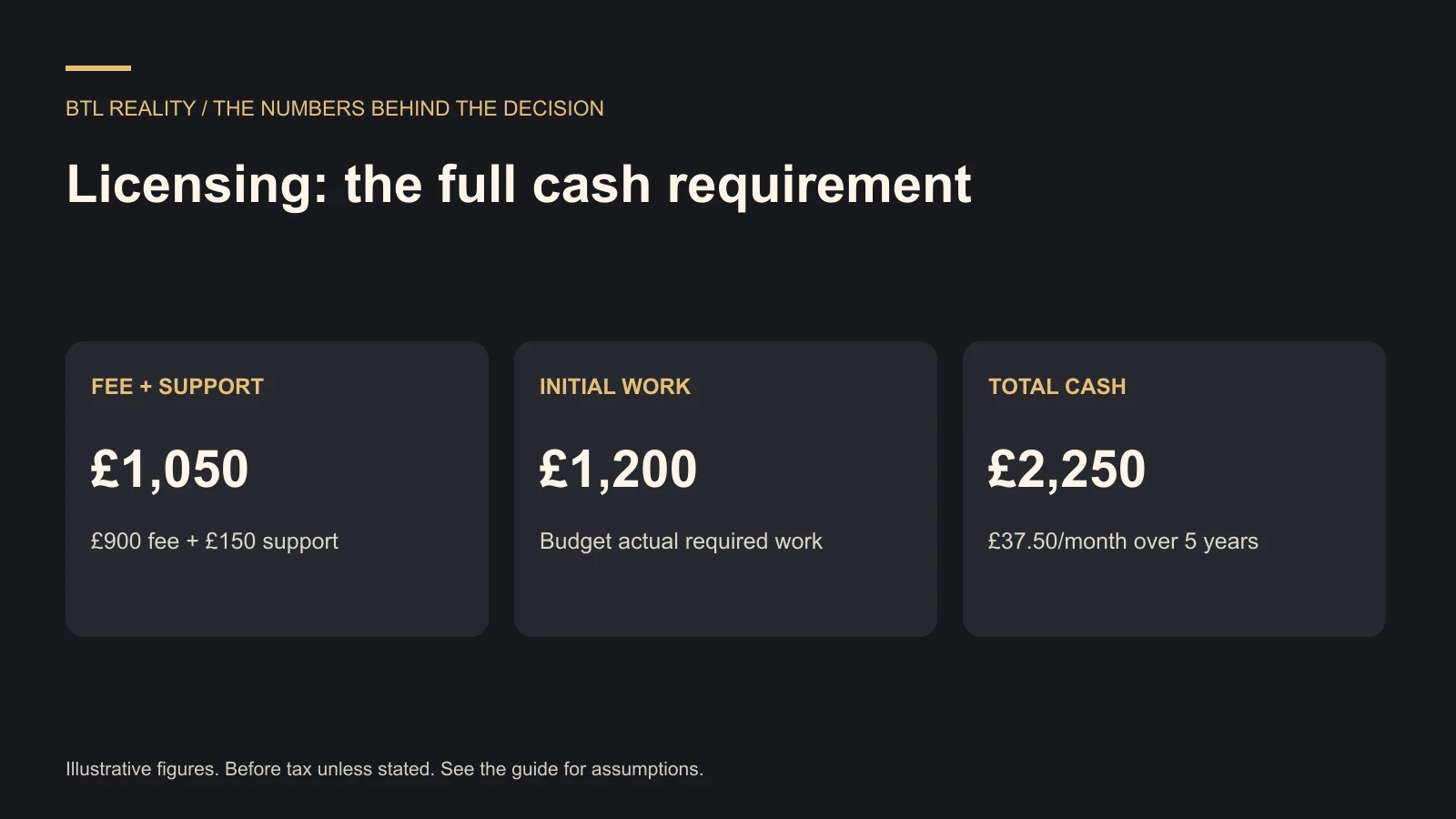
Consider an illustrative property with a £900 licence fee, £150 of application support and £1,200 of initial work. The total initial cash allowance is £2,250. Spread across a five-year budgeting period, that is £37.50 a month. This is an example, not a quote or a statement that your licence will last five years.
The fee and application support alone amount to £17.50 a month over that same period. Showing both numbers avoids suggesting that all the work is a recurring licensing charge. Some repairs might have been necessary even without a scheme. For the purchase decision, however, you still need the cash to complete them.
Budget the licensing cash requirement
Illustrative costs. The selected period is a budgeting assumption, not the length of a licence or a payment plan. Work may be necessary independently of licensing.
JavaScript is required to change the results. The figures above show the default worked example.
Upfront cash and monthly economics are different
Spreading £2,250 over sixty months is useful for comparing investments, but it does not let you pay an electrician over sixty months. If the costs arrive before the first rent, your cash budget must cover them at that point. The calculator's monthly figure is an economic equivalent, not an offered payment plan.
Suppose a property is expected to leave £250 a month before tax and before these costs. Subtracting the £37.50 monthly equivalent leaves £212.50. That change may be manageable, but it matters when comparing two otherwise similar deals. A thin margin should not be described as comfortable because the cost occurs only once.
Enter the genuine upfront requirement into the buy-to-let deal calculator. Avoid counting the same repairs twice under refurbishment and licensing work. Keep ongoing maintenance, future renewals and contingency separate from the initial figures. Your accountant can advise how individual expenses should be treated for tax.
Who manages the application and the conditions?
Agree responsibilities with your letting agent in writing. A useful instruction names the person who gathers documents, submits the application, checks progress, responds to council queries and keeps the final licence. It should also identify who monitors any deadlines or continuing conditions after the licence is granted.
Ask whether the service is included in the management fee. If not, obtain the additional charge before authorising it. You want a complete price and a clear scope, not a vague promise to “sort compliance”. The letting-agent fees guide helps you compare the whole management agreement.
Keep your own accessible copy of the evidence even when an agent handles the work. If the agency relationship ends, a new manager should be able to understand the position without reconstructing it from disconnected emails. A property file with dates, documents and named responsibilities is considerably more useful than an inbox search during a problem.
How licensing should influence your buying decision
Do not use a licensing scheme as a shortcut for judging an entire area. Your decision still depends on the street, property condition, achievable rent, purchase price and total costs. A cheaper home outside a scheme can be a worse investment if it attracts weaker demand or needs more work.
Compare two complete cases. For each, show acquisition cash, pre-let work, annual operating costs, rent and cautious void assumptions. Then test whether you can absorb a cost overrun. If a £1,000 surprise would make the purchase impossible, the reserve deserves attention before the property search expands.
For wider changes, use the landlord rules hub. If you are still building a buying process, Starter Club is designed around developing your plan and asking questions along the way. It does not replace a council decision, qualified legal advice or a competent inspection.
Frequently asked questions
Does a single-family rental need a selective licence?
It can. Selective licensing is not limited to shared houses. Check the exact address and letting arrangement against the council's designation, rather than assuming that a family tenancy removes the requirement. The decisive evidence is the current scheme and any applicable exemption.
How do I find out whether my street is covered?
Use the council's official property-licensing map or address checker and read the scheme details. If the result is unclear, ask the licensing team for written confirmation. Save the response with your purchase documents and repeat the check if the transaction or intended use changes.
Is the licensing fee the same across England?
No. Obtain the current schedule for the particular council and scheme. Check payment stages, any stated discounts and extra administration costs. Do not build your budget from a fee quoted in an article about another authority, even when the properties look similar.
Can I rely on the seller saying the property is licensed?
Ask for the document and have your conveyancer check what it means for your purchase. Establish what application or notification will be needed under the new arrangements. A verbal assurance is not a substitute for the address, conditions, dates and named parties on the paperwork.
Does using a letting agent mean I can ignore licensing?
No. Agree the agent's role and obtain evidence of completed work. Delegating the administration is different from checking that the property has the correct arrangements. Keep copies yourself so that the compliance file remains usable if you change agents later.
Should I avoid every area with selective licensing?
Not automatically. Treat the requirements as part of the deal analysis, alongside condition, demand and financing. A transparent, fully costed purchase may still suit your plan. Walk away when the unresolved requirements or overall numbers exceed your resources, rather than relying on a blanket rule about whole towns.