Can Landlords Refuse Benefits or Families With Children?
October 3, 2026
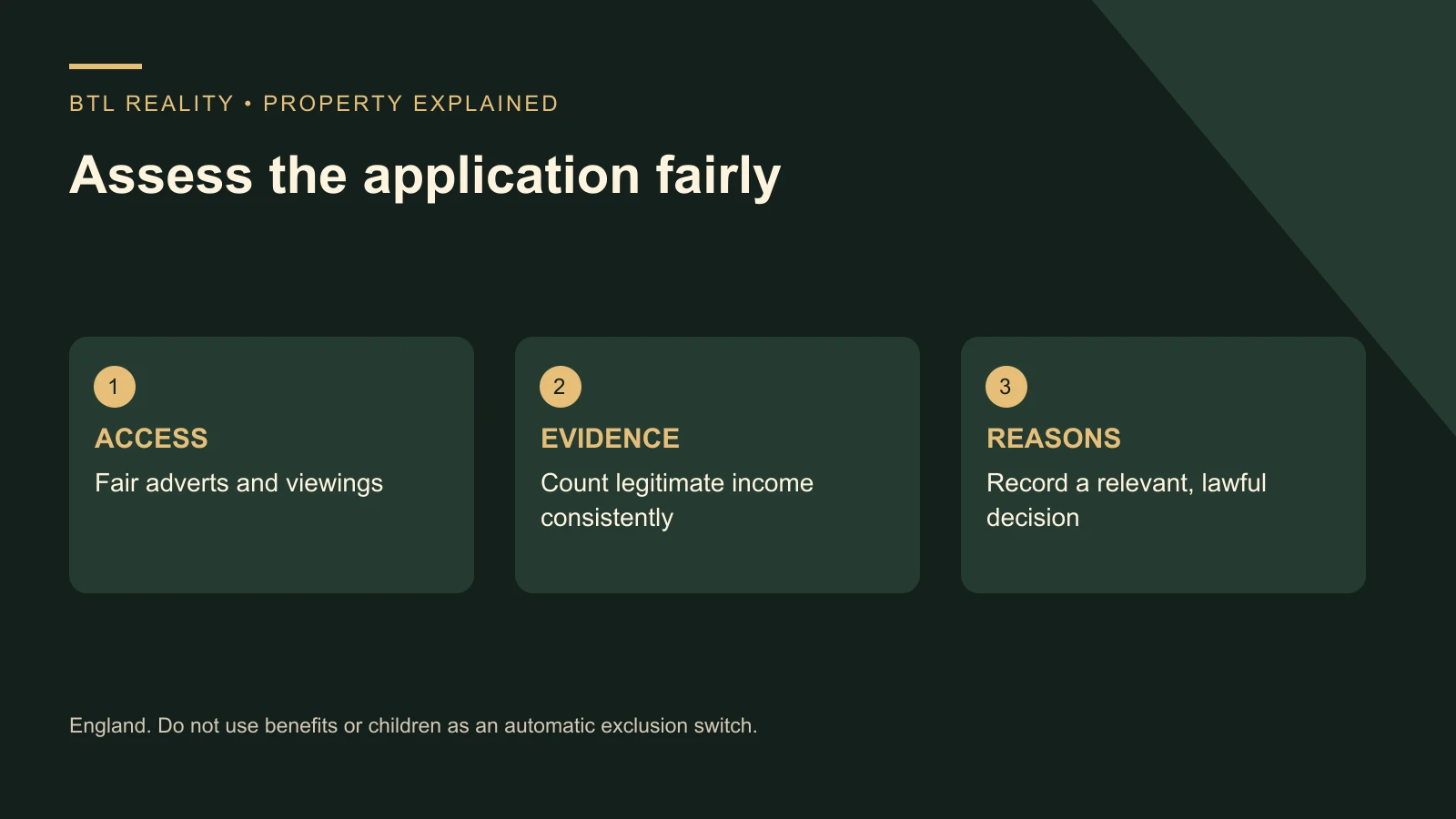
Landlords cannot exclude an applicant simply because they receive benefits or have children. England’s new rental-discrimination rules are part of the Renters’ Rights Act changes operating from 1 May 2026. You can still assess whether a household can afford the rent and whether occupation is lawful. You need a fair process based on the actual application, rather than a blanket ban disguised as a referencing policy.
For an investor, this is more than wording in an advert. It affects enquiries, viewings, affordability checks, instructions to agents and the reasons recorded when an application is declined. A professionally managed property should have a repeatable selection process that treats applicants consistently while protecting the business from avoidable losses.
This guide covers the rules for relevant assured tenancies in England. Other jurisdictions and tenancy arrangements require their own checks. The examples below illustrate a process, not a legal decision about an individual applicant.
What counts as rental discrimination?
The government’s landlord guide explains that the restrictions extend beyond signing a tenancy. Withholding information, blocking a viewing or disadvantaging an applicant because of benefits or children can all create problems. The rules also cover people acting for you, including agents and referencing businesses.
An advert saying “working professionals only” deserves a careful review if the actual intention is to exclude anyone receiving benefits. A neutral-looking form can cause the same problem if it automatically rejects a household after a benefits question. Changing the visible words while leaving the rejection rule in place does not fix the underlying process.
Ask a simple operational question: could this applicant reach the same assessment stage as another applicant with comparable finances? If the answer is no because of their benefits or children, investigate the rule before advertising again. Keep the assessment focused on relevant evidence, suitability and lawful occupation.
Can you still check affordability?
Yes. A fair assessment is not a requirement to accept rent that an applicant genuinely cannot afford. The important distinction is between considering their financial position and excluding a legitimate source of income because of a prejudice about the person receiving it.
GOV.UK’s benefits guidance says benefit income must be considered in the same way as other income in an affordability check. A referencing company cannot simply ignore it and then describe the resulting rejection as neutral arithmetic. The guidance also explains that a mortgage or superior lease ban is not an automatic escape from the discrimination rules.
For example, imagine two applications for a £1,000 monthly rental. Household A has £3,000 of relevant monthly income. Household B also has £3,000, comprising £2,200 from work and £800 from benefits. If your calculation counts all of A’s income but only £2,200 for B, you have changed the test before considering their wider circumstances.
This illustration does not say either household must be accepted. Actual affordability involves evidence, commitments and an appropriate assessment. It shows why the source of income must not become an arbitrary exclusion switch. Request proportionate information and avoid collecting sensitive detail that has no necessary purpose.
A useful referencing process
Set the written process before reviewing applicants. Record what evidence is needed, how different legitimate income types are considered and who reviews unusual cases. Do not let an automated pass or fail become the final answer when the underlying assumptions are unclear.
- Use the same relevant assessment stages for comparable applicants.
- Ask your agent how benefits, pensions and variable income are handled.
- Check why an application failed, rather than accepting an unexplained score.
- Record genuine property-capacity or licensing constraints separately from income.
- Explain decisions accurately without inventing reasons after the event.
If a guarantor is considered, do not automatically demand one solely because someone receives benefits. Review the reason, consistency and legality with your agent or adviser. A guarantor also needs an enforceable agreement; the existence of a name on a form is not equivalent to reliable financial protection.
Your preparation checklist
Tick the records you have checked. This is a working list, not a compliance certificate. Selections stay in this page only.
What about children and property suitability?
The official children guidance includes children who live at or visit a property. It does not let an owner assume that every family will cause damage or that adults are automatically preferable. A household can also change after a tenancy starts.
Some specific restrictions may be justified as a proportionate means of achieving a legitimate aim. Real overcrowding, licensing or safeguarding issues can require consideration. This is a narrow, fact-sensitive assessment, not a template excuse for saying no to every household with a child. The corresponding benefits rule does not have this same general justification exception.
Consider a property with an evidenced lawful occupancy limit. Assess the proposed number of occupants against the actual limit. Keep the licence, room information and decision record. That is a different exercise from declaring a property unsuitable for families because you would prefer quieter tenants or worry about wear to carpets.
Where a concern can reasonably be addressed, investigate the practical answer. A generic assumption about stairs, decoration or neighbours is a weak substitute for understanding the property. Obtain advice before relying on an exception, particularly where disability, equality duties or disputed safety issues are involved.
Does an insurance clause allow a ban?
There is a limited transitional insurance exception described in the government guidance. It concerns qualifying restrictions in an insurance contract that started before 1 May 2026. The exception ends when that contract ends or renews, and an applicant can ask to see it.
Do not assume that a broker’s old email, a mortgage condition or a general statement that “insurers dislike benefits” proves an exception. Read the current contract and dates. Before renewal, discuss compliant cover with a qualified broker so that your business does not depend on a temporary arrangement continuing indefinitely.
Record the outcome in the property file. A useful record identifies the actual policy, expiry date, relevant wording and professional advice received. If the exception no longer applies, update the advert, application process and agent instructions together. Otherwise the public advert can look compliant while the back-office screening remains wrong.
What should you ask your letting agent?
Delegation should improve consistency, not hide the process. Ask the agent to show you the advert template, enquiry script and referencing criteria. Find out whether any software automatically filters benefit recipients or families before a human sees their application.
Ask how they identify and correct mistakes. A good answer includes ownership, records and a route for reviewing an applicant’s challenge. “Our system has always done it this way” is not evidence that the process remains appropriate after a law change.
Then compare the service with the fee you pay. The cheapest management quotation may not be cheapest if it excludes meaningful compliance support or leaves you unable to retrieve essential records. Use the free property resources to examine the deal’s costs, and ask separate questions about what your agent actually does for those costs.
The commercial case for a wider, fairer application process
A rental business needs reliable occupancy and a sustainable relationship with the household. A blanket exclusion removes potential applicants without proving that the remaining group will pay more reliably. Good evidence is more useful than a stereotype.
Suppose an unnecessary restriction adds two weeks to a void at £1,000 monthly rent. Using an annualised weekly calculation, the lost gross rent is approximately £462: £1,000 × 12 ÷ 52 × 2. That excludes council tax, utilities and any other costs you bear while empty. It is an illustration of a commercial cost, not evidence that a particular screening policy causes a specific void.
Do not respond by lowering every assessment standard. Improve the standard: clear adverts, fair access, proportionate checks and decisions you can explain. Your property model should include realistic voids and maintenance regardless of who applies. The buy-to-let deal calculator helps separate the purchase case from assumptions about perfect occupancy.
Turn this into an operating system
Before the next advert goes live, check the full path from enquiry to tenancy. Remove obsolete wording, inspect automated rules and confirm that the agent has a documented review process. Keep copies of the material actually used, not just the template you intended to use.
If a complaint arrives, preserve the records and obtain appropriate advice. Do not rewrite earlier notes or ask an agent to create a more convenient reason. Understand the applicable rules, the applicant’s concern and any action needed to put the process right.
For broader investor education, Starter Club can help you build a structured plan and ask better questions of your professional team. Individual discrimination disputes and contested applications belong with a qualified adviser. Use the 2026 landlord rules hub to see how tenant selection fits alongside rent reviews, paperwork and the other reforms.
Frequently asked questions
Can a landlord say no DSS in 2026?
For relevant assured lettings in England, a blanket exclusion because an applicant receives benefits conflicts with the new rental-discrimination rules. Check the whole application process as well as the advert. Replacing the phrase with different words does not make an equivalent automatic rejection fair or lawful.
Can a landlord refuse a tenant who cannot afford the rent?
A genuine affordability assessment remains possible. Benefit income must not simply be ignored, and the test should use relevant evidence consistently. An invented affordability explanation for excluding a benefit recipient is different from a substantiated assessment of the applicant’s actual financial position.
Can a landlord refuse families with children?
There is no general right to exclude families because they have children. Specific, proportionate restrictions may require examination where a legitimate aim is involved, such as actual licensing or overcrowding issues. Take advice on the facts before relying on an exception or using a standard rejection policy.
Does my mortgage ban benefit tenants?
The official guidance says a discriminatory mortgage or superior-lease term is not an automatic justification for excluding applicants receiving benefits. Do not rely on an old condition without checking the new rules. Insurance has a separate, limited transitional exception with specific dates and conditions.
Am I protected if my letting agent makes the decision?
Do not assume that appointing an agent removes all responsibility or risk. The rules cover people acting for landlords. Ask how enquiries and referencing work, retain instructions and obtain advice if a complaint identifies a problem. Clear responsibilities and retrievable evidence are part of professional management.
Are these tenant-selection rules the same throughout the UK?
This guide addresses England’s relevant assured-tenancy rules. Wales, Scotland and Northern Ireland have different rental systems and legal frameworks. Check the property’s jurisdiction and tenancy type before applying a checklist or using a document designed for a different part of the UK.