Is a Studio Flat a Good Buy-to-Let Investment?
October 19, 2026
A studio flat can work as a buy-to-let when the layout, local demand, finance and ongoing costs all fit. A low purchase price and attractive gross yield are not enough. Small floor area, restrictive lending criteria or a high service charge can make the apparently cheap option more demanding than a conventional one-bedroom flat.
The key is to assess the exact studio rather than the label. This guide combines a property checklist with a cashflow example, showing what to verify before you rely on the rental return or an eventual refinance.
What are you actually buying?
A studio generally combines living and sleeping space in one main room, with kitchen and bathroom arrangements depending on the property. The practical question is whether the layout offers a usable home for the intended occupant, not whether the marketing description sounds modern.
Check usable floor area, storage, natural light, ventilation, heating, cooking space and the bathroom. Think about where someone would sleep, eat, work and keep belongings. A clever photograph can make one arrangement look spacious while hiding how little room remains once everyday furniture is in place.
Ask the surveyor and conveyancer to establish the relevant facts, including whether the unit's use and any conversion were properly authorised. Do not assume that an existing tenant, a separate door or a portal listing proves all planning, building-control or title matters are resolved.
There is no single mortgage size rule for every studio
Lenders set their own criteria for floor area, layout, tenure, construction and marketability. A minimum quoted by one lender is not a universal legal minimum or a guarantee of borrowing elsewhere.
For example, The Mortgage Works' property criteria specify a minimum internal floor area of 30 square metres for the relevant flat categories and require a studio to have a separate bathroom. That is a named lender's current criterion, with the rest of its assessment still applying.
Give a broker the measured area and actual layout early. If you need a particular mortgage to make the purchase work, confirm the route before spending heavily or entering a binding commitment. An estate agent's statement that the property is “mortgageable” does not identify the terms available to you.
Smaller does not always mean more affordable to own
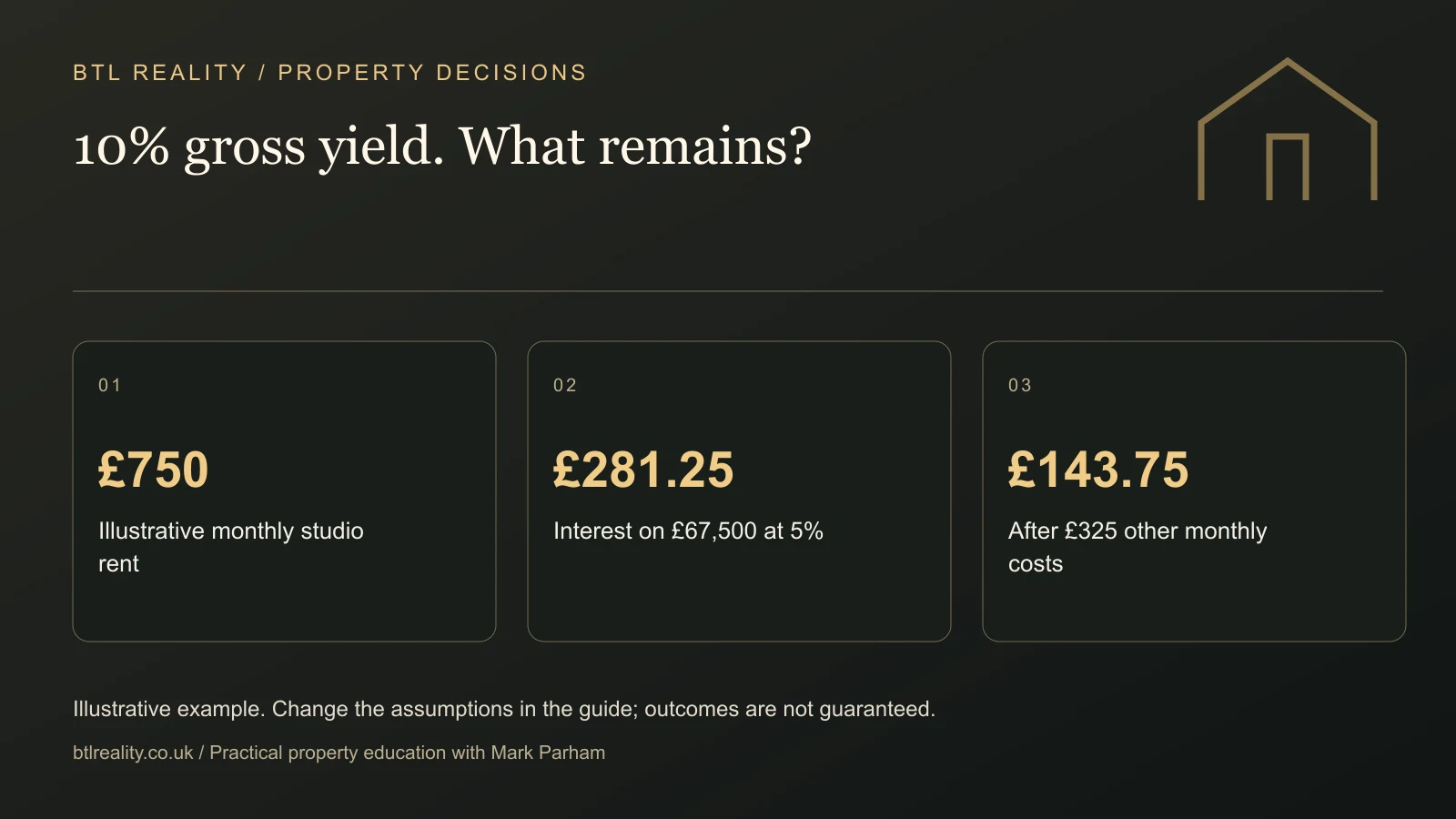
Imagine a studio priced at £90,000 with monthly rent of £750. Annual gross rent is £9,000, so gross yield is 10%. That headline can look substantially stronger than a larger flat elsewhere.
Assume a 75% loan-to-value interest-only mortgage at an illustrative 5% rate. The £67,500 loan costs £281.25 a month. If the service charge is £200 and other operating costs are £125, the cashflow before tax and exceptional work is £143.75 a month.
Increase the service charge to £300 and that falls to £43.75. The extra £100 monthly charge removes £1,200 a year, or nearly 70% of the initial routine surplus. The property still has the same 10% gross yield, demonstrating how little that measure says about spendable income.
Make the example your own
What does the studio leave after ongoing costs?
Use a realistic rent and check which expenses are already included in the service charge.
Interest-only scenario. Excludes tax, exceptional work, transaction costs and unentered vacancies. The chosen mortgage terms may not be available for the property. Illustrative only. Inputs stay in this page and are not saved or sent.
The model lets you change rent, service charge and interest assumptions. Include management, insurance, maintenance and void allowances in the other-cost line where appropriate. Check what the service charge already covers to avoid deducting the same expense twice.
A restricted mortgage can increase the deposit
At 75% loan-to-value, the £90,000 studio needs a £22,500 deposit. If the available route instead supports only 65%, the deposit becomes £31,500. That is £9,000 more cash before fees, transaction taxes, work and reserves.
These percentages are examples, not a statement of typical studio lending. Your actual options may differ or no suitable mortgage may be available. The point is to use the mortgage you can obtain, rather than assuming every small flat qualifies for the maximum leverage in an online calculator.
Cash purchasing avoids an immediate mortgage application but does not remove resale or future refinance questions. Read our guide to buying with cash and mortgaging later if that is your proposed route.
The service charge and lease need a full review
Obtain the current service-charge budget, recent accounts, reserve information and details of planned work. A small internal area does not necessarily mean a small contribution to lifts, roofs, external walls or shared facilities.
Ask your conveyancer to explain the lease term, use restrictions, ground-rent provisions where applicable and how costs are allocated. Check whether letting is permitted on the terms you intend and whether consents are needed. A plan for short stays or serviced accommodation should not be assumed compatible with ordinary residential letting rights.
Review potential major works separately from the annual charge. The major-works guide explains why future cash demands can change the return even where the current budget looks manageable.
Test the tenant market at the correct rent
Studios may appeal to people who value an independent space at a lower total rent than a larger flat. The strength of that proposition depends on local alternatives, employment, transport and what is included in the cost.
Compare the studio with rooms in shared accommodation and with one-bedroom flats, not just with other studios. If a one-bed costs only slightly more each month, applicants may prefer the extra separation. If the studio has a strong location or included amenities, those features may support demand, but the evidence needs to be local.
Ask agents about achieved rents, enquiries from suitable applicants, likely letting time and turnover. Avoid taking the highest advertised rent as the default. A £50 monthly error in the expected rent is material when the modelled surplus is only £143.75.
Make the layout and specification work honestly
Storage, durable finishes and a sensible furniture layout can improve the experience without expensive cosmetic work. A room that feels ordered and usable may be more appealing than one packed with oversized furniture to suggest multiple functions it cannot comfortably support.
Check the cost and practicality of maintaining the kitchen, bathroom and heating. Access for repairs can be awkward in compact layouts. Replacement appliances need to fit the available space, connections and any relevant requirements.
Do not try to turn a studio into a nominal one-bedroom flat by adding a partition without professional advice. Light, ventilation, access, safety, planning, building regulations and lease consent can all be relevant. A new label does not automatically create a better or lawful home.
Resale needs its own evidence
Your eventual buyer may depend on mortgage options that are more limited for small units. Some owner-occupiers may prefer a separate bedroom, while some investors will focus heavily on service charges and rent. Understand the likely buyer pool before assuming an easy exit.
Look at completed sales of similar-sized units with comparable leases and charges. A larger one-bed in the same building may not support the valuation you want. Ask how long comparable transactions took and whether funding or lease issues affected them.
A narrow resale market is not automatically a reason to reject the property, but it needs to be priced and planned for. Keep a holding reserve and avoid a strategy that requires sale or refinance on an exact date without alternatives.
Compare the studio with the next realistic option
If you have enough cash to choose between a studio and a one-bed, compare total purchase cash, net income and the remaining reserve. The cheaper unit may leave more money available, but only if extra financing constraints or works do not absorb the difference.
For an illustrative one-bed at £120,000 with £800 rent, £200 operating costs and 75% interest-only finance at 5%, cashflow is £225 monthly before tax. That exceeds the studio example's £143.75, although the deposit is £7,500 higher. Neither comparison alone decides suitability; it clarifies the trade-off.
Use the buy-to-let deal calculator for a complete cash appraisal and the one-bed versus two-bed guide for the same incremental thinking across larger units.
Put the constraints into the buying brief
Write down your acceptable floor area, mortgage route, lease position, maximum ongoing charges and evidence of demand. Record what happens if the accepted rent or valuation is lower than expected. A disciplined brief prevents a low asking price from deciding the strategy for you.
BTL Reality's Done For You service sources properties against an agreed brief. Studios can be considered where they suit that brief, but there is no need to force one into the plan simply because the entry price looks accessible.
The right studio is one that works as a home, as a financed asset where borrowing is used, and as an investment after realistic costs. All three perspectives deserve attention before completion.
Frequently asked questions
Can I get a buy-to-let mortgage on a studio flat?
Potentially, if the property and your circumstances meet a lender's criteria. Floor area, bathroom arrangement, tenure, construction and marketability can matter. Ask a broker to assess the specific unit early, rather than relying on a general claim that studios can or cannot be mortgaged.
Is there a universal minimum studio size for mortgages?
No single lender minimum applies across the whole market. Different lenders set different requirements, and meeting a floor-area threshold does not guarantee approval. Confirm the measured area and layout, then ask which current products could fit the complete property and application.
Does a separate bathroom matter to a lender?
It can. The Mortgage Works is one example of a lender whose published studio criteria require a separate bathroom. Other lenders have their own requirements. Treat layout as part of the specific lending assessment and the tenant's practical experience, not merely a marketing description.
Can service charges remove the apparent yield advantage?
Yes. Gross yield ignores service charges and other costs. In our illustration, an extra £100 monthly service charge reduces cashflow from £143.75 to £43.75 before tax. Review current charges, planned work and what is included before relying on an attractive gross percentage.
How should I investigate studio rental demand?
Gather recent comparable achieved rents, likely letting times and feedback from local agents. Compare studios with one-bed flats and shared accommodation at similar total monthly costs. Check the condition, layout and location of the evidence rather than assuming all compact units serve the same market.
What affects the eventual resale market?
Mortgage availability, floor area, lease terms, service charges, building condition and local demand can all matter. Review comparable completed sales and keep an alternative holding plan. A property that lets successfully today can still take time to sell at the price you hope to achieve.
Put the next step into practice
Use the free tools to test your numbers, then choose the level of support that fits your next decision.