One-Bed or Two-Bed Flat: Which Is the Better Buy-to-Let?
October 18, 2026
A two-bedroom flat is not automatically a better buy-to-let than a one-bedroom flat. The extra bedroom needs to earn its place in the purchase price, financing costs, service charges and local demand. A well-located one-bed can outperform a larger flat with expensive common areas or a weak rental premium.
The useful comparison is between two actual opportunities serving identifiable tenants. Start with the extra rent the second bedroom can realistically command, then subtract the extra costs and cash required. This guide gives you a practical comparison model rather than a rule that one property type always wins.
Start with the tenant, not the bedroom count
Ask who rents each type of property in the specific area. A one-bed close to a hospital, employment centre or transport connection may suit an individual or couple who values convenience. A two-bed may appeal to a small household, a couple wanting a workspace or sharers where the tenancy and property are suitable.
Those are hypotheses to investigate, not guarantees of demand. Speak to local letting agents about completed lets, time to secure a tenant, competing stock and the features applicants actually request. A second room too small for the intended use may not support the rent premium shown in an optimistic advert.
Collect comparisons with similar condition, parking, furnishing, outdoor space and location. Comparing a tired one-bed with a recently refurbished two-bed confuses the value of the bedroom with the value of the specification.
Compare the extra rent with the extra price
Imagine a one-bedroom flat costing £120,000 with expected monthly rent of £800. A two-bedroom flat costs £150,000 and is expected to rent for £1,000. Both have an 8% gross yield: annual rent divided by purchase price.
The second bedroom costs an extra £30,000 and adds £2,400 annual gross rent. On that narrow comparison, the incremental gross yield is also 8%. But the calculation has not yet included service charges, finance, maintenance or tax.
Now suppose the two-bed only rents for £900. The extra annual rent is £1,200, giving a 4% incremental gross return on the £30,000 price difference. The whole property's headline yield can still look respectable while the extra capital earns a weaker return.
This is why a useful viewing question is “What supports the rent premium?” rather than “Is two bedrooms better?” Evidence of achievable rent should come before a preferred answer.
Make the example your own
Does the extra bedroom pay its way?
Compare an interest-only model. Monthly costs should include service charges, maintenance, management and void allowances as appropriate.
Excludes tax, buying costs, exceptional work and capital value changes. Finance eligibility and terms may differ. Compare total cash committed separately. Illustrative only. Inputs stay in this page and are not saved or sent.
Use actual monthly operating costs for each flat, including service charges and a realistic maintenance and void allowance. The tool compares an interest-only financing scenario before tax. It does not assess mortgage eligibility or predict future rents.
A worked comparison after costs and finance
Return to the £120,000 one-bed at £800 rent and the £150,000 two-bed at £1,000. Assume both are purchased with 75% loan-to-value interest-only mortgages at an illustrative 5% rate. The loans are £90,000 and £112,500, producing monthly interest of £375 and £468.75.
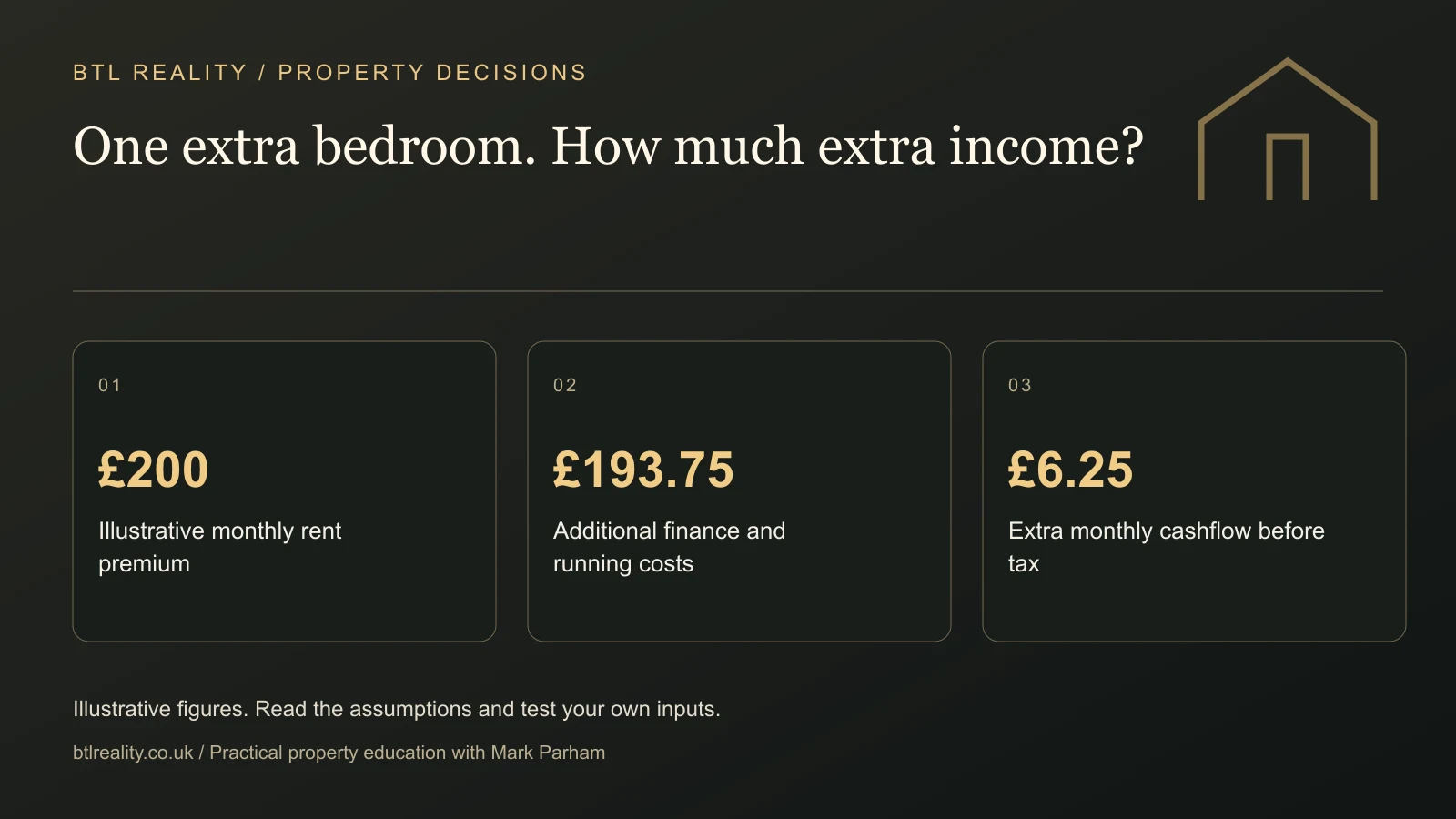
Suppose ordinary monthly operating costs are £200 for the one-bed and £300 for the two-bed. Monthly cashflow before tax and exceptional work is then £225 and £231.25 respectively. The larger flat produces only £6.25 more each month despite its £200 higher rent.
Deposits are £30,000 and £37,500. You commit an additional £7,500 deposit for £75 a year of additional routine cashflow in this example. That is a 1% incremental annual cash return on the extra deposit, before differing purchase costs and all remaining risks.
The example does not prove the one-bed is the better purchase. The two-bed might offer stronger local demand, a different exit market or a better long-term fit. It shows why “£200 more rent” is not the same as “£200 more income”.
Calculate the rent premium needed to stand still
In the example, the larger loan costs an extra £93.75 a month and operating costs are £100 higher. The two-bed therefore needs £193.75 more monthly rent simply to match the one-bed's routine pre-tax cashflow.
With the one-bed at £800, the two-bed needs £993.75 to reach that cashflow break-even point. At £1,000 it is only just ahead. At £950 it is behind by £43.75 a month. Small differences between asking and achieved rent now matter a great deal.
This calculation is especially useful when negotiating. If the seller wants a larger premium, ask what supports it: better condition, lower future work, stronger demand or a reliable rental difference. “Two beds always sell better” is not enough evidence for your specific investment.
The free rental yield calculator helps compare headline returns, while the buy-to-let deal calculator brings purchase cash and operating assumptions together.
Service charges can reverse the result
Look at actual accounts and budgets rather than a rounded figure in the listing. Understand what the charge covers, how it has changed and whether the building has significant work planned. A gym, lift or concierge may support demand, but also creates operating and maintenance obligations.
A £100 monthly difference is £1,200 a year. Against the £2,400 gross rental premium in the example, it consumes half the extra rent before additional mortgage interest. A large one-off contribution can be more significant still.
Read our guide to buying a flat with major works planned before treating the current service charge as the complete cost of ownership. Lease terms, reserve funds and planned work deserve their own review with the conveyancer.
Vacancy and tenant turnover need evidence too
A larger flat does not automatically mean longer tenancies, and a one-bed does not automatically mean constant turnover. Ask local agents about the actual tenant market, including how quickly comparable properties let at realistic prices.
Model the cash effect of a gap. One empty month in the one-bed example removes £800 gross rent; in the two-bed it removes £1,000. Some variable costs may fall, but mortgage interest, service charges and other obligations can continue.
If you expect the two-bed to avoid an extra month's vacancy each year, make that assumption explicit and ask what supports it. Do not quietly give your preferred property perfect occupancy while stressing the alternative. Consistent assumptions make the comparison useful.
Check layout, lease and letting suitability
Bedroom count is a blunt measure of usable space. Look at natural light, storage, circulation, noise, bathroom access and whether a second bedroom can function for the tenant you have in mind. An awkward conversion may disappoint both renters and future buyers.
Review lease restrictions and the proposed occupancy with your conveyancer and agent. A plan to let to sharers may raise different licensing or management questions from a single-household let, depending on location and occupation. Do not assume an extra room can be rented separately without further checks.
The property also needs to meet the lender's requirements. Floor area, construction, tenure, surrounding uses and building issues may matter independently of the bedroom count. A stronger rent forecast cannot resolve an unacceptable security.
Compare total cash committed and the exit
Include deposit, transaction taxes, legal and mortgage fees, initial work, furnishing and reserves for both options. A comparison based only on the deposit understates the cash at risk and can exaggerate the return.
Then ask who could buy each flat when you sell. Owner-occupiers and investors may value different features. Look for evidence of completed sales of genuinely comparable units and investigate the lease length, service-charge position and building condition that future buyers will also review.
Capital growth should be a scenario rather than the number that rescues weak monthly economics. If you assume one flat will grow faster, explain why and test the outcome if both grow at the same rate or values fall. Your holding budget should remain visible throughout.
Make the choice fit your wider plan
For a first rental, a simpler property with manageable costs may be more valuable than squeezing in another bedroom. For an established portfolio, you may be seeking a different tenant market or reducing dependence on one type of unit. The best purchase depends on that purpose.
Write a brief decision note comparing local demand, verified rent, full cash required, monthly cashflow, major risks and the exit. Mark which figures are evidenced and which remain assumptions. This makes it easier to revisit the decision objectively after a survey or mortgage valuation.
BTL Reality's Done For You sourcing service searches against an agreed brief. A useful brief describes the income, cash commitment and complexity you can accept rather than insisting on a bedroom count before the market evidence has been considered.
Frequently asked questions
Is a two-bedroom flat always a better investment?
No. It may produce more rent, but can also require a larger deposit, higher mortgage interest and greater service charges. Compare the full economics and local tenant demand for the actual properties. The extra bedroom needs to justify its additional cost within your investment plan.
How much extra rent justifies paying more for a second bedroom?
Start with the additional finance and operating costs, then consider the return required on extra cash invested. In our illustration, £193.75 more rent is needed just to match routine cashflow. Your answer depends on the price difference, borrowing terms, charges and evidenced achievable rents.
Should I compare gross yield or net cashflow?
Use both, but recognise what each measures. Gross yield is a quick comparison of rent and price. Net operating income and cashflow show what remains after more of the costs. Also compare total cash committed, tax and one-off expenditure before deciding which investment is stronger.
Can a one-bedroom flat be easier to let in some locations?
Yes, if it matches local demand and is priced appropriately. Employment, transport, competing supply and the property's condition can matter more than an extra room. Ask for recent comparable letting evidence instead of applying a national assumption to a specific street or building.
Do service charges change the comparison?
They can change it substantially. A higher charge may consume much of the rent premium, while planned works can create additional cash demands. Review the lease, accounts, budgets and reserve arrangements. Compare what is included so you do not double-count costs or omit obligations.
What local evidence should I collect before choosing?
Collect recent comparable achieved rents, likely letting times, tenant profiles, completed sale evidence and accurate building costs. Check condition, layout, lease and finance suitability too. Record the source and date of each estimate so a confident sales pitch does not become an unsupported forecast.
Put the next step into practice
Use the free tools to test your numbers, then choose the level of support that fits your next decision.