Why Fixed Mortgage Rates Rise When Bank Rate Stays the Same
September 22, 2026
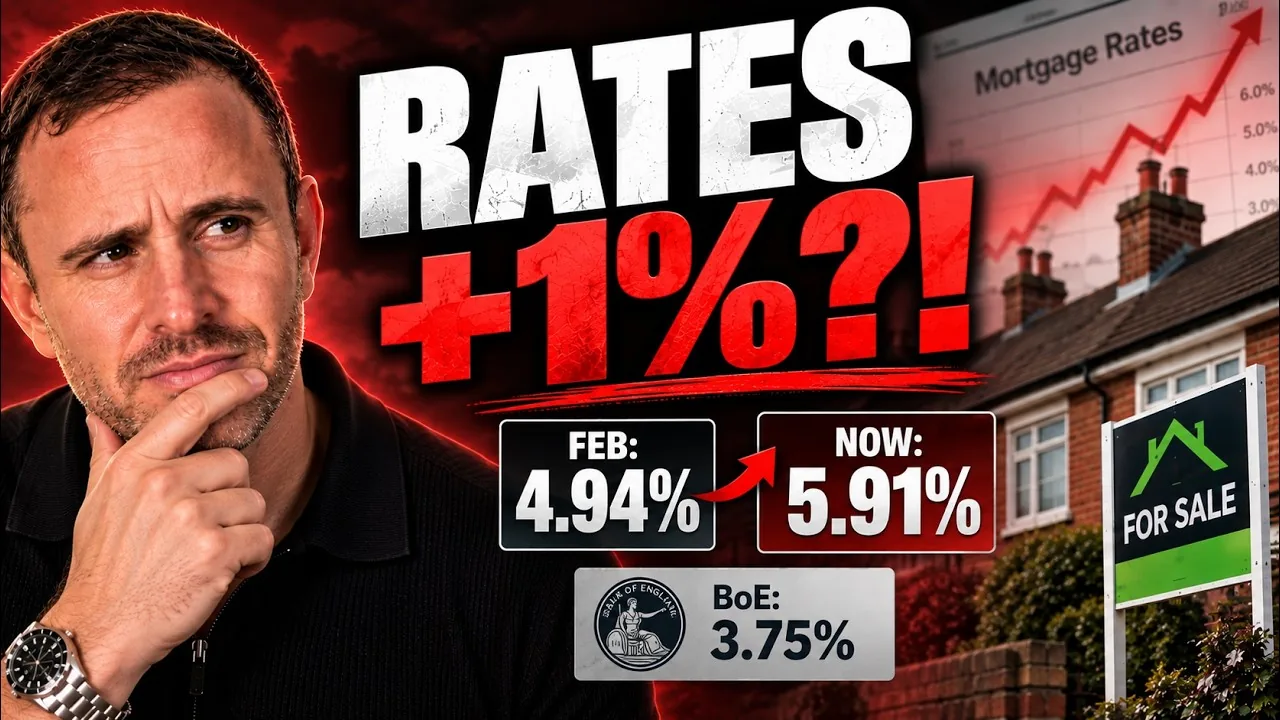
A fixed mortgage can become more expensive even when the Bank of England leaves Bank Rate exactly where it was. That sounds strange if you’ve been treating the central-bank announcement as the only number worth watching, but it’s exactly the distinction I wanted to explain in my September video.
The lender is offering to fix the price of your borrowing for several years. It has to think about the cost and risk of doing that over the whole period, not just the interest rate in force on the day you apply. Market expectations can change before the Bank of England makes another decision.
I’ve been investing in UK property for around 15 years. Across my portfolio I have close to £2 million of mortgage debt, so this isn’t an abstract discussion for me. A relatively small movement in borrowing costs can remove a substantial amount of annual cash flow.
You can also watch my video on rising UK fixed mortgage rates.
The difference between Bank Rate and your mortgage rate
Bank Rate is the Bank of England’s policy rate. It influences borrowing conditions, but it isn’t a universal price that every borrower pays. A mortgage lender also has to consider funding, credit risk, capital, operating costs, competition and the terms of the particular product.
A tracker and a fixed mortgage therefore behave differently. A tracker follows the reference rate specified in its contract. A fixed deal holds your contractual rate for the agreed period, even though the market’s view of future rates can change around you.
If you’re already on a fixed deal, a rise in newly advertised rates doesn’t automatically change your existing payment. It becomes relevant when you need a new product, refinance, move or reach the end of the deal, subject to the terms of your mortgage.
That’s the first distinction I’d make when reading a headline. Are we talking about new offers, an existing variable rate or the cost a borrower will face after their current fix ends? Those are related questions, but they aren’t the same question.
Why swap rates matter to fixed mortgages
One of the markets behind fixed mortgage pricing is the interest-rate swap market. In simple terms, swaps allow participants to exchange different forms of interest payments and manage exposure to changing rates. Lenders can use that market when managing the risk of offering fixed-rate borrowing.
I don’t think you need to become a trader to understand the practical effect. If markets start expecting interest rates to stay higher for longer, the cost of fixing money over a period can rise. Lenders may then raise mortgage offers before Bank Rate actually changes.
Swap rates aren’t a perfect prediction of what the Bank of England will do. They reflect market pricing and risk, and mortgage prices aren’t determined by swaps alone. But they help explain why the price of a new five-year fix can move while the policy rate stays still.
The reverse can happen too. If expectations improve and relevant funding costs fall, lenders can reduce fixed offers ahead of a Bank Rate cut. Waiting for the central bank to move first means you may miss what has already happened in mortgage pricing.
What changed between February and September 2026?
The figures I discussed in the video were an average five-year fixed rate of 4.94% in February and approximately 5.91% on 21 September, attributed there to Moneyfacts. Treat those as the dated comparison used in the video, not a live quote or a rate available to every borrower.
The difference is 0.97 percentage points, or 97 basis points. That’s almost one percentage point; it isn’t a 1% proportional increase in the old rate. Being precise about that language helps when we turn the movement into money.
The Bank of England’s February decision held Bank Rate at 3.75%, with four committee members preferring a cut. By September, the policy rate was still 3.75%, but three members preferred an increase. The same headline rate sat alongside a very different debate about the next move.
The September Monetary Policy Summary and Minutes also described a tightening in financial conditions and a rapid effect on mortgage pricing. It reported quoted two-year fixed mortgage rates around 95 basis points above their pre-conflict level.
That official comparison concerns a specific quoted-rate measure and period. It shouldn’t be treated as identical to every product average in the video. What it supports is the underlying point: mortgage pricing had moved significantly without a corresponding rise in Bank Rate.
Energy prices change the outlook, not just today’s bill
In the video, I discuss the Middle East conflict and energy costs as important reasons for the changed inflation outlook. More expensive energy can affect households and businesses directly, while also influencing expectations about inflation and future monetary policy.
Lenders don’t have to wait for the next decision before responding. If the expected path of rates changes, the market price of fixing exposure can change now. That is why a quiet day for Bank Rate can still be an expensive day for someone arranging a mortgage.
Market probabilities are especially easy to misuse. A reported chance of a future increase is a snapshot of pricing under current conditions, not a commitment by the committee. I wouldn’t build a purchase on the assumption that one probability quoted during a news cycle will remain valid.
For the broader policy backdrop, my September Bank of England update covers the decision itself. Here, the useful question is how that backdrop reaches the payment on the property you’re considering.
What a higher rate means on a repayment mortgage
Let’s use the rates from the video as an illustration. On £200,000 borrowed over 25 years, a repayment mortgage at 4.94% costs approximately £1,162 a month. At 5.91%, the payment is approximately £1,278. The increase is about £115 a month, allowing for rounding.
These calculations assume monthly payments, an unchanged 25-year term and no fees added to the loan. They illustrate the rate difference, rather than quote a lender’s product. Actual payments depend on the loan terms and how the lender calculates them.
At £300,000, using the same assumptions, the difference is approximately £173 a month. At £500,000, it’s about £288. The interest-rate movement is the same, but the cash impact grows with the amount borrowed.
If you’re refinancing an existing mortgage, use the balance and remaining term at that point. Extending the term can reduce the monthly payment, but it changes the comparison and can increase total interest paid. A lower payment doesn’t necessarily mean cheaper borrowing overall.
Interest-only borrowing makes the cash-flow effect clearer
Many buy-to-let investors, including me, use interest-only borrowing. The monthly interest calculation is easier to see because it doesn’t include scheduled repayment of the principal. The debt still needs to be dealt with under the mortgage terms.
An extra one percentage point on £100,000 of borrowing is £1,000 a year of additional interest. On £300,000, it is £3,000 a year, or £250 a month. On £2 million, it is £20,000 a year.
In my video, I explain that my average borrowing costs have moved from around 3% towards 6% as mortgages have refinanced over recent years. On approximately £2 million of debt, that three-percentage-point difference equates to about £60,000 a year of extra interest.
That’s the scale of the change I’m dealing with. It doesn’t mean every loan changed rate on the same day, or that £60,000 is a separate verified accounting total for a particular year. It’s the arithmetic showing what that change in average cost means across that amount of debt.
Higher rent doesn’t automatically restore the margin
Rents have increased during this period, which can help. But I can’t assume that rental income will rise at the same speed as a mortgage payment, or that every property will achieve the increase I’d like.
A deal bought when finance was cheap can feel very different at refinance. The original purchase price hasn’t changed, yet the amount left after costs may be much smaller. This is why I keep returning to the numbers that exist when I’m making the decision.
For an individual purchase, I’d put the achievable rent beside a current finance illustration, management, maintenance, voids, insurance and other applicable costs. Then I’d look at a less comfortable scenario. If the investment needs a rate cut to become viable, that dependency deserves attention before I buy.
My article on buy-to-let mortgage rates and cash flow explores that relationship. An average mortgage headline helps explain the environment; it doesn’t replace the quote and cost schedule for your own deal.
What does this mean for house prices and negotiating?
Buyers usually have a monthly budget. If borrowing costs more, they may need a bigger deposit, more income or a cheaper property. That can restrict purchasing power without automatically causing a house-price crash.
The September Rightmove update also showed buyers had more choice and enquiries were lower than a year earlier. I covered that separately in my Rightmove September index article. More competing properties can make a realistic conversation about price easier.
As an investor, I like being able to negotiate. But a discount doesn’t cancel a higher mortgage bill. I still want an okay house on an okay street at a price that leaves enough room after finance and running costs. The apparent opportunity and the extra cost have to be assessed together.
Could fixed mortgage rates come down before Bank Rate does?
Yes, the pricing mechanism can work in that direction too. If inflation expectations ease and markets expect less restrictive policy, relevant funding costs may fall and lenders may reduce new fixed offers. Competition between lenders also matters.
I don’t know when that will happen or how far rates will move. The sensible distinction is between understanding the mechanism and pretending to know the outcome. A forecast is useful for testing a plan; it isn’t a substitute for a plan that can survive being wrong.
If you’d like to discuss your own investment numbers, book a free 30-minute strategy call. You can also explore the Starter Club or Done For You service. Watch the actual cost of borrowing available to you, not just the headline Bank Rate.