RICS September 2026: Weaker Buyers, Stronger Tenant Demand
October 8, 2026
Buying a property and letting it are two different markets. The September 2026 RICS survey is a useful reminder: buyer enquiries weakened while tenant demand increased. For a buy-to-let investor, that combination deserves attention. It does not remove the need to check the street, the building and the borrowing.
A quieter sales market can give you time to investigate an opportunity properly. It cannot tell you whether the asking price is fair or whether the advertised rent will arrive. This update separates the new survey findings from a practical purchase example, then gives you a tool to test your own assumptions.
What does the latest RICS survey actually show?
The September RICS report records buyer enquiries at -22, agreed sales at -18, tenant demand at +23 and near-term rent expectations at +37. These are survey net balances, not percentage changes in enquiries, sales or rents. The monthly lettings figures are not seasonally adjusted.
The methodology says headline readings cover England and Wales; Scotland and Northern Ireland are collected separately. A net balance subtracts the proportion reporting a decrease from the proportion reporting an increase. It describes the breadth of sentiment, not the size of a change.
That distinction matters when you see a dramatic chart on social media. You cannot take a survey balance and increase your proposed rent by that percentage. Nor can you apply it as a discount to a seller's asking price. Your spreadsheet needs property-specific evidence.
A slower sales market does not automatically mean a bargain
An asking price is an invitation to negotiate. It is not an independent valuation. If a house was advertised at £165,000 and later reduced to £150,000, you have not proved a £15,000 discount. The first price might simply have been too high.
Start with comparable completed sales, the condition of those properties and the differences that affect their usefulness as comparisons. An extra bedroom, a short lease, structural work or an awkward location can matter more than the headline reduction. Ask how long the property has been marketed and whether an earlier sale fell through, then investigate the answer.
Keep two separate numbers in your analysis: the price you might agree and the value you can support with evidence. Do not make a future refinance depend on the higher number until the relevant lender has assessed it. Our latest house-price and refinance example explains why paper equity and available cash can give very different answers.
Worked example: what does a £7,500 lower price really buy you?
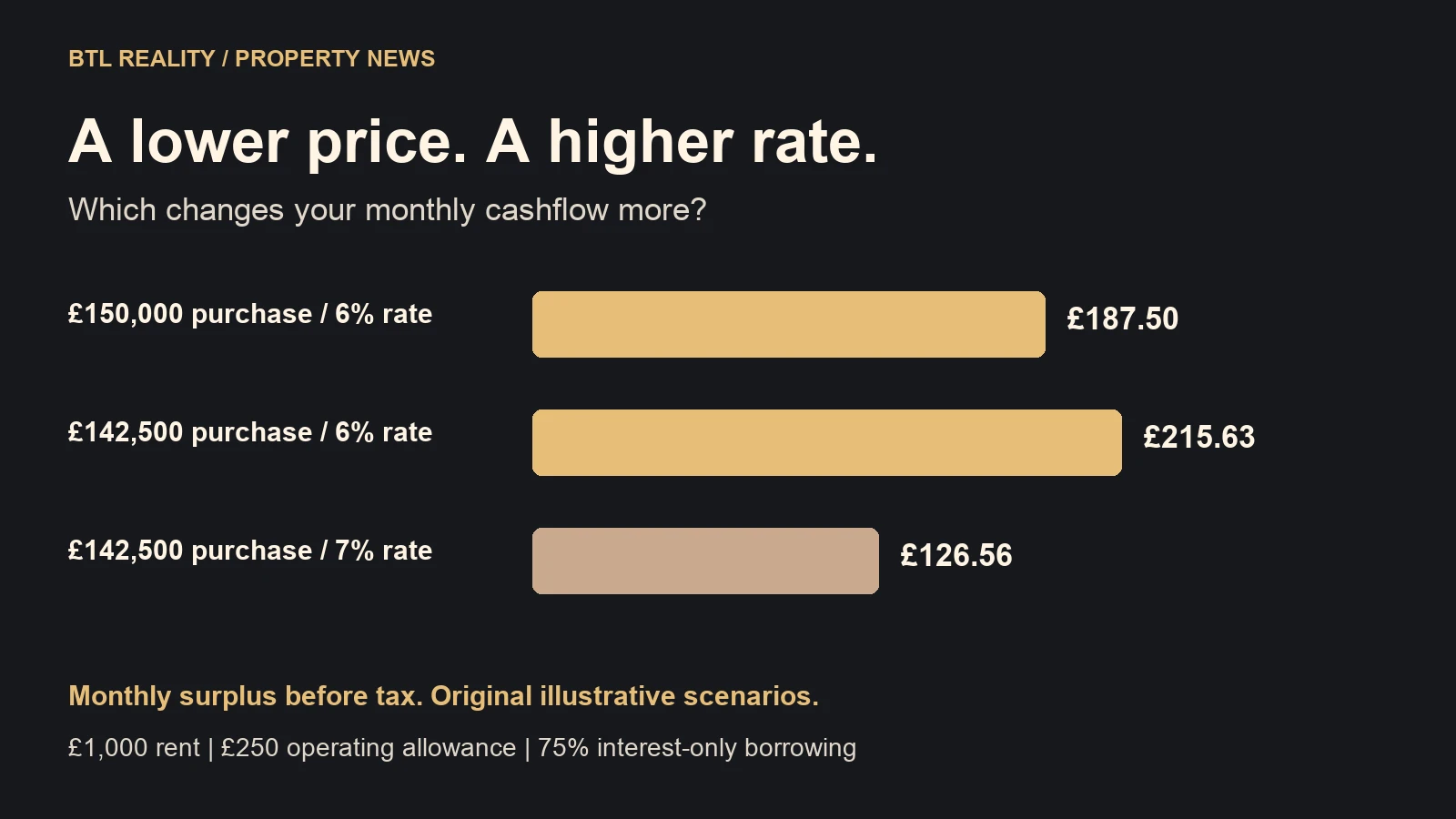
Consider a fictional single-let property renting for £1,000 a month. Compare a £150,000 purchase with a negotiated £142,500 price. Assume an interest-only mortgage at 75% of the actual purchase price, a 6% interest rate and a £250 monthly allowance for operating costs and voids. These are our modelling assumptions, not RICS forecasts, lender offers or typical local rents.
| Price and mortgage rate | Deposit only | Loan | Monthly interest | Monthly surplus before tax |
|---|---|---|---|---|
| £150,000 at 6% | £37,500 | £112,500 | £562.50 | £187.50 |
| £142,500 at 6% | £35,625 | £106,875 | £534.38 | £215.63 |
| £142,500 at 7% | £35,625 | £106,875 | £623.44 | £126.56 |
Scroll sideways on smaller screens. Scenarios are not valuations, mortgage quotes or forecasts. Costs are detailed below.
The £7,500 price reduction lowers the cash deposit by £1,875 because the assumed lender also advances £5,625 less. Monthly interest falls by £28.13 after rounding. The lower purchase price helps, but it does not put the entire headline discount back into your bank account on completion.
There is another reason to keep the assumptions visible. At £142,500 and a 7% mortgage rate, monthly interest becomes £623.44 and the modelled surplus falls to £126.56. A one percentage point rate increase more than reverses the cashflow benefit of negotiating the lower price at 6%.
The surplus is before tax and exceptional spending. It excludes purchase tax, legal costs, survey, refurbishment, finance fees and selling costs. It also assumes the £250 operating allowance is sufficient. For a full purchase budget, enter the property into the buy-to-let deal analyser rather than treating the deposit as all the cash you need.
Test the price, rent and rate together
Move the purchase-price slider and change the other inputs. The tool recalculates the deposit, mortgage, gross yield, monthly interest, pre-tax surplus and simplified break-even mortgage rate. It keeps the relationships visible rather than labelling a property good or bad from one percentage.
Does the lower price survive the higher rate?
Illustration only. Loan = price × selected borrowing percentage. Monthly interest = loan × rate ÷ 12. Surplus = rent minus operating allowance minus interest. Gross yield uses annual rent ÷ purchase price. Break-even rate uses annual rent after the allowance ÷ loan. Excludes tax, capital repayments, purchase costs and exceptional spending. No valuation, affordability or lender rental-coverage test is applied. Capital remains owed. With no loan there is no mortgage break-even rate.
The break-even rate assumes rent and the operating allowance stay unchanged. It is not a lender's affordability test and does not provide a safety margin. At that rate, every pound left after the stated operating allowance goes towards interest. There is nothing left in this model for tax or an unexpected bill.
If the deal only looks attractive after you raise the rent, reduce repairs and assume cheaper finance at the same time, you have found the optimistic case. Save it, but run a less comfortable version beside it. The mortgage stress calculator is useful for comparing repayment borrowing with interest-only, where the capital remains owed.
How to check tenant demand before making an offer
An area-wide story cannot answer whether your particular property will let. Pick the likely tenant first, then test the product against what they can afford and what else is available. A convenient two-bedroom home and a large family property may face different competition within the same postcode.
Ask at least two local letting agents for evidence behind their rental estimate. Useful questions include how many comparable homes they recently let, what rents were agreed and how long those properties took to secure a tenant. Asking rents on listings are a starting point; a listing disappearing is not proof it achieved its advertised figure.
Check practical details: transport, parking, heating, property condition and the cost of making the home ready. Look at competing listings again over time. Repeated reductions or a property returning to the market deserve an explanation. If the agents disagree sharply, use the lower supported figure until you understand why.
Then check local licensing and property-specific obligations before committing. A strong rental estimate does not cancel a licence requirement, repair problem or restriction on the intended use. Build those costs into the purchase decision rather than hoping the first year's rent will cover them later.
Give an empty month a proper place in the numbers
In the example, £250 a month represents £3,000 a year for operating costs and voids combined. It is a planning allowance, not a quote. Break it into management, maintenance, insurance, compliance and expected lost rent so you can see whether it is credible for the building.
One empty month at £1,000 rent removes £1,000 of gross income before allowing for any reduced variable charges. The mortgage still needs paying. If your allowance already includes that void, do not deduct it twice; compare the actual annual cost against the amount you reserved.
For perspective, the £150,000 example produces £2,250 a year before tax and exceptional costs. A separate, unbudgeted £1,500 repair would absorb two-thirds of that figure. That is why a reserve matters even when the monthly result is positive. A spreadsheet average does not stop bills arriving together.
Separate the income case from the growth case
Write down whether the purchase still makes sense if its value stays flat for several years. Rental income can support a holding strategy, but only after costs, financing and tax. If you must refinance quickly to repay other borrowing or fund another commitment, that is a different risk from choosing to refinance when conditions suit you.
Consider how you would respond to a lower valuation, a weaker rent or a larger repair bill. Would you have enough cash to keep choices open? Could you wait to sell? Would the property still meet your original objective? A deal that requires everything to go right deserves a different decision from one with room for ordinary setbacks.
Use the property refinance calculator when you want to explore potential borrowing after fees and rental coverage. Keep released borrowing separate from profit. A future loan can move money between investments, but it also leaves a repayment obligation and may increase monthly costs.
For the separate question of whether the purchase can be funded at all, see our Bank of England lending update and mortgage funding-gap calculator. It shows how a smaller loan or lower valuation changes the cash required to complete while protecting a reserve.
Your next practical step
Before viewing another ten listings, make a short decision sheet for the strongest one. Record your maximum price, supported rent, complete buying budget, repair priorities, funding terms, reserve and reasons a tenant would choose it. Include a downside case and decide what finding would make you walk away.
For help identifying a property against an agreed brief, explore BTL Reality's Done For You property sourcing. You can also use the free resource calculators to work through the numbers yourself. The useful outcome is a better purchase decision, whether that means proceeding, negotiating or leaving the deal alone.
Frequently asked questions
Does weaker buyer demand mean I should buy a rental property now?
It can justify looking more carefully at opportunities, but it is not a buying instruction. Check the supported price, realistic rent, funding, condition, reserve and holding period. An individual property can still be expensive in a slower market.
Does a RICS net balance of +37 mean rents will rise 37%?
No. It is the balance of respondents expecting increases over decreases, not the size of expected rent growth. Do not put that number into your rent forecast.
How much deposit does a £7,500 price reduction save?
At an assumed 75% mortgage against the purchase price, the deposit saving is 25% of £7,500, or £1,875. The loan falls by £5,625. Buying costs and any lender restrictions must be calculated separately.
Can a cheaper property still produce worse cashflow?
Yes. Higher borrowing costs, lower rent or larger running costs can outweigh the benefit of a lower price. The worked example shows this explicitly. Compare the whole deal rather than sorting properties by price or headline yield alone.
Is the calculator's monthly surplus spendable profit?
Not necessarily. It is rent minus the entered operating allowance and interest. Tax, capital repayments, upfront costs and exceptional spending are excluded. Money allocated to maintenance or voids should remain available for those costs.
What should I check before relying on future refinancing?
Check the likely lender valuation, borrowing limits, rental coverage, fees and timing with an appropriate broker. Model a case where no additional money is released. Do not promise another purchase using refinancing cash that has not been agreed.
Sources: RICS September survey, pages 2–5, and RICS survey library, which lists 6 October 2026. Scenarios are original BTL illustrations, not forecasts. Educational information, not personal mortgage, tax or investment advice.