UK House Prices Flat in September: What It Means for Your Next Deal
October 7, 2026
UK house prices were flat in September, according to the Lloyds House Price Index released on 7 October 2026. Its average was £298,441, with monthly and annual changes both rounding to 0.0%. For an investor, the useful question is what happens if your next purchase has to work without a rising valuation doing the heavy lifting.
A flat market can still contain good purchases and expensive mistakes. You need a credible rent, a purchase price supported by local evidence and enough cash to hold the property when the refinance takes longer than planned. This update puts the new figures beside a practical valuation stress test you can change yourself.
What do the September house-price figures show?
The official Lloyds release reports a 0.2% quarterly decline. It also revises August’s monthly fall to 0.3%. These are national, seasonally adjusted measures. Do not confuse the monthly movement with the annual comparison, or an index average with a valuation of your property.
The September report and methodology show regional annual growth of 7.4% in Northern Ireland, 3.4% in Scotland, 2.4% in the North East and 1.9% in the North West. Greater London fell 2.2%, while the South East fell 2.1%. Regional annual figures use the latest three months of approved mortgage transaction data. They are not September-only regional changes.
That spread matters more to a buying decision than treating the whole country as one market. It still does not tell you which street to buy on. A regional rise cannot rescue a property with weak tenant demand, serious defects or a purchase price that already assumes several years of future growth.
For a deeper area comparison, use our guide to UK locations, rental yield and capital growth. It uses a different source and period, so compare the methods before comparing the percentages.
What flat prices mean for a buy-to-let investor
Separate three things: the value of the building, the equity you own and the cash you can actually access. They are connected, but they are not the same number. An interest-only borrower can collect rent for a year without reducing the mortgage balance. If the valuation is unchanged, that alone has not created more borrowing headroom.
Your rental surplus may still build a useful reserve or fund the next deposit. Equally, a boiler replacement or an empty period can consume it. Start with cashflow after realistic operating allowances and mortgage costs. Then look at tax for your ownership structure. A capital-growth assumption should sit alongside that work rather than hide a shortfall.
There is a useful companion in our rental-yield and cashflow update: a higher gross yield can still leave less monthly cash when financing becomes more expensive. You need both sides of the investment to make sense.
Worked example: a £150,000 property with 75% borrowing
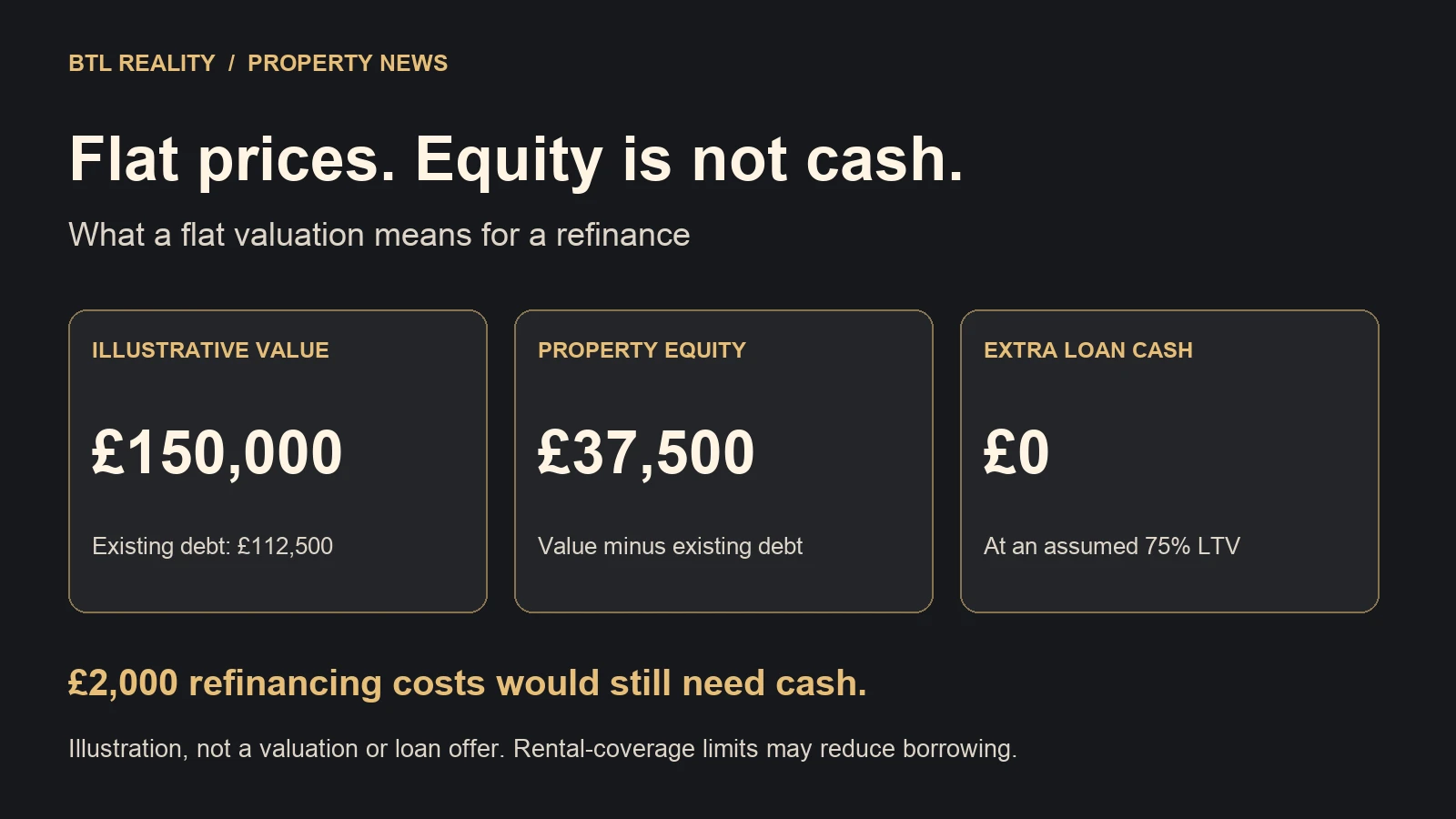
Take an illustrative £150,000 property with a £112,500 interest-only mortgage. The starting equity is £37,500. Keep that debt unchanged and compare three valuation outcomes. These are deliberately simple scenarios, not forecasts based on the Lloyds release.
Illustrative outcomes, not a house-price forecast. Scroll the table sideways on a small screen.
| New valuation | Equity before refinance | Assumed new loan | Balance after old loan and costs |
|---|---|---|---|
| £142,500 | £30,000 | £106,875 | £7,625 cash required |
| £150,000 | £37,500 | £112,500 | £2,000 cash required |
| £157,500 | £45,000 | £118,125 | £3,625 available |
A 5% property-price fall removes £7,500 from equity, which is 20% of the starting £37,500. A 5% rise adds the same amount. Leverage magnifies both directions. The example excludes buying costs, selling costs, tax and rental profits, so the equity movement is not a complete investment return.
The refinancing columns assume a new loan at exactly 75% of the valuation and £2,000 of cash-paid costs. A negative balance means cash is required to complete that particular refinancing scenario. It does not mean the existing lender automatically demands that amount simply because a market index falls.
At a flat £150,000 valuation, the new loan just replaces the old £112,500 debt. There is no extra loan cash to fund the £2,000 costs. At a 5% higher valuation, the new loan could be £118,125. After repaying the old balance and paying costs, the model leaves £3,625, not the full £7,500 increase in property value.
Change the valuation and see the effect
Use the controls below to change your starting value, debt, valuation movement, assumed new loan-to-value and costs. The result is a borrowing illustration, not an approval. Rental coverage, lender criteria, credit, property condition and other restrictions can reduce the loan further.
Your valuation stress test
Illustration only. New loan = scenario value × chosen LTV; cash balance = new loan minus existing debt minus costs. No rental-coverage or affordability limit is applied. No tax, early-repayment charge or other cost unless included in your cost input. Interest-only; the capital remains owed. Fees are paid in cash, not added to the loan.
If you want to include an indicative rental-coverage limit, continue to the property refinance calculator. It also shows the borrowing-cost effect. Keep a copy of your assumptions so you can compare the model with a broker’s actual illustration later.
How much growth would release £15,000?
Using the same £112,500 debt, £2,000 costs and 75% assumed loan-to-value, releasing £15,000 requires a loan of £129,500. Divide that by 75% and the required valuation is approximately £172,667. That is about 15.1% above £150,000.
This calculation sets a threshold, not a completion date. It does not say the property will reach that value or that a lender will advance the money. If rent restricts the loan, the valuation alone will not be enough. If fees are higher or lending criteria change, the threshold changes too.
The money released is additional secured borrowing. It is not rental income or free profit. At an illustrative 6% interest-only rate, the extra £17,000 borrowing costs £85 a month. Only £15,000 reaches your bank in this example because £2,000 pays costs. That distinction belongs in the next-deal calculation.
Does buying below market value help?
It can improve the starting position, provided the claimed value survives independent scrutiny. Imagine paying £135,000 for a property genuinely worth £150,000. A mortgage of 75% of the purchase price is £101,250. If a later lender accepts the £150,000 value and advances 75%, the arithmetic allows £11,250 before costs, or £9,250 after the same £2,000 allowance.
The phrase “genuinely worth” carries a lot of weight. A seller’s original asking price is not proof of market value. Neither is a sourcing presentation. Use suitable completed-sale comparisons, condition evidence and a lender’s assessment. Product rules and the time since purchase may also affect what valuation or borrowing is accepted.
Compare the entire cash requirement, including purchase tax, legal work, survey, refurbishment, finance charges and reserve. Our buy-to-let deal calculator helps you keep those items visible. A headline discount with large repair costs can be less attractive than a straightforward purchase with a smaller apparent discount.
What to check before your next mortgage decision
MoneyHelper’s remortgaging guide explains why loan-to-value, valuation evidence, new-product fees and existing early-repayment charges matter. It is general mortgage guidance; a buy-to-let broker must check the relevant rental coverage and product rules for your property.
Bring the broker an up-to-date mortgage balance, current rent, tenancy details, expected costs and realistic valuation evidence. Ask for the total cost over the period you expect to hold the deal. A low advertised interest rate with a large fee can give a different answer from the rate alone.
Run a hold scenario alongside the refinance. If you stay on the present borrowing arrangement, what happens at the end of the current deal? If you refinance without extracting cash, does the property remain comfortable? If values fall, how much reserve would protect your choices? Answer those questions before committing the next deposit to money you do not yet have.
Build the buying brief around evidence
A sensible brief sets the maximum all-in spend, minimum acceptable cashflow, required reserve and the problems you are prepared to take on. Decide those limits before viewing a persuasive listing. Then use the same checks on every candidate so a strong photograph does not quietly change the rules.
BTL Reality’s Done For You property sourcing service searches against an agreed brief and helps assess proposed opportunities. Scope and fees are agreed in writing. You make the purchase decision and appoint your own finance, legal and survey professionals. No sourcing service can promise the next valuation or remove market risk.
Questions investors are asking
Are UK house prices falling in September 2026?
The Lloyds national monthly and annual measures both round to zero for September; its quarterly measure is negative. That combination describes different comparison periods. It does not mean every home stayed at exactly the same value.
Is the Lloyds index the same as the old Halifax index?
Lloyds renamed the Halifax House Price Index from July 2026 without changing its methodology. The series already used Halifax and Lloyds mortgage data. Check the release date and data month when comparing older Halifax headlines with newer Lloyds coverage.
Can I refinance a buy-to-let if prices do not rise?
Possibly. Refinancing to change a mortgage deal is different from borrowing extra cash. Existing equity, reduced debt or different lending terms may help, but lender approval is still required. Flat prices alone do not establish whether you qualify or how much you can release.
Does £50,000 of property equity mean I can withdraw £50,000?
No. A lender normally leaves some equity in the property, and the existing loan and costs must be covered. Start with the permitted new loan, subtract the debt being repaid, then subtract costs. Rental coverage or other criteria may impose a tighter limit.
Should I buy in the North because its prices are rising?
Use regional performance to guide research, not replace it. Check comparable sales, realistic rent, local demand, condition and costs for the actual home. Yesterday’s regional growth is not tomorrow’s guaranteed return, and different streets can produce very different investments.
What if the refinance valuation is lower than expected?
Recalculate before spending anticipated proceeds. Discuss evidence and options with your broker, including whether less borrowing or a cash contribution would work. Avoid making another purchase dependent on an unconfirmed valuation. The stress test above shows how quickly a small price change affects the cash available.
Sources checked 7 October 2026. Educational analysis, not a valuation, mortgage offer or personalised investment advice. Property values and income can fall.