Mortgage Availability Falls: Can Your Property Budget Take a Smaller Loan?
October 8, 2026
The Bank of England's latest Credit Conditions Survey, published on 8 October 2026, reports reduced availability of secured credit to households. For anyone planning a property purchase, that raises a practical question: does your budget still work if the mortgage is smaller than you expected? Read the original Bank of England release.
A comfortable monthly payment is only one part of a workable deal. You also need enough money to complete the purchase, pay the costs and keep a reserve afterwards. The example and calculator below put those three things together.
What the new mortgage survey actually says
The availability balance was -15.5, compared with +2.6 previously. These are weighted net balances of lender responses, not percentages of applications rejected or pounds of lending withdrawn. The separate buy-to-let demand balance was -22.2; demand is different from availability. Lenders expected a slight availability improvement in the next period, not a guaranteed recovery. Source: Bank of England, Q3 survey.
Timing matters. Responses were collected from 17 August to 4 September. The survey's Q3 changes refer to the three months to end-August, and expectations to the three months to end-November. The availability headline covers household secured credit generally, not a dedicated buy-to-let availability measure.
That does not give you a new universal deposit requirement. Nor does it tell you that your chosen lender has changed its criteria today. The useful response is to check your own funding assumptions before treating an asking price as affordable.
A smaller mortgage can turn a funded purchase into a cash shortfall
Consider an illustrative £150,000 rental property. Assume the lender accepts a £150,000 valuation and lends 75% of the lower of price and valuation. That gives a £112,500 mortgage and leaves £37,500 to fund from your own money.
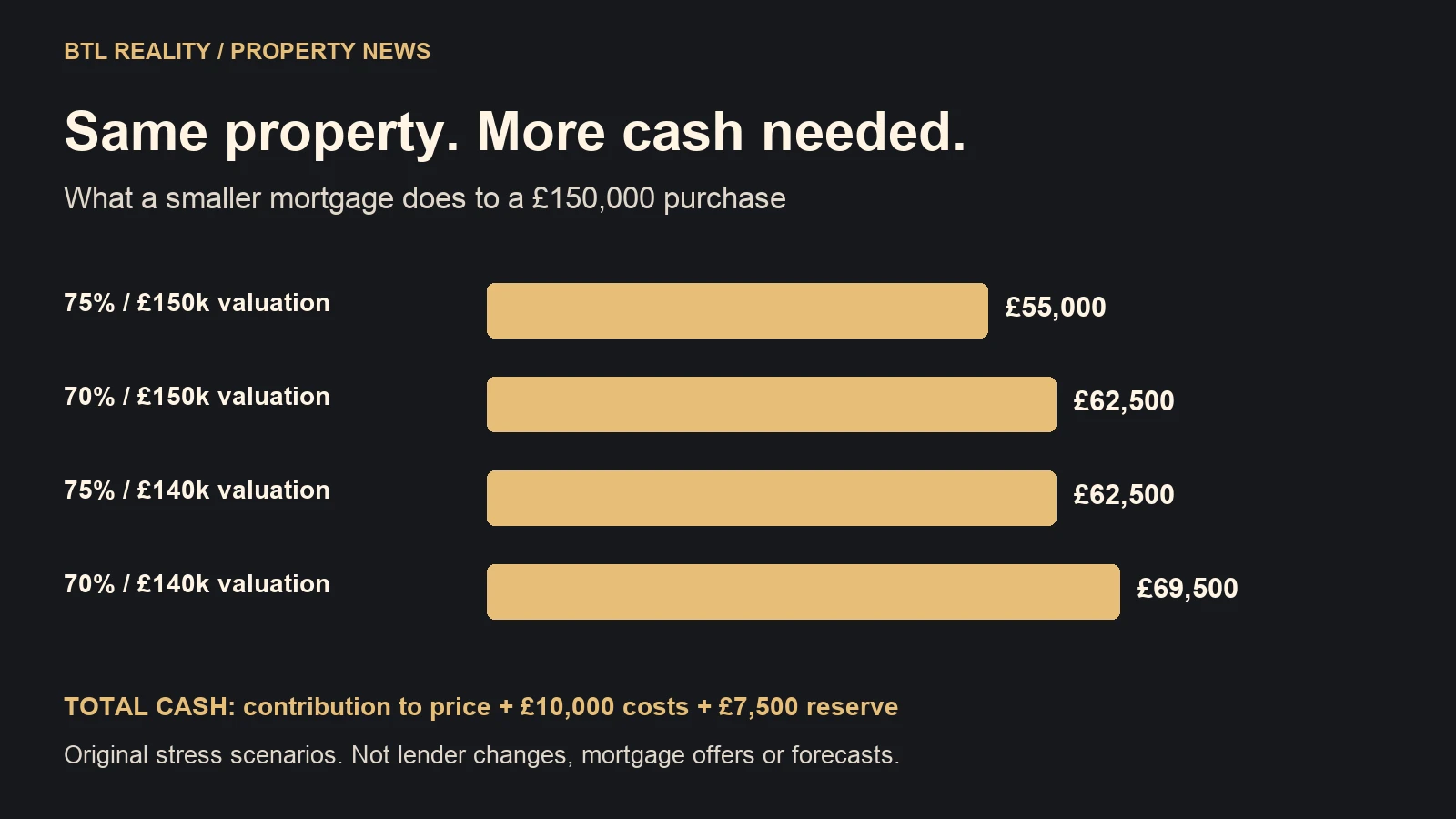
Now add £10,000 for buying costs and keep £7,500 aside as a protected reserve. Your total cash budget is £55,000. That is considerably more than the deposit alone.
The £10,000 is an example allowance, not a tax calculation or quote. Replace it with the purchase tax, legal work, survey, lender fees and other costs applicable to your circumstances. Refurbishment and initial holding costs must also be added if relevant. The reserve is an assumption too, not a recommendation for every property.
What happens if the available borrowing percentage is 70% instead? The loan falls to £105,000. You now need £45,000 towards the price, plus the same costs and reserve: £62,500 altogether. Someone with £55,000 available has a £7,500 funding gap.
| Scenario | Valuation | Borrowing | Loan | Total cash required | Shortfall |
|---|---|---|---|---|---|
| Base case | £150,000 | 75% | £112,500 | £55,000 | £0 |
| Lower borrowing limit | £150,000 | 70% | £105,000 | £62,500 | £7,500 |
| Lower valuation | £140,000 | 75% | £105,000 | £62,500 | £7,500 |
| Both changes | £140,000 | 70% | £98,000 | £69,500 | £14,500 |
Original illustrative scenarios, not mortgage offers. Scroll sideways on a smaller screen.
These are independent BTL stress scenarios. They do not mean lenders have universally reduced loan-to-value limits from 75% to 70%, and they are not Bank of England forecasts.
The practical lesson is simple: a deal can become impossible to complete before it becomes unaffordable each month. A smaller loan may reduce interest payments, but you must find the additional cash first.
A lower valuation can produce the same problem
Keep the purchase price at £150,000 and the assumed borrowing percentage at 75%, but reduce the accepted valuation to £140,000. Under our model, the loan becomes £105,000. You still owe the seller £150,000, so your contribution towards the price becomes £45,000.
A valuation gap is therefore not automatically a cash gap of the same size. Here, a £10,000 valuation reduction cuts the loan by £7,500. The borrowing percentage determines the impact. Combine the £140,000 valuation with 70% borrowing and the mortgage falls further to £98,000. Total cash required, including our costs and reserve, reaches £69,500.
This model deliberately uses the lower of price and valuation. Actual lending treatment can differ by product and transaction. Ask your broker what value the lender will use, rather than assuming that a claimed discount creates a bigger loan.
Our buy-to-let deal calculator helps you examine the wider investment after you have established a realistic mortgage figure. Enter that borrowing figure alongside the purchase and operating costs.
Test your own funding gap
Use the slider to change the borrowing percentage. You can also alter the price, valuation, buying costs, reserve and available cash. The result separates money required to complete from money you want left afterwards.
Can you fund the purchase and keep your reserve?
Model: loan = lower of purchase price and valuation × selected LTV. Cash to complete = price minus loan plus cash-paid costs. Total budget adds your protected reserve. The funding position compares that total with allocated cash. No affordability, rental-coverage or property-eligibility test is applied. No tax calculation or automatic fees are included. This is an illustration, not a mortgage offer. Results stay in this browser.
Start with an achievable quote or broker indication, then test a less favourable scenario. For example, reduce the valuation while keeping the agreed price unchanged. If that leaves a shortfall, identify how it would be resolved before making commitments that depend on the original loan.
A positive cash buffer is not proof that a lender will approve the application. This is a purchase-budget calculation. It does not assess your income, credit history, property eligibility or rental coverage. It also does not calculate the property's future return.
Ask your broker six specific questions
Rather than asking only for the lowest rate, take the actual property and your full circumstances into the conversation. Useful questions include:
- What loan amount looks realistic for this property and ownership structure?
- Which value will the lender use, and what happens if its valuation is lower than the agreed price?
- Could the rent assessment restrict borrowing below the headline loan-to-value limit?
- Which fees must be paid in cash, and which, if any, can be added to the loan?
- Are there property, lease, construction or condition issues that could narrow the lender options?
- What evidence and conditions remain outstanding before a mortgage offer can be relied on?
Prepare a concise funding sheet with your available cash, proposed purchase price, expected rent and itemised costs. Keep documents supporting the figures organised. That helps the adviser work from evidence and makes it easier to spot which assumption is driving the budget.
Ask about the practical timetable as well. If your transaction has a firm completion deadline, you need to know whether the funding process fits it. A headline rate without a workable route to completion is not a finished financing plan.
Protect the reserve instead of making the spreadsheet look better
It is tempting to close a funding gap by deleting the contingency line. That changes the display, but it does not remove the possibility of an empty month, an urgent repair or a bill landing earlier than expected.
In our £55,000 example, using the £7,500 reserve to cover the smaller mortgage would let the arithmetic reach completion. It would also leave no protected property reserve from that pot. Those are different outcomes, even though both might be described casually as having enough cash.
A more useful exercise is to write down what the reserve must cover. Separate known works from genuinely unexpected spending. Include the period before the first tenant pays, where relevant. Then decide what buffer remains appropriate after those known costs have been funded.
Do not double-count money. Cash earmarked for your household emergency fund, another purchase or an upcoming tax payment is not automatically spare deposit money. The calculator's available-cash input should represent the amount actually allocated to this purchase, including its intended reserve.
What can you change if the numbers no longer work?
You have several possible responses, and none should be selected just to keep a particular deal alive. You could negotiate the price, choose a lower-priced property, contribute more genuinely available capital, investigate another suitable lending option with your broker, or decide not to proceed.
Compare each response against the full investment case. Paying more cash can lower the mortgage bill while reducing the capital left for your next purchase. Accepting a different product might solve completion but change fees, restrictions and monthly cashflow. A cheaper property can still be expensive to repair or difficult to let.
Use the mortgage rate stress calculator to explore the payment side after establishing the loan amount. Use the purchase-tax calculator as a starting estimate for the relevant UK jurisdiction, with your adviser checking the actual transaction.
Keep the two decisions separate: can you fund the purchase, and is the resulting investment attractive on realistic assumptions? Passing the first test does not answer the second.
Frequently asked questions
Does lower mortgage availability mean I cannot get a buy-to-let mortgage?
No individual lending decision can be inferred from this headline. Take the property details and your financial position to a suitable mortgage adviser. Ask for a realistic loan amount and the outstanding conditions, rather than assuming the maximum advertised percentage applies to you.
How much extra deposit do I need if borrowing falls from 75% to 70%?
On a £150,000 price and accepted valuation, our example loan falls by £7,500. Your contribution towards the price rises by the same amount. Costs and reserves are additional. This is an illustrative five-percentage-point change, not a claim about a lender's current products.
What happens if the mortgage valuation is lower than the purchase price?
Under this calculator's assumptions, borrowing uses the lower figure. At 75%, a £140,000 valuation against a £150,000 price produces a £105,000 loan and a £45,000 contribution towards the price. Confirm the actual lender's treatment with your broker before relying on this example.
Does the calculator include stamp duty and mortgage fees?
Only through the buying-costs figure you enter. It does not calculate taxes automatically. Add the relevant purchase tax and all cash-paid transaction fees, plus any works or initial holding costs you want included. Keep the protected reserve separate so that the same money is not counted twice.
Is a smaller mortgage always worse for a property investment?
No. Less borrowing can reduce interest costs and exposure to debt. The trade-off is more cash tied up in the purchase. Compare the resulting monthly surplus, return on the cash committed and remaining reserves. Do not judge the investment by leverage alone.
Should I wait for mortgage lending to improve before buying?
A possible market improvement is not a plan for funding a specific purchase. Compare an achievable deal today with the costs and uncertainties of waiting. If the purchase only works with a loan that has not been confirmed, resolve that issue before committing rather than relying on a forecast.
Put the funding and the strategy together
Start with the free BTL Reality calculators to make the assumptions visible. If you want to discuss how a purchase fits your wider property plans, Book Your Free Call. A strategy conversation can help organise your next steps; your mortgage adviser must assess lending suitability and availability.
Educational information, not personal mortgage, investment or tax advice. Calculations are original BTL examples. Actual lending decisions, costs and valuations require individual checks.