UK House Prices Fall 1.2% Over the Year, Lloyds Reports
November 6, 2026
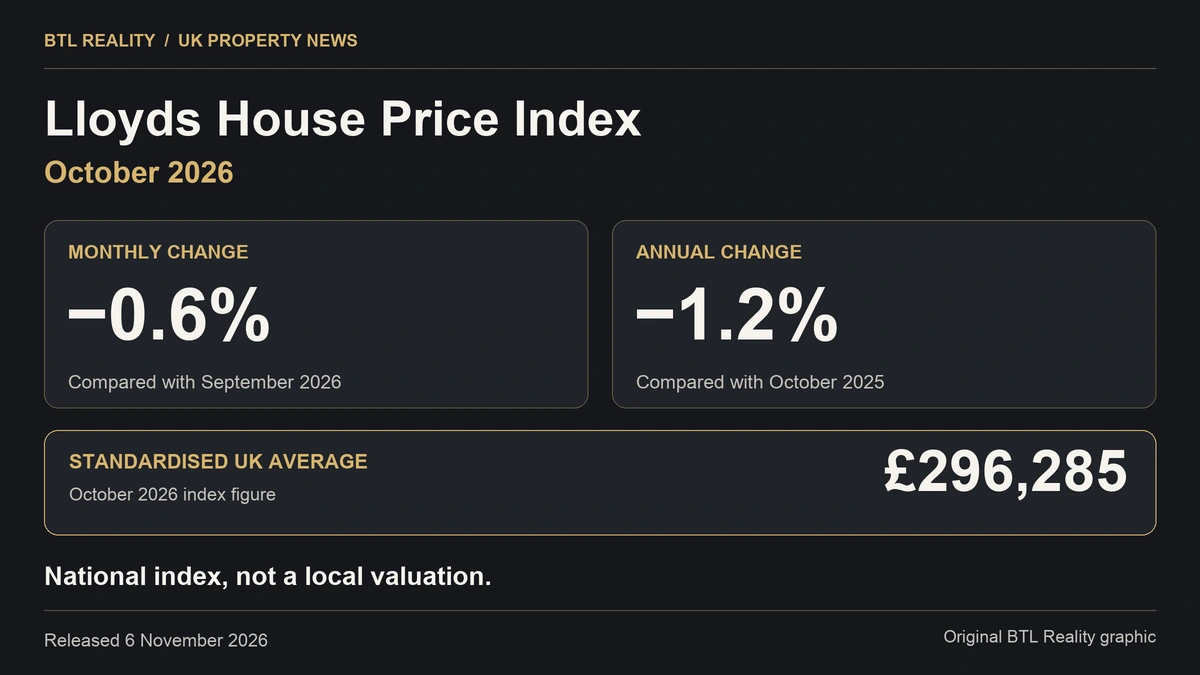
UK house prices fell 1.2% over the year to October, according to the Lloyds House Price Index published today. That is the largest annual decline in this measure since October 2023. The monthly fall was 0.6%, taking its standardised average price to £296,285.
For a buyer or landlord, the useful question is how a different purchase price or valuation changes the numbers. A lower price can reduce the deposit and borrowing required. More expensive finance can absorb that benefit. Looking at one percentage without the other can leave you with a misleading impression of affordability.
The figures to keep separate: October’s monthly change was −0.6%; the three-month comparison was −0.5%; the annual change was −1.2%. These are national index measures, not a valuation of every home or an automatic discount from an asking price.
What does the new Lloyds release show?
The official October release shows a clearer fall than September’s initially reported flat result. The latest report puts September’s standardised average at £298,167, with monthly and annual changes both revised to −0.1%.
Those revisions matter. Our 7 October assessment of the September release records the figures available then. Compare October with the revised September figures in today’s report, rather than combining observations from different releases.
| Measure | October 2026 | September, revised |
|---|---|---|
| Standardised average price | £296,285 | £298,167 |
| Monthly change | −0.6% | −0.1% |
| Three months on previous three months | −0.5% | −0.2% |
| Annual change | −1.2% | −0.1% |
The report’s methodology explains that the standardised average uses mix adjustment and that national index comparisons are seasonally adjusted. Recent figures can be revised. Lloyds also says quarterly data gives a clearer indication of the overall trend than a single month, which can be volatile.
The regional picture still matters
The same report’s regional figures show Greater London down 3.1% annually, while Northern Ireland remains up 4.4%. Regional annual figures use the latest three months of approved mortgage transaction data. They are not changes occurring solely during October.
| Area | Annual change |
|---|---|
| Northern Ireland | +4.4% |
| Scotland | +2.8% |
| North West | +2.2% |
| North East | +2.0% |
| Wales | +1.6% |
| Greater London | −3.1% |
| South East and South West | −2.4% each |
A regional rise does not establish demand for your property. A regional fall does not tell you every seller will negotiate. Check comparable completed sales, property condition, realistic rent and the tenant market for the specific address. Our location, rental yield and capital growth guide helps frame those separate decisions.
Why another index can tell a different story
Nationwide’s October report, released on 30 October, showed prices broadly unchanged monthly and up 0.5% annually. Its average price was £273,566, explicitly not seasonally adjusted. Different lending samples and methods can produce different results. Do not treat the difference between the two average prices as a fall in the same house.
Lloyds was previously the Halifax House Price Index; the name changed in July while the methodology remained the same. Neither lender index should be confused with an asking-price tracker or a valuation survey for your purchase.
A lower purchase price can still mean a higher payment
Take a hypothetical buy-to-let purchase at £250,000, funded with a 25% deposit and 75% interest-only mortgage. Assume an annual mortgage rate of 5.5%. Now test a price 1.2% lower, at £247,000. This deliberately borrows the headline percentage for an illustration; it does not assert that a particular property has fallen by that amount.
The deposit falls from £62,500 to £61,750, saving £750. Borrowing falls from £187,500 to £185,250. At the same 5.5% rate, monthly interest would fall from £859.38 to £849.06.
But change the assumed rate to 5.75% and monthly interest on the smaller loan becomes £887.66. That is £28.28 more than the original £250,000 purchase scenario, despite the lower price.
| Assumption | Starting purchase | Lower price | Lower price, higher rate |
|---|---|---|---|
| Price | £250,000 | £247,000 | £247,000 |
| Deposit | £62,500 | £61,750 | £61,750 |
| Loan | £187,500 | £185,250 | £185,250 |
| Annual rate | 5.50% | 5.50% | 5.75% |
| Monthly interest | £859.38 | £849.06 | £887.66 |
The calculation is loan multiplied by annual rate, divided by twelve. Differences use unrounded values. These are assumed rates, not available offers. The model leaves the original debt outstanding and excludes fees, purchase tax, legal costs, repairs, operating expenses and income tax. A repayment mortgage needs a different calculation.
The Bank of England raised Bank Rate to 4% on 5 November. That does not mean every fixed mortgage rises by the same amount. Today’s price report concerns October, so it cannot measure the effect of yesterday’s decision. Use current quotations for the actual property and ownership structure, then test the wider costs in our buy-to-let deal calculator.
Our November Bank Rate explanation separates fixed deals, trackers and lender-set rates. Check which contract applies before putting a new rate into the property budget.
Check rental cashflow as well as the headline yield
Add an assumed rent of £1,200 a month to the purchase example. That is £14,400 gross rent over twelve fully paid months. On a £250,000 price, the gross yield is 5.76%; on £247,000 it improves to about 5.83%. The rent has not changed. The improvement comes entirely from dividing it by a smaller purchase price.
Yet the higher-rate version leaves less cash after interest. Using unrounded interest, the starting calculation leaves £340.63 a month from the £1,200 rent after £859.38 interest. The lower-price, 5.75% version leaves £312.34 after £887.66 interest. These are calculated before rounding and before management, repairs, insurance, voids, compliance costs and tax. Monthly interest and remaining cash are rounded separately, so subtracting displayed figures can differ by a penny. Neither figure is profit or net yield.
This is why a more attractive gross yield can sit alongside a tighter cash position. Put the same achievable rent into each scenario and change the finance separately. Then add realistic operating costs. Do not quietly raise the rent assumption to make a disappointing mortgage quotation look comfortable.
A £3,000 lower purchase price also does not release £3,000 into your spending account. In this example, only £750 reduces the deposit; the other £2,250 reduces borrowing. Legal costs, purchase tax, works and reserves need their own lines. Check the complete cash requirement before deciding that a cheaper purchase solves an affordability problem.
What a lower valuation means when refinancing
Keep the original £187,500 debt and imagine an existing property’s accepted valuation falls from £250,000 to £247,000. Its loan-to-value becomes about 75.91%. A hypothetical replacement lender limited to 75% would lend £185,250, leaving a £2,250 gap before refinancing costs.
The same hypothetical valuation fall reduces equity from £62,500 to £59,500 while debt stays unchanged. The £3,000 movement is 4.8% of the starting equity, even though the property value moved only 1.2%. That illustrates leverage. It excludes rental cash, tax, transaction costs and any capital repayments, so it is not a complete investment-return calculation.
That models a proposed replacement loan. It does not establish that an existing lender automatically demands £2,250 because an index has fallen. Actual mortgage terms, valuation, rental coverage and lender criteria determine the options. Use our property refinance calculator beside a broker’s illustration to test the borrowing headroom and costs.
Use the release to test your plan
For a purchase, refresh the comparable sales and request an updated finance illustration. Include the property’s required work and accessible reserve. If buying only makes sense after an assumed rent increase or quick valuation uplift, make that dependency visible before committing.
For a property already owned, check the deal end date, balance and likely refinancing requirements. A national price fall is a reason to stress-test the plan, not a substitute for the evidence an adviser or valuer needs.
Lloyds expects subdued conditions in the near term but does not forecast sustained price falls. That is its outlook, not an established outcome. A disciplined appraisal should work through several plausible prices, rates and costs rather than rely on one forecast being correct. For help developing that process, explore Starter Club and check the current education offer.
Frequently asked questions
Did UK house prices fall 1.2% during October 2026?
No. Lloyds reports a 1.2% decline over twelve months to October. Its seasonally adjusted monthly fall was 0.6%. Keep the period attached to each number when comparing reports.
Is this the Halifax House Price Index?
It is the series formerly called the Halifax House Price Index. It became the Lloyds House Price Index in July 2026 while retaining the same methodology, according to Lloyds.
Can I automatically offer 1.2% below an asking price?
The annual index change creates no entitlement to a discount. An asking price may already reflect changed conditions, or may be unrealistic. Build the offer around comparable sales, condition, finance and the seller’s circumstances.
Why do Lloyds and Nationwide show different results?
They use different lending samples and methods. Their averages are not interchangeable valuations. Read the period and seasonal-adjustment notes before comparing them, and use property-specific evidence for an actual purchase.
Can a cheaper property still cost more each month?
Yes, in an illustrative borrowing comparison. Our £247,000 purchase at 5.75% costs more monthly interest than the £250,000 version at 5.5%, despite borrowing less. Fees and repayment terms can also change the result.
Does a lower valuation automatically require a mortgage repayment?
The index itself does not value your property or trigger a contractual demand. A lower accepted valuation can restrict a proposed replacement loan. Check the existing mortgage terms and actual refinancing options before assuming a cash payment is required.