Bank of England Raises Bank Rate to 4%: What Landlords Should Check
November 5, 2026
Property News · UK · Decision announced 5 November 2026
By Mark Parham · Published
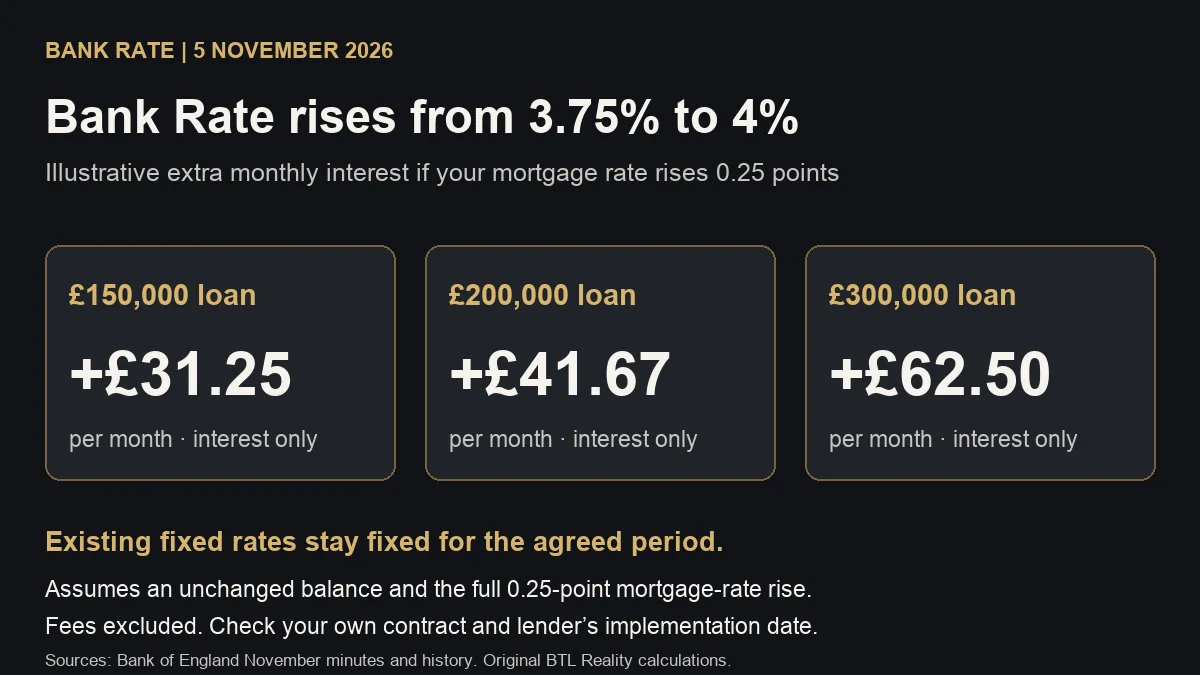
The Bank of England raised Bank Rate from 3.75% to 4% on 5 November 2026. For landlords, the useful next step is to check the mortgage attached to each property and recalculate the cash left after costs. A headline rate change does not tell you what every loan will cost.
The official Bank Rate history records the new rate from 5 November. Existing fixed deals, trackers and lender-set variable rates need different checks.
What did the Bank of England decide?
The MPC meeting ended on 4 November, with the decision published on 5 November. Eight members supported a quarter-point rise; Catherine Mann preferred a half-point rise to 4.25%. The next scheduled decision is 17 December 2026. These details appear in the November decision and minutes.
The Bank cited energy-related inflation pressures. Its projection of inflation around 5% by mid-2027 is a conditional forecast, rather than a current reading or a promised outcome. It also made clear that the future policy path remains open.
For your property plan, separate the rate announced today from assumptions about later decisions. Model those assumptions individually rather than treating an expected future rate as an agreed mortgage price.
Which mortgage payments could change?
If you already have a fixed rate
Your agreed rate stays fixed for the fixed period. The November decision does not itself reprice that deal. The important date is when the fix ends and the contractual follow-on rate or a new product begins. The Co-operative Bank’s mortgage guidance explains this distinction.
Put that end date beside your outstanding balance and current payment. A property can look comfortable today while needing a larger allowance when its mortgage renews. Prepare the renewal calculation using an actual available quote when you have one, with a separate higher-rate scenario.
If you have a tracker
Check what your mortgage tracks, the contractual margin and when a change feeds into payments. The lender’s notice and your agreement determine the practical timing. Avoid assuming every tracker changes on the announcement date.
As one lender-specific example, Nationwide’s 5 November announcement says its tracker rate changes apply from 1 December. That is an example of implementation timing, not a statement about every lender or a buy-to-let product range.
If you have a standard variable rate or need a new fix
An SVR is set by the lender. New mortgage pricing also reflects funding costs, the borrower, the property and competition. The Bank Rate increase therefore does not establish that every available mortgage rises by exactly 0.25 points. UK Finance explains how lenders set mortgage prices.
What does a 0.25-point increase cost on interest-only borrowing?
The following calculation assumes your actual mortgage rate rises by 0.25 percentage points and the balance stays unchanged. It is an illustration, not a lender quote.
| Interest-only balance | Extra per month | Extra per year |
|---|---|---|
| £150,000 | £31.25 | £375 |
| £200,000 | £41.67 | £500 |
| £300,000 | £62.50 | £750 |
The formula is the balance multiplied by 0.0025, divided by 12. Annual figures use the unrounded calculation. Fees are excluded, and the capital still needs repaying at the end of an interest-only loan.
A £31.25 change may sound manageable. Its importance depends on what the property had left before the increase and what else that cash needs to cover.
A rental example: a small rate change can use up a thin buffer
Consider an illustrative £200,000 property with a £150,000 interest-only mortgage. Assume £1,000 monthly rent, £250 of operating-cost allowances and a further £100 set aside as a separate cash reserve. The operating allowance and reserve are separate, so the same expected costs are not counted twice.
| Item | Mortgage at 5% | Mortgage at 5.25% |
|---|---|---|
| Rent | £1,000 | £1,000 |
| Operating-cost allowances | −£250 | −£250 |
| Mortgage interest | −£625 | −£656.25 |
| Cash before extra reserve | £125 | £93.75 |
| Separate reserve allocation | −£100 | −£100 |
| Cash after reserve allocation | £25 | −£6.25 |
The higher rate leaves £93.75 before the extra reserve, which is £6.25 short of the planned £100 contribution. This is a cash-planning illustration. The reserve allocation is money retained, not automatically an accounting expense, and neither final figure is after-tax profit.
The property’s headline gross yield is 6% in both cases: £12,000 annual rent divided by £200,000. The financing change still alters the cash available. That is why a yield figure needs a full cost calculation beside it.
Repayment mortgages need a different calculation
On an illustrative £200,000 repayment mortgage with 25 years remaining, a total mortgage rate of 5% produces a monthly payment of about £1,169.18. At 5.25%, it becomes about £1,198.50, an increase of £29.32.
These figures use monthly interest and the standard repayment formula, holding the balance and remaining term constant and excluding fees. They are separate hypothetical scenarios, not current product quotes. The full payment affects cash flow, while the capital element reduces the debt.
Compare the whole deal before switching
Give each mortgage option the same comparison period. List the monthly payments, product fee, broker costs, legal or valuation costs where applicable, and any charge for leaving the existing deal. Show fees paid upfront separately from any fees added to borrowing.
For example, a hypothetical £1,500 fee is equivalent to £62.50 a month spread across 24 months, before considering interest or the timing of payment. A lower headline rate needs enough savings to justify that extra cost.
Also check what happens if you sell, refinance or need to leave earlier than planned. A product that fits a five-year hold may fit a short project differently. Compare written terms and suitable quotes rather than selecting a deal from a forecast about the next MPC vote.
Keep the portfolio total visible
Repeat the calculation property by property before adding up the results. If five separate £150,000 interest-only loans each rose by a full quarter point, the combined extra interest would be £156.25 a month, or £1,875 a year. If only two loans changed, apply the increase to those two.
Keep current payments and future renewal scenarios in separate columns. Otherwise you can accidentally treat a possible future cost as an expense already being paid, or overlook a renewal because the current payment is fixed.
Finally, give each scenario a clear date and set of assumptions. Keep the lender notice or quote alongside the figures. When another product or rate becomes available, you can update the relevant loan and see what has changed across the portfolio.
What landlords can check now
- Make a mortgage list. Record each balance, payment, product type, fixed-period end date, follow-on rate and relevant exit charges.
- Update the property budget. Use realistic rent and include management, maintenance, insurance, licensing, service charges and void allowances where applicable.
- Test more than today’s move. Calculate the position at your expected renewal rate and at higher rates, with rent held steady.
- Check available cash. Identify how you would cover a shortfall without counting a hoped-for rent increase or refinance as money already available.
Use the BTL Reality mortgage stress calculator to compare payment scenarios. Then put the finance into the wider purchase and running-cost picture with the buy-to-let deal calculator. Both are educational tools; an output is not a mortgage offer.
If you want structured help understanding your first or next property plan, explore Starter Club. For a mortgage recommendation, take your figures and current documents to an appropriately qualified mortgage adviser.
Frequently asked questions
What is Bank Rate after the November 2026 decision?
Bank Rate is 4%, following a 0.25 percentage point increase on 5 November 2026. Bank Rate is a reference rate, rather than a mortgage product available to borrowers.
When is the next Bank of England interest rate decision?
The next scheduled decision is 17 December 2026. Its outcome has not been decided, so a further rise, hold or cut should not be treated as certain.
Will an existing fixed mortgage payment increase now?
The rate remains fixed until the agreed fixed period ends. Check the end date, the follow-on rate and any conditions in your mortgage documents rather than assuming the November decision changes your payment.
What would a quarter-point rise cost on a £150,000 interest-only mortgage?
If the actual mortgage rate increases by exactly 0.25 percentage points, the extra interest is £31.25 a month, or £375 a year. This assumes an unchanged £150,000 balance and excludes fees.
Does a standard variable rate automatically rise by 0.25 points?
No. The lender sets its standard variable rate. Check its announcement and your own payment notice for the amount and timing of any change.
Should landlords choose a fixed rate or a tracker now?
Compare suitable products using your expected ownership period, fees, exit charges, cash reserves and ability to absorb higher payments. Test several rate paths and discuss eligibility with a mortgage adviser. This decision alone does not establish which option will cost less.
Information checked against the sources linked above on 5 November 2026. Calculations are illustrative and before tax. This article provides general property education, not a personalised mortgage recommendation.