Do I Need Planning Permission to Convert a House Into an HMO?
October 19, 2026
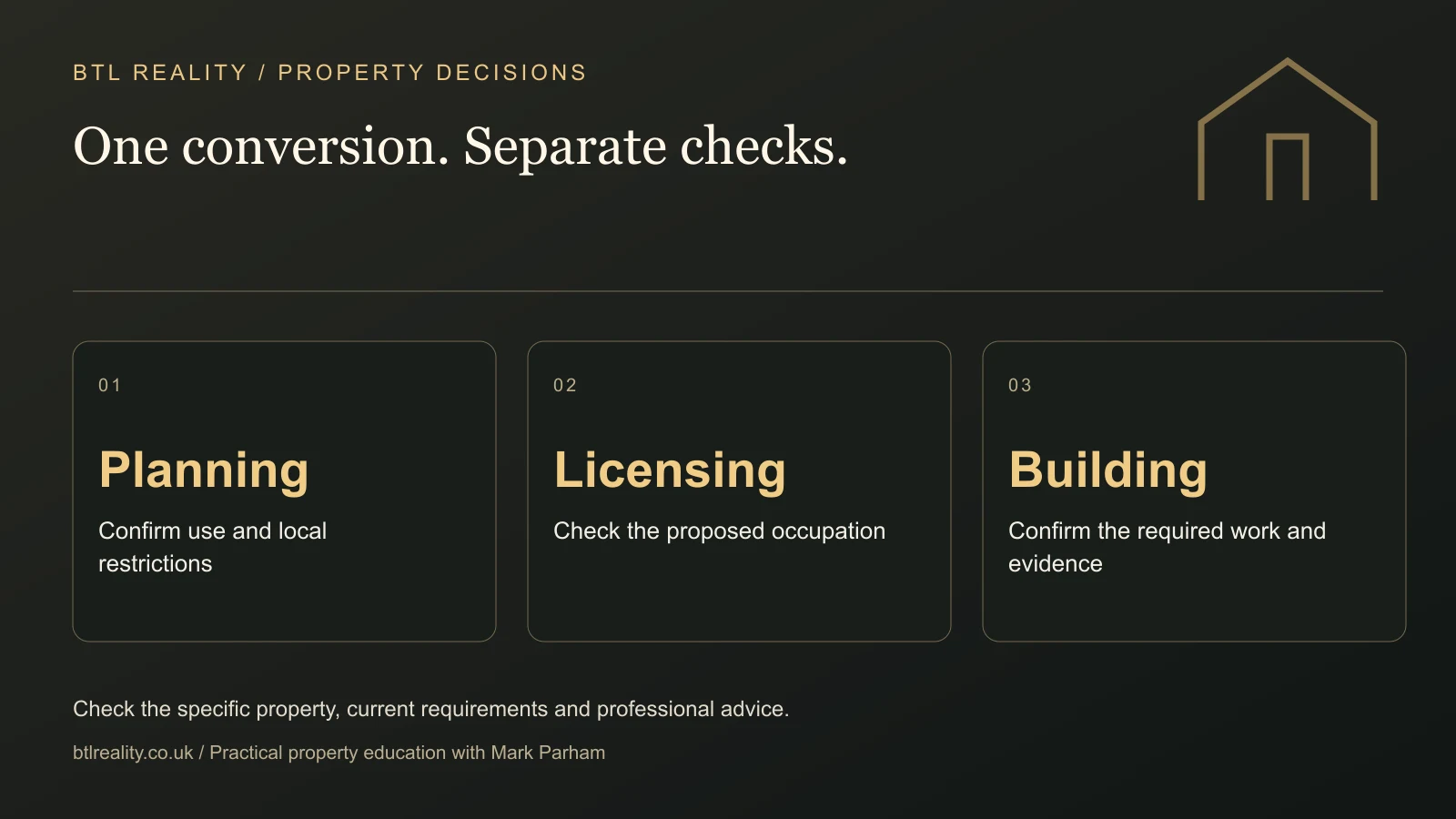
Converting a house into an HMO can require planning permission, but the answer depends on the address, existing lawful use, proposed occupation and local restrictions. An HMO licence is a separate issue. Buying a property with enough rooms does not establish that you can legally rent each one to a different household.
This guide focuses on England. Planning and licensing arrangements differ elsewhere in the UK. The useful starting question is not simply “Does this house need planning?” It is “What evidence confirms that this exact property can operate in the way my investment forecast assumes?”
Separate the permissions before you run the numbers
Create separate lines in your appraisal for planning use, HMO licensing, building regulations, title restrictions, mortgage approval and insurance. Each answers a different question. Passing one does not automatically settle the others.
The government's planning guidance explains that permitted development rights can remove the need for a planning application in some circumstances, while other consents may still be required. Rights can also be restricted. That is why a generic national summary cannot complete an address-specific assessment.
Your practical file should contain the source of each conclusion, the person responsible for checking it and any outstanding condition. “Agent says fine” is not the same entry as a professional review supported by relevant documents.
Understand small HMOs and Article 4 directions
In England, a small HMO occupied by three to six unrelated people sharing facilities may fall within planning use class C4. A change from a C3 dwellinghouse to C4 can have permitted development rights, but an Article 4 direction may remove that route in the affected area. Planning conditions can also matter.
Sheffield City Council's HMO planning guidance illustrates how local restrictions change the answer. Its local boundaries and dates should not be applied to another council area. Check the actual address against the current direction and planning history.
A larger HMO can fall outside C4 into a different planning category. Do not assume that adding one more occupier is an administrative update. Ask a planning professional to assess the proposed use and whether an application or other formal evidence is necessary.
A licensing answer is not a planning answer
Licensing looks at a different set of requirements and responsibilities. England's mandatory HMO licensing rules generally cover properties occupied by five or more people forming more than one household and sharing facilities. Local additional licensing can bring other HMOs into scope.
Start with the government's HMO licence guidance, then check the council's current schemes and standards. Never use the number five as a universal dividing line between “HMO” and “not HMO”, or between “regulated” and “unregulated”.
For your budget, identify the proposed permitted occupancy, relevant fees, works and management requirements. A plan that counts rent from an extra room before confirming the permitted arrangement can overstate income from day one.
Make the example your own
Is the proposed HMO use evidenced?
Track separate reviews for the exact address and intended occupation in England. Ticking a box does not grant permission.
0 of 6 checks reviewed
This is an organiser, not approval to invest. Selections stay in this page and are not saved or sent.
Use this checklist to organise evidence, not to award yourself permission. A completed checklist means you have recorded the necessary reviews; the council and relevant professionals still determine the applicable requirements.
Confirm the lawful existing use
An advert saying “previously let to students” does not establish a lawful HMO use. Nor does a floor plan with several beds prove that the current layout is authorised. Ask your solicitor and planning adviser what evidence is needed for the particular property.
Request relevant permissions, approved plans, conditions, certificates and supporting occupation records. Check that documents refer to the correct address and actual configuration. An approval for a different layout or a historic arrangement may not support the intended purchase strategy.
If the seller relies on an existing-use argument, have that assessed before relying on the associated rental income. Consider whether formal confirmation is appropriate. Missing evidence should remain an unresolved risk in the appraisal, rather than becoming a confident assumption because the transaction is moving quickly.
Inspect the proposed living arrangement
Draw the full layout, including kitchens, bathrooms, circulation, shared space and escape routes. Consider where occupants will store belongings, dry laundry and spend time. A property has to function as a home, not simply as a collection of rent-producing rectangles.
Have suitable professionals assess fire precautions, ventilation, electrical provision, drainage and other relevant works. A basic decorating quote will not necessarily include the changes required for the intended occupation. Ask contractors to quote against a defined specification rather than a vague instruction to “make it HMO ready”.
Speak to experienced local letting agents about demand for that exact room type and location. Compare realistic rents for the finished specification. A larger gross total is only helpful if the accommodation is lawful, desirable and manageable.
Compare the HMO with a workable single-let alternative
Consider an illustrative house costing £150,000. A proposed HMO conversion requires £30,000 of work, plus £10,000 for professional costs and contingency. These amounts are additional to purchase taxes, finance costs and any reserves not already included.
Suppose the single-let alternative could achieve £1,000 monthly gross rent, while four rooms might produce £450 each, or £1,800 altogether. The apparent uplift is £800 a month. It is not an £800 increase in profit.
If the HMO brings £350 of additional monthly bills, management and maintenance provision, the modelled uplift falls to £450. Recovering the extra £40,000 through that uplift alone would take approximately 7.4 years, before tax, financing differences, vacancies, major replacements or changes in rent. None of these illustrative figures establishes local demand or consent.
Run both options through the buy-to-let deal calculator. Compare total cash committed and the resulting cashflow, then stress the assumptions. Sometimes the simpler use better fits the available capital and time.
Price delay as well as the building work
An application, revised design or extra evidence request can move the timetable. Your mortgage, insurance, contractors and expected tenancy start all need to fit the actual sequence.
For example, £900 monthly holding costs over four extra months require £3,600 of additional cash. That amount is separate from the building budget. If the purchase already uses every available pound, a manageable delay can become a financing problem.
Keep a written contingency plan: what happens if permission is refused, takes longer, or supports fewer occupants? The alternative should be something you can actually fund and operate. A fallback single let that produces negative cashflow is not automatically a reassuring exit.
Ask the broker and insurer about the final use
Give your broker the intended occupation, layout, planning position and work programme. A mortgage suitable for a standard house may not permit the proposed HMO use or conversion process. Avoid planning to complete on one basis while intending an undisclosed different use.
The insurer also needs accurate information about occupancy and works. Arrange appropriate cover for the stages involved, including any empty period. Confirm what must be notified as circumstances change.
Keep these conversations aligned. A technically achievable conversion can still fail your investment test if finance is unavailable on acceptable terms or the required cash exceeds the budget.
Build a decision file before committing
A useful file contains the address, title documents, existing and proposed plans, planning assessment, licensing review, work specification, quotes, rent evidence and finance route. Add the unresolved items and their deadlines at the front.
Agree with your solicitor which matters need resolution before you become legally committed. Auction conditions and other accelerated transactions deserve particular care because investigation time can be limited. Do not assume a low price compensates for a use that may not be available.
If you want help finding a property against an agreed brief, Done For You sourcing is the relevant BTL Reality service. Sourcing should begin with your capital, objectives and workable criteria; planning, legal and technical reviews remain essential parts of the purchase process.
Frequently asked questions
Is an HMO licence the same as planning permission?
No. They address different requirements, and having one does not establish the other. Keep separate evidence for the property's lawful planning use, licensing position and required building work. Ask the relevant council teams and advisers about the actual intended occupation, rather than relying on a general statement that the property is “an HMO”.
What does an Article 4 direction change?
It can remove specified permitted development rights within its defined area, meaning a change that could otherwise proceed without a planning application may need one. Check the direction's precise scope, boundaries and effective date. Its existence does not automatically prove that an existing HMO is unlawful or that a new application will be refused.
Do small HMOs always avoid planning permission?
No. The answer depends on the existing and proposed use, local restrictions, conditions and property history. A small number of occupants is not a blanket exemption. Confirm the position for the address and planned arrangement before using room-by-room income to justify the purchase price or mortgage.
Does adding another bedroom change the permitted use?
It can change the assessment, especially if it changes occupancy, layout or the nature of the use. A bedroom count is not the same as a permitted number of occupants. Have the revised proposal checked across planning, licensing, building standards, finance and insurance before advertising the additional room.
How do I verify the lawful existing use?
Ask your solicitor and planning adviser to assess the relevant permissions, conditions, certificates and evidence of actual use. Establish what the documents prove and what remains uncertain. Where formal confirmation is needed, agree the appropriate route rather than treating an estate-agent description or an old rental advert as conclusive evidence.
Should I buy before the council confirms the position?
Only with a clear understanding of what is unresolved and professional advice on the consequences. If the deal requires a particular use to work financially, that uncertainty can be fundamental. Agree conditions, timing or another suitable approach with your solicitor; do not let a conversion budget substitute for evidence that the conversion can proceed.
Put the next step into practice
Use the free tools to test your numbers, then choose the level of support that fits your next decision.