Is an Ex-Council Flat a Good Buy-to-Let Investment?
October 19, 2026
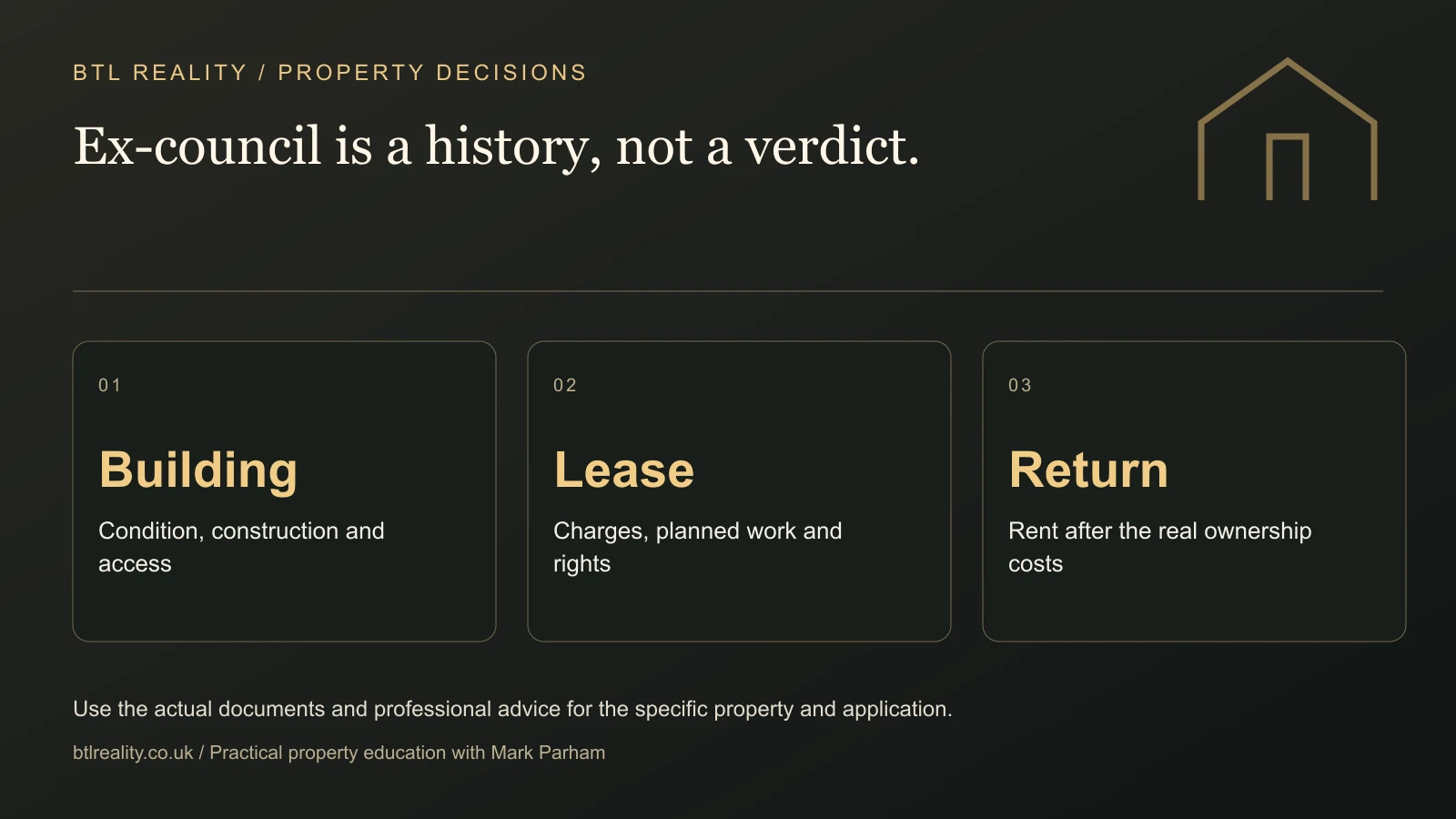
An ex-council flat can be a good buy-to-let, but its ownership history is not enough to judge the investment. The individual building, lease, service charges, planned work, mortgage options and local rental demand matter far more than a simple “ex-council is good” or “ex-council is bad” rule.
A lower price can make the numbers attractive. It can also reflect restrictions or future costs that a headline yield misses. This guide sets out a practical investigation process and a worked cashflow example so you can compare the opportunity with other properties on a consistent basis.
Look at the actual home and its setting
Start with the fundamentals a tenant experiences: location, internal space, layout, light, heating, noise, access and the condition of shared areas. A generously sized flat near employment and transport may have a strong rental proposition regardless of who originally built it.
Visit at different times where practical and inspect the route from the street to the front door. Entrances, lifts, lighting, waste areas and access arrangements affect day-to-day use. Ask local letting agents about demand for this block or estate rather than relying on broad comments about the postcode.
Evaluate observable conditions and relevant evidence, not stereotypes about other residents. Mixed tenure is not itself a defect. What matters is whether the property offers a suitable home, can be managed well and meets the requirements of the purchase and lending arrangement.
Mortgage eligibility is property-specific
Lenders can apply criteria concerning building height, construction, access, floor area, tenure and marketability. Some ex-local-authority properties fit those criteria; others have fewer options. A broker needs accurate information about the actual building before giving a meaningful view.
As one example, The Mortgage Works publishes specific property criteria, including restrictions for local-authority flats. That is one lender's policy, not a rule that every block above a certain height is unmortgageable across the whole market.
Do not assume a previous mortgage proves your proposed application will succeed. Products, valuations and the building's circumstances may have changed. Check the intended ownership, borrowing amount and property details together, then keep the broker updated when legal or survey findings emerge.
Understand what the lease makes you responsible for
The lease determines important rights and obligations, including contributions to maintenance and shared costs. Ask the conveyancer to explain the remaining term, ground-rent provisions where relevant, service-charge mechanism, insurance arrangements and restrictions on use or alterations.
A council or housing organisation remaining as freeholder does not remove the need for this review. Nor does it mean every cost is automatically reasonable, capped or predictable. You need to understand how charges arise and what information is available about future expenditure.
GOV.UK's leasehold buying guide is a useful starting point for understanding the documents and questions. Your own lease and conveyancer's advice determine the position for the transaction.
Make the example your own
Have you checked the flat beyond its asking price?
Review the actual building and documents with your professional team. This checklist does not approve the purchase.
0 of 6 checks reviewed
This is an organiser, not approval to invest. Selections stay in this page and are not saved or sent.
Use the checklist as a record of the evidence still needed. It is not a scoring system that turns six ticks into a recommendation to buy. A material unresolved building or finance issue can outweigh several reassuring details.
Review past charges and future work separately
Obtain the available service-charge accounts, current budget, reserve information and details of planned major works. The latest annual bill describes one period; it does not necessarily capture a roof replacement, lift renewal or external work that is being planned.
Ask about notices, surveys, programmes of work and any estimates of your flat's contribution. Distinguish a broad programme announcement from an approved cost and a formal demand. If an amount is uncertain, model a range rather than treating it as zero.
Our guide to buying a flat with major works planned explains the cash implications and why consultation thresholds are not a universal cap on what a leaseholder may pay. Ask the conveyancer how known costs will be allocated between seller and buyer.
A low purchase price can hide a thin cash margin
Consider an illustrative flat at £120,000 with monthly rent of £900. Its gross yield is 9%, which looks strong before costs. At 75% loan-to-value, a £90,000 interest-only mortgage at 5% costs £375 a month.
Assume £175 monthly service charge and £150 for management, maintenance, insurance or void allowances not already included in that charge. The remaining cashflow is £200 a month before tax and exceptional work. That is £2,400 a year, not the £10,800 gross rental figure.
An illustrative £12,000 major-works contribution equals five years of that routine cashflow. It may be payable long before five years of rent has been earned. A property can have an attractive gross yield while demanding more available cash than the buyer expected.
The example is not a prediction of ex-council charges. Replace the assumptions with the actual documents and quotations in the buy-to-let deal calculator. Avoid double-counting costs already covered by the service charge, but do not omit excluded obligations.
Construction and building safety need separate attention
Identify the construction type and any relevant building issues through appropriate professional inspection. Some buildings use systems that require more specific lending or technical assessment. An attractive internal refurbishment does not establish the condition of the structure or external envelope.
Ask the conveyancer and surveyor what building-safety information is relevant to the particular block and what remains outstanding. Do not assume every flat needs the same document, or that possession of one certificate answers all safety, funding and saleability questions.
The legal treatment of remediation costs can be complex and depends on the building and leaseholder circumstances. Obtain advice rather than assuming either that you must pay everything or that all costs are protected. Our non-standard construction guide gives a wider framework for investigating the physical building.
Check the rental case independently of the sales case
An estate agent's suggested rent should be tested with comparable completed lets and local letting expertise. Match the block, floor, condition, parking and furnishing where possible. A nearby new-build development may not be a meaningful comparison just because both properties have two bedrooms.
Ask what would need doing before marketing, what specification tenants expect and whether the proposed rent depends on that work. Include the preparation period and costs in the budget. A projected rent after refurbishment is different from the income available immediately after completion.
Also consider practical management. Who handles repairs in shared areas, how are faults reported and how responsive is the process? You cannot control every common-area decision, so understand the channels and likely implications before promising tenants a service you cannot deliver.
Compare the exit as carefully as the rent
The future buyer will ask many of the same questions about the lease, charges, construction and finance. A narrower lending market can affect the pool of buyers, even if the property lets well throughout your ownership.
Look at completed sales of similar flats in the same or genuinely comparable buildings. Investigate time on the market and transactions that fell through where reliable information is available. Do not assume an asking-price discount represents instant equity that a future valuation will recognise.
Run a slower-sale scenario and retain enough cash to hold the property during the process. A planned refinance is subject to future valuation and lending criteria. If you need the deposit back on a precise date, the uncertainty deserves a prominent place in the decision.
Write a clear purchase decision
Before committing, summarise the full cash requirement, achievable rent, ordinary costs, known work, finance route and unresolved questions. Give each major assumption an evidence source and date. This makes it easier to update the appraisal after legal enquiries or a survey.
Set a walk-away condition for issues that exceed your budget or risk tolerance. It might be an unacceptable works exposure, an unsuitable lease or unavailable finance. Having that condition in advance reduces the temptation to rationalise a problem because the asking price initially looked cheap.
For BTL Reality's Done For You sourcing service, the agreed brief should state whether ex-council flats are acceptable and what limits apply to service charges, building complexity and cash demands. The aim is a property that fits the plan, not a particular ownership label.
Frequently asked questions
Can I get a buy-to-let mortgage on an ex-council flat?
Potentially, but the property and applicant must fit the lender's criteria. Building height, construction, access, lease and marketability can affect options. Give a broker accurate details and obtain a property-specific assessment rather than relying on the fact that another owner previously had a mortgage.
Does the height of the block affect mortgage options?
It can. Some lenders restrict particular types or heights of former local-authority blocks, while others use different criteria. Height is one part of the assessment, alongside construction, access and other factors. A restriction from one lender is not a universal market-wide rule.
Why can an ex-council flat have a large major-works bill?
The lease can require contributions towards shared building expenditure, and substantial work may be costly. Review the actual lease, planned programmes, notices, reserves and estimates. The council's involvement does not by itself mean charges are capped or that the current annual service charge covers future work.
What should I ask about the construction and building safety?
Ask what the building is made from, what condition or safety concerns are known and which reports or assessments are relevant. Have the surveyor and conveyancer interpret the evidence. Do not assume an internal refurbishment, a single certificate or a lender valuation answers every question.
Does a low purchase price guarantee a high return?
No. Finance, service charges, maintenance, voids and major works can consume the rent, while resale restrictions can affect capital outcomes. Compare total cash invested and net cashflow, then stress-test the costs. A high gross yield is a starting calculation, not a complete investment assessment.
Which documents should I see before exchange?
Ask your conveyancer for the relevant lease and title documents, service-charge accounts and budgets, reserve details, planned-works information and building or insurance records. Include the survey and confirmed finance position. The exact pack depends on the building and transaction, so obtain a tailored list.
Put the next step into practice
Use the free tools to test your numbers, then choose the level of support that fits your next decision.