Should I Buy a Non-Standard Construction Property to Rent Out?
October 16, 2026
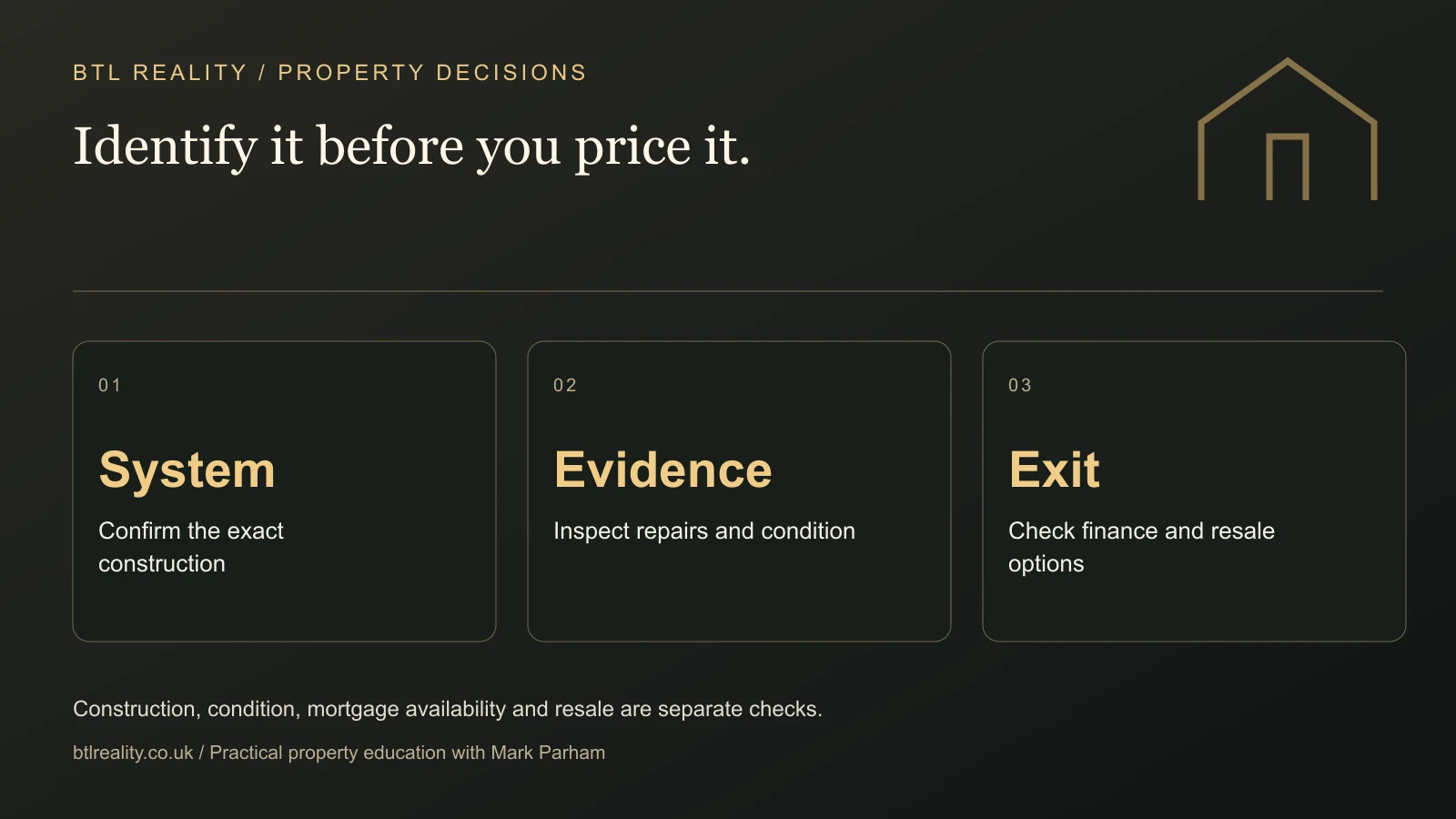
A non-standard construction property can be a viable rental, but the construction needs to be identified and assessed before the price becomes the main attraction. The decision depends on the exact building system, condition, repair history, mortgage options, insurance and likely resale market. A cheap house with an unresolved lending problem can tie up much more cash than you intended.
This guide gives you a practical way to investigate the opportunity. It does not classify an individual building or replace a surveyor, structural engineer, broker or conveyancer. The aim is to arrive at those conversations with the right evidence, rather than hoping the mortgage valuation will sort everything out later.
What does non-standard construction actually mean?
It is a broad lending and surveying description, not a single diagnosis. Two houses that look similar from the street can have different structural systems behind their external finishes. Concrete panels, steel frames, some timber systems and unusual wall or roof arrangements can raise different questions. Age, detailing, alterations and maintenance also matter.
Do not assume every timber-frame home is problematic. A modern, recognised system with appropriate evidence is a different proposition from an unidentified older structure. Equally, adding an attractive external finish does not establish what supports the building or whether earlier defects were properly repaired.
For an example of how specific the assessment can become, The Mortgage Works publishes construction criteria that distinguish named systems, dates, property types and repair arrangements. Those are one lender's criteria, not a universal mortgage rule. An acceptance in principle also remains subject to the actual property's assessment.
Your first useful question is therefore: what exactly is it? Ask for the system name, approximate construction date, supporting documents and the basis on which the seller or agent has identified it. “Concrete house” is not enough detail for a confident purchase decision.
Separate three questions before judging the deal
First, is the property structurally suitable in its current condition? That is a technical question for the relevant qualified professionals. A lending decision alone is not a complete condition assessment.
Second, can you finance and insure this specific property on terms that work? A sound building can still fall outside a particular lender's appetite. An insurance quotation may include conditions or exclusions that deserve investigation.
Third, will the numbers compensate you for the remaining limitations? Restricted resale demand, specialist inspections or a more expensive mortgage may erode the apparent saving. None of these questions can be answered by the gross rental yield alone.
Keep a separate evidence column for each one. Otherwise a positive answer in one area tends to spill over into the others. “The tenant loves it” does not establish mortgage availability, and “a lender has considered this system before” does not establish the condition of this house.
Build a construction evidence file
Start with the particulars, title information and any existing survey or engineering reports the seller is willing to provide. Record who produced each document, when it was prepared, what it covers and whether you can rely on it. A report commissioned for someone else may be useful background without giving you a right to rely on its conclusions.
Where repairs have been completed, collect specifications, certificates, guarantees, building-control records and the identity of the contractor or supervising professional. Ask your advisers what further evidence is necessary. An invoice showing money was spent is not the same as confirmation that a recognised repair scheme was completed satisfactorily.
Terraced and semi-detached buildings can need particular attention because neighbouring structures may affect the assessment. Do not assume work to your side alone resolves every issue. The exact system and the lender's requirements need checking.
Photographs help professionals understand what they are reviewing, but photographs do not substitute for inspection. Include elevations, roof details, visible alterations and any areas highlighted by the surveyor, without undertaking intrusive work or unsafe access yourself.
Make the example your own
Is the construction evidence ready for review?
Tick when the evidence has been obtained and reviewed by the relevant professional. This is not a safety or lending score.
0 of 6 checks reviewed
This is an organiser, not approval to invest. Selections stay in this page and are not saved or sent.
The checklist records unresolved questions. It is deliberately not a percentage score for whether the property is safe. One unanswered structural or lending issue can matter more than five completed administrative tasks.
The discount must survive the complete cash calculation
Consider an illustrative comparison. A conventional property costs £150,000. Another property costs £125,000 but needs additional investigation and may have a narrower lending market. Both are assumed to rent for £1,000 a month. These are invented modelling figures, not evidence of typical discounts or current mortgage products.
At 75% loan-to-value, the £150,000 property needs a £37,500 deposit. At the same leverage, the cheaper property needs £31,250. That initially looks like a £6,250 cash saving, before tax, purchase costs, work and reserves.
Now suppose the feasible lending route for the cheaper property is only 65% loan-to-value. Its deposit becomes £43,750. Despite the lower price, you need £6,250 more deposit than for the conventional property. Add an illustrative £3,000 of extra investigation and initial work and the difference becomes £9,250.
The lesson is not that 65% is a standard restriction. It is that your available mortgage terms, not a generic percentage copied into a spreadsheet, determine the cash requirement. Use actual broker feedback and keep a cash-purchase scenario in the model if financing remains uncertain.
Our free buy-to-let deal calculator helps you compare the whole purchase budget. Put specialist costs in the budget explicitly rather than burying them inside an optimistic contingency.
Monthly profit can change as well
Using the same illustrative prices, a £112,500 interest-only loan at 5% costs £468.75 a month. A £81,250 loan at 6% costs £406.25 a month. The second payment is lower, but only because considerably less money has been borrowed relative to the price.
With £1,000 rent and £250 monthly operating costs, the respective cashflows before tax are £281.25 and £343.75. That £62.50 monthly improvement needs assessing against the larger deposit, additional costs and remaining risks. Looking only at the mortgage payment hides the capital committed.
These rates are scenario inputs, not quotations. Repairs, voids, taxation, fees and repayment mortgages can change the comparison. If you expect stronger rent from one property, support it with relevant local evidence rather than using rent as the number that makes the deal work.
Think about your next buyer now
An investment can produce rent while still being awkward to sell. The future buyer may depend on a different lender, a smaller deposit or a more cautious surveyor. A limited mortgage market can reduce the pool of potential purchasers even where the property suits you personally.
Ask local agents about completed sales of genuinely comparable construction, not just similar bedroom counts. Find out how long transactions took and whether lending concerns caused problems. An asking price for an unsold house is weak evidence of a clean exit.
Then model a slower sale, a lower sale price and the costs of holding the property during that period. You are not predicting that all three will occur. You are checking whether the investment only works if they do not.
This is especially important if your strategy depends on refinancing quickly. A future lender is not obliged to adopt today's opinion, and an expected uplift does not guarantee an acceptable security. Our cash purchase and later mortgage guide explores that separate funding risk.
A sensible order of work
Begin with enough identification evidence for a broker and surveyor to give a meaningful steer. Agree the inspection scope and the construction questions in writing. Ask the broker to distinguish a broad policy view from an assessment of this address and your application.
Obtain insurance terms early enough to investigate concerns. Give your conveyancer the technical findings and ask about relevant certificates, warranties and alterations. Return to the price only after the important assumptions have been tested.
Set a decision deadline that fits the transaction, but do not let sunk costs force the purchase. Spending money to discover an unsuitable investment can be a successful outcome. Completing simply to justify those fees can make a small loss much larger.
For investors using BTL Reality's Done For You sourcing service, construction preferences and exclusions should form part of the agreed brief. Sourcing can help organise the search and appraisal; it does not remove the need for independent technical and legal checks.
Frequently asked questions
What counts as non-standard construction for a mortgage?
The definition varies between lenders and depends on the precise materials and building system. Ask a surveyor to identify the structure and a broker to check relevant lending criteria. Do not rely on the estate agent's label alone, or assume every property described this way faces the same restrictions.
Can I get a buy-to-let mortgage on a concrete house?
Potentially, but “concrete house” is too broad to determine eligibility. The named system, condition, repair status, location and lender's criteria may affect the outcome. Obtain a property-specific assessment before assuming a mortgage will be available at your preferred loan-to-value or price.
Does a repair certificate guarantee mortgage availability?
No. A certificate is evidence to assess, not a promise that every lender will accept the property. The repair scheme, scope, issuer, surrounding structures and present condition can matter. Your broker, surveyor and conveyancer should confirm what the document establishes and what further checks remain.
Are all timber-frame homes non-standard?
No single label usefully covers every timber-frame property. Construction date, system, external finishes, warranties and condition can lead to different treatment. Some recognised timber-frame homes fall within a lender's ordinary criteria. Identify the exact building rather than treating the presence of timber as an automatic rejection.
Can construction type affect insurance and resale?
It can affect the available terms and the number of buyers able or willing to proceed. Check insurance using accurate construction details, and examine evidence of comparable completed sales. A rental that cashflows today still needs an exit plan that accounts for its actual market.
What should I verify before relying on a cheap purchase price?
Confirm the structure, condition, repair evidence, mortgage route, insurance, realistic rent and likely resale options. Then calculate the deposit, specialist costs and contingency using those findings. A lower price is useful only when the whole investment, including its remaining uncertainty, suits your resources and objectives.
Put the next step into practice
Use the free tools to test your numbers, then choose the level of support that fits your next decision.