How to Delegate a Property Purchase Without Losing Control
October 13, 2026
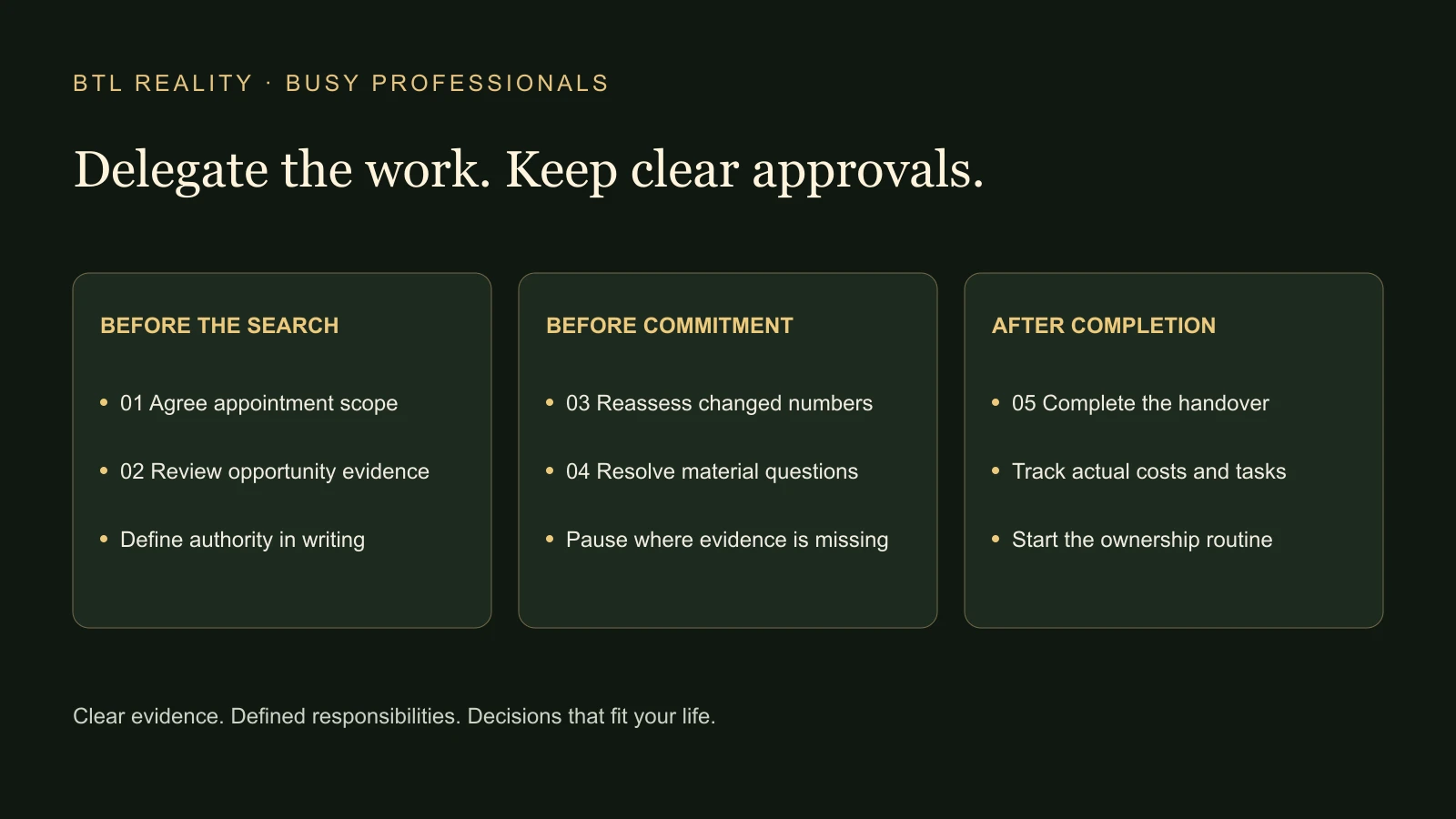
Delegating a property purchase should save you time without leaving you unsure what you are buying. The key is to delegate defined tasks while keeping clear approval points for the decisions that change your money, obligations or risk.
That is especially important if your working week is already full. You cannot review every message immediately, but you can agree how an opportunity will be presented, what evidence must accompany it and when the process must pause for your decision.
This guide gives you a practical delegation system: a written brief, five approval points, a weekly summary and an exception process. It is not a promise of a hands-off investment or a substitute for independent professional advice.
Separate execution from authority
Start by listing the work involved. Searching, arranging viewings, gathering rent evidence, coordinating professionals and obtaining quotations can often be delegated under an agreed service. Approving a purchase, accepting a financing proposal or committing to additional expenditure needs an explicit authority arrangement.
Do not assume the words “fully managed” cover the purchase. A letting agent's management service and a sourcer's acquisition service are different contracts. Ask what each includes, where it starts, when it ends and what requires an additional fee.
For a broader introduction, read can someone find an investment property for me?. This article focuses on how you control the work once you decide to delegate it.
Write a brief that can reject a deal
A useful brief does more than describe an ideal property. It explains what would make an opportunity unsuitable. State the maximum total cash commitment, the reserve you intend to retain, the type of property and the work you are willing to undertake.
Separate firm limits from preferences. You might prefer a certain area but be unwilling to take on a major refurbishment. If those are not distinguished, someone may spend hours presenting opportunities that were never a fit.
Include your intended rental approach and the evidence you expect for rent and costs. “High yield” is not sufficiently precise when one calculation is gross rent divided by price and another deducts operating costs. The deal comparison guide helps put proposals on a consistent basis.
Finish the brief with your review availability. A realistic response window is better than implying that you can approve a major decision in ten minutes between meetings.
Approval one: the appointment and its scope
Before a service begins, get the scope, fee and payment milestones in writing. Ask who is doing the work, how they communicate, what happens if no suitable opportunity is found and how any conflicts or referral arrangements are disclosed.
An introduction to a professional is not the same as commissioning their work. Confirm who appoints and pays them, and who receives their findings. Review the property sourcer due diligence guide before committing to sourcing fees.
Make authority explicit. For example, someone may be authorised to gather quotations but not to approve works. Someone may communicate an offer after you approve the exact amount and conditions. Your actual arrangements should be documented appropriately, not inferred from a WhatsApp message saying “crack on”.
Approval two: the opportunity pack
Request a concise pack before considering an offer. It should explain why the property meets the brief, how the proposed price was assessed and where the rent and cost assumptions came from. Include photographs, known condition concerns and unresolved questions.
Ask for two categories of figures: evidenced and estimated. A written quotation is different from an allowance. A comparable asking rent is different from a completed letting. This distinction makes it easier to decide what needs investigation next.
Run the numbers in the free buy-to-let calculator. Include purchase costs and realistic operating assumptions. The purpose is not to produce a flattering return but to expose what changes if the optimistic inputs are wrong.
Approval three: changes after due diligence
A good process expects new information. A survey concern, financing condition, legal restriction or revised contractor quotation can change an apparently attractive opportunity. That is not an inconvenience to hide until completion.
Agree which changes must trigger a fresh review. Useful examples include exceeding your cash limit, reducing your retained reserve, changing the letting use or discovering work that materially affects the timetable. Set thresholds that fit the actual transaction rather than using a universal percentage.
Imagine a hypothetical £8,000 works allowance becoming a £15,000 quotation. The extra £7,000 is only part of the decision. The works may also delay rent, change finance requirements or increase the amount you need available after purchase. Update the whole appraisal before approving the revised plan.
Approval four: readiness to commit
Before a binding commitment, make sure the relevant professionals have explained their findings and outstanding conditions. Ask your solicitor what the commitment means and which issues remain unresolved. Ask your broker about the status and conditions of finance.
You should be able to identify the current version of the price, cash requirement, works scope and expected timetable. A pile of unread documents is not a completed review. Request explanations where you do not understand a material point.
Avoid compressing every approval into the final day. A short written list of unresolved matters gives you a useful conversation with your team and a clear reason to pause where necessary. Purchase timelines vary; a target date should not become a reason to skip investigation.
Approval five: completion and the operating handover
Completion is a transition into ownership, not the end of your system. Agree who holds keys, who checks the property, what work remains, who arranges insurance and which records the letting agent needs.
Create a handover folder with the documents relevant to ownership and letting. Requirements differ by property, tenancy and UK jurisdiction, so have your appointed professionals confirm the correct contents. Avoid treating an online checklist as a complete legal compliance assessment.
Record the final actual costs beside the original budget. This helps you understand where the assumptions were strong and where your next purchase needs more investigation. Keep a cash reserve available rather than treating every unspent pound as a deposit for the next property.
Check your delegation arrangements
Your delegation checklist
0 of 6 arrangements reviewed
Your selections are not saved or sent. This is an organiser, not investment approval.
A checked box simply records that you have thought about an item. It is not approval to purchase or confirmation that the arrangement is legally sufficient. Where a point is uncertain, turn it into a named task with a deadline and evidence required.
Use a weekly summary that leads to decisions
Ask for a short update with four parts: completed work, outstanding evidence, decisions you need to make and changes to the budget or timetable. Attach the relevant documents, but keep the summary readable in a few minutes.
For each decision, request the options and consequences. “Survey back, please review” is less useful than an explanation of the finding, the professional's recommendation and the next investigation required. The professional should remain responsible for explaining their own advice.
Have an exception route for urgent matters. Agree what qualifies as urgent and how you will be contacted. Do not promise immediate availability if your job prevents it; instead, plan around the points where your approval is essential.
What should you never assume?
Do not assume the person finding the deal has checked every legal or technical issue. Do not assume that a broker's early indication means unconditional finance. Do not assume a rental valuation guarantees immediate occupancy or that a management agreement covers refurbishment supervision.
Likewise, no agreed process removes investment risk. Delegation can improve organisation and save time, but prices, costs, finance and rental performance can still move against you. A useful team will make uncertainty visible rather than promise to eliminate it.
Choose support for the task you actually need
If finding and assessing suitable opportunities is the bottleneck, Done For You is BTL Reality's property sourcing service against an agreed brief. Scope and fees are agreed separately, and you retain the decision on whether to proceed.
If you want ongoing help understanding the decisions and building a plan, Starter Club offers group support. These are different needs, and buying education does not automatically commission a property search.
Start by writing the one-page brief and the first approval point. You can explore the numbers using our free resources without a membership. The goal is a purchase process you can explain and oversee, even when other people do much of the work.