NHBC Q3 2026: New-Home Registrations Fall 13%
October 26, 2026
Fewer homes entering the building pipeline matters to property buyers. It can affect future choice, competition and the confidence behind a development. But it does not tell you what a particular house is worth or what a tenant will pay.
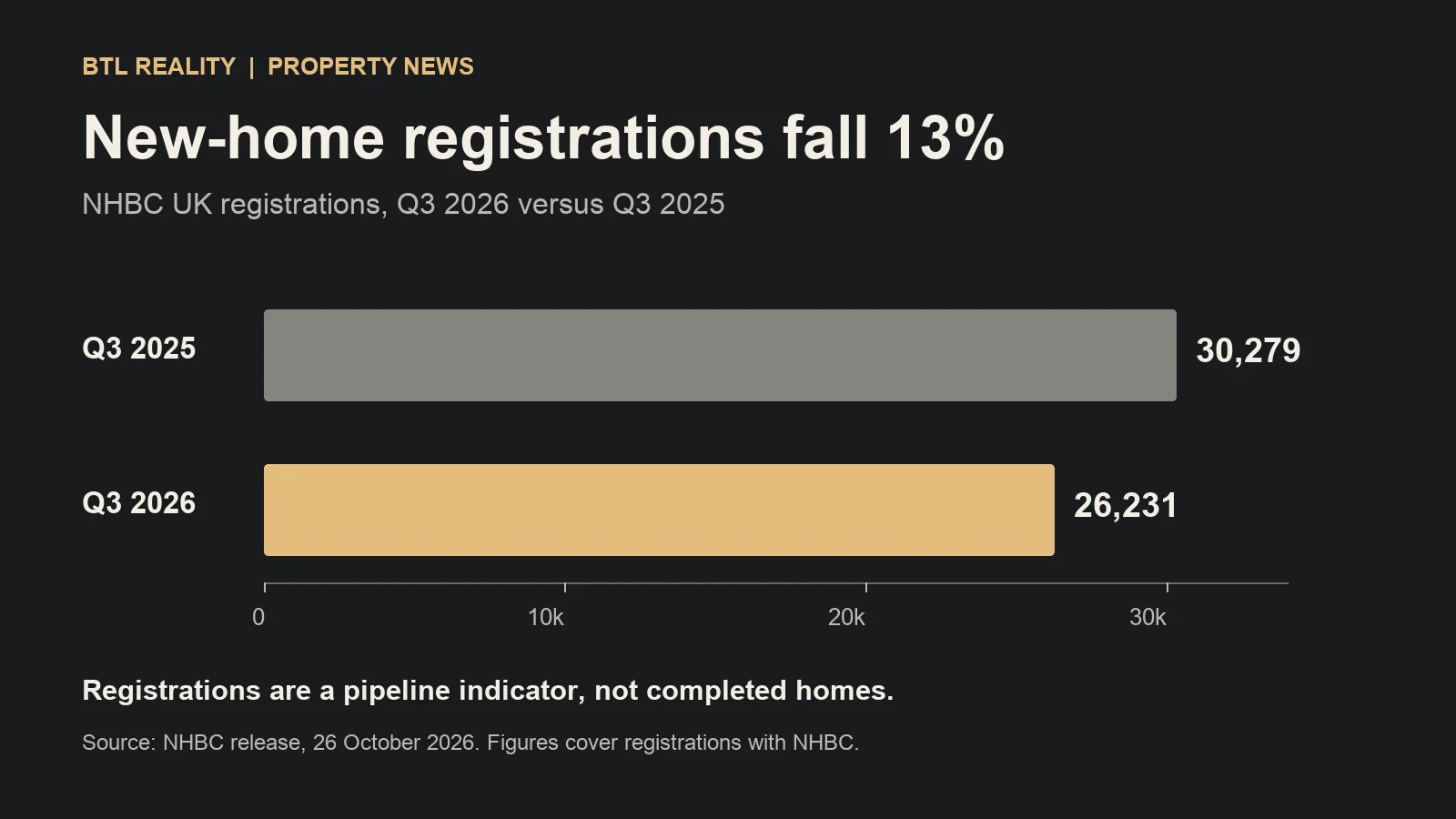
In its 26 October release, NHBC reports 26,231 new-home registrations in the third quarter of 2026, against 30,279 a year earlier, a fall of 13%. Those are the comparisons in the current release.
I would use that warning to ask better questions about a purchase. I would not add a scarcity premium to an asking price and assume the rent will catch up. The useful question is whether the actual property works at the price, borrowing cost and achievable rent in front of you.
What changed in the latest figures?
| NHBC registrations | Q3 2025 | Q3 2026 | Annual change |
|---|---|---|---|
| All homes | 30,279 | 26,231 | Down 13% |
| Private | 20,054 | 18,359 | Down 8% |
| Rental and affordable | 10,225 | 7,872 | Down 23% |
The figures concern July to September. Percentages are rounded, and the rental and affordable category is NHBC’s combined classification. It is not a count of every privately owned buy-to-let property.
The larger fall in that combined category deserves attention. However, it would be a mistake to convert it into a claim that private rental stock has fallen by the same proportion. Existing homes being bought, sold or let are a different part of the market.
A registration is not a completed home
These are homes registered with a warranty and insurance provider before construction, rather than keys handed to buyers. NHBC separately offers information on starts, completions and building stages through its residential construction statistics.
That makes registrations useful as a pipeline signal. It does not make them a complete measure of housing added across the UK. Nor can a quarterly UK comparison directly establish how an England-only government building target is progressing.
Timing also matters. A development registered this quarter may reach occupants later, while a home completed today may have entered the pipeline much earlier. Before using a headline to support a buying decision, establish which stage it measures.
I would keep a similar distinction when looking at a proposed development nearby. Planning, an active site, a completed building and a home genuinely available to rent are different pieces of evidence. They answer different questions about competition and delivery.
Check the local market before changing your offer
NHBC reports declines in ten of its twelve regions, with Yorkshire and the Humber and the West Midlands recording increases. That variation is another reason to investigate the particular area rather than buy the national story.
For a rental purchase, I would compare similar homes within a sensible local area. Look at property type, condition, parking, transport links and the tenant you expect to attract. A new family house and a furnished city-centre flat can face very different competition.
Ask how much competing accommodation is actually available and how long it has been marketed. Check the proposed rent against credible alternatives, not simply the highest advertised figure. An asking rent is a starting point for investigation, rather than proof that someone has agreed to pay it.
Future supply belongs in that assessment, alongside employment, tenant affordability and the quality of the existing stock. It cannot replace those checks. A smaller pipeline may coexist with weak demand, and a growing area may still have poorly priced properties that struggle to let.
New build or existing property: compare the whole deal
A new home might offer the layout and specification your target tenant wants. An existing property might offer a lower purchase price or a more established rental comparison. Neither description settles the investment case.
I would compare the purchase price, immediate work, likely ongoing costs and realistic rent. Include development or estate charges where they apply, and establish what the documents actually require. Do not assume that a new property removes the need for maintenance or a cash reserve.
The new-build versus existing-property guide provides a framework for that comparison. Put both options through the same assumptions, so an attractive brochure or a tired kitchen does not do the thinking for you.
For an unfinished purchase, use the off-plan buy-to-let guide to structure the checks. Ask about the build programme, the evidence supporting the expected handover and what your contract says if it slips. Have the relevant professionals explain the finance and deposit arrangements for that particular purchase. A national registration figure cannot answer those questions.
A £200,000 example: income and delay are different tests
Here is a hypothetical deal, not one of my properties or a forecast. Assume a £200,000 purchase, a £150,000 interest-only loan at 6%, rent of £1,100 a month and £150 of other monthly operating expenses.
| Monthly assumption | Calculation | Amount |
|---|---|---|
| Rent received | Assumed | £1,100 |
| Interest | £150,000 × 6% ÷ 12 | £750 |
| Other operating expenses | Assumed | £150 |
| Remaining cash | £1,100 − £750 − £150 | £200 |
That £200 is before tax and additional reserves for repairs, replacements or other capital costs. The example also excludes purchase costs. It is not £200 of guaranteed spendable profit.
Use the buy-to-let deal calculator beside your actual rent evidence and cost estimates. Replace the assumptions with figures for the property you are assessing, and test what happens when one of them disappoints.
Now assume letting is delayed for three months after the borrowing has been drawn, while the £150 monthly expenses continue. Interest would be £2,250 and those other expenses £450. You would need £2,700 of cash to meet them, with no rent coming in during that period.
This is a specific funding assumption. It does not mean every off-plan buyer pays a full mortgage from reservation. Check when your own borrowing and expenses actually begin.
The three months also contain £3,300 of rent that the original plan expected to receive. Do not add that to the holding costs and call the result a £6,000 loss. The original three-month plan already included those costs and left £600. The delayed version requires £2,700, a £3,300 deterioration against that plan.
The practical question is whether you can fund the delay without relying on the first tenant’s payment. A sensible-looking monthly result can still leave you exposed when the start date moves.
What I would establish before committing
First, separate a property that is ready to let from one whose income depends on work, completion or another event. Write down what needs to happen, who controls it and when the associated costs start.
Second, check your expected rental start against your borrowing arrangements. Ask what happens if a mortgage offer expires before completion or the final valuation differs from your purchase price. Get answers for the actual product and contract, rather than assuming flexibility.
Third, identify the cash available after the purchase. A deposit and an operating reserve do different jobs. If the transaction uses every pound, a delay or an early repair can become a financing problem.
Finally, record what would make you renegotiate or walk away. That could be unsupported rent, an unresolved cost or unacceptable completion uncertainty. A headline about future supply should not overrule a problem you have already identified in the deal.
Keep Budget expectations outside the base case
This release arrives before the 28 October Budget. There is plenty of discussion about support for housing, but an investment appraisal should distinguish an announced intention from published terms and an option you can actually use.
I would assess the purchase without assuming a future scheme will improve its price, rent or financing. If confirmed policy changes later alter the numbers, reassess them then. Do not commit to a marginal deal because somebody expects the Budget to rescue it.
If you want to work through the decision, the property strategy call is a relevant next step. Bring the purchase price, rent evidence, finance assumptions and available reserve. Those figures make the conversation useful.
Your questions answered
Does the 13% fall mean fewer homes have already been completed?
No. This release measures NHBC registrations, which concern the building pipeline. Completions are a separate measure. Check the stage and geographical coverage before using any housing statistic.
Does the rental and affordable figure measure all private buy-to-let homes?
No. It is a combined registration category. It does not measure every existing privately rented property, so it cannot establish an equivalent fall in private rental stock.
Should I pay more because fewer homes are entering the pipeline?
The headline alone does not justify a higher offer. Compare completed sales, competing properties, realistic rent and your costs. Future supply is one part of the local assessment.
What does the three-month delay example require in cash?
Under the stated assumptions, £2,700 covers interest and continuing expenses. That assumes borrowing is already drawn. Your own exposure depends on the timing of the loan, completion and operating costs.
Is the £200 monthly remainder profit I can spend?
It is a hypothetical pre-tax cash remainder before additional reserves and capital costs. It excludes acquisition costs and assumes the rent is received. Decide what reserve the actual property needs before treating any amount as available income.
Should I wait for the Budget before buying?
There is no universal answer. Assess the current deal and identify any specific policy uncertainty affecting it. If you need an unconfirmed future benefit to make the purchase work, the present appraisal is incomplete.
This article is educational information. The cash-flow scenario is illustrative and does not predict investment returns.