Should I Buy a New-Build or an Older Buy-to-Let?
October 5, 2026
A new-build buy-to-let is not automatically a better investment because it is new, and an older property is not automatically better because it looks cheaper. Compare the complete cash commitment, realistic rent, running costs, financing and likely maintenance. Then ask which property fits the type of landlord you want to be.
A clean specification and a reassuring brochure can make a decision feel easy. An older house with cosmetic potential can create the opposite temptation: assuming every pound of work will add more than a pound of value. Both need evidence.
Compare properties that solve the same problem
Comparing a central new-build flat with an older suburban house is partly a comparison of location, tenant market and tenure. You cannot attribute every difference in rent or costs to the building's age.
Start with a clear brief. Who is likely to rent the property? What can that household afford? How do transport, employment, layout and local alternatives support demand? A modern finish is useful only if tenants value it enough to support the expected rent.
My article on houses versus flats for buy-to-let explains why the property type itself matters. Keep that question separate from whether the building is newly constructed.
A worked comparison before mortgage costs
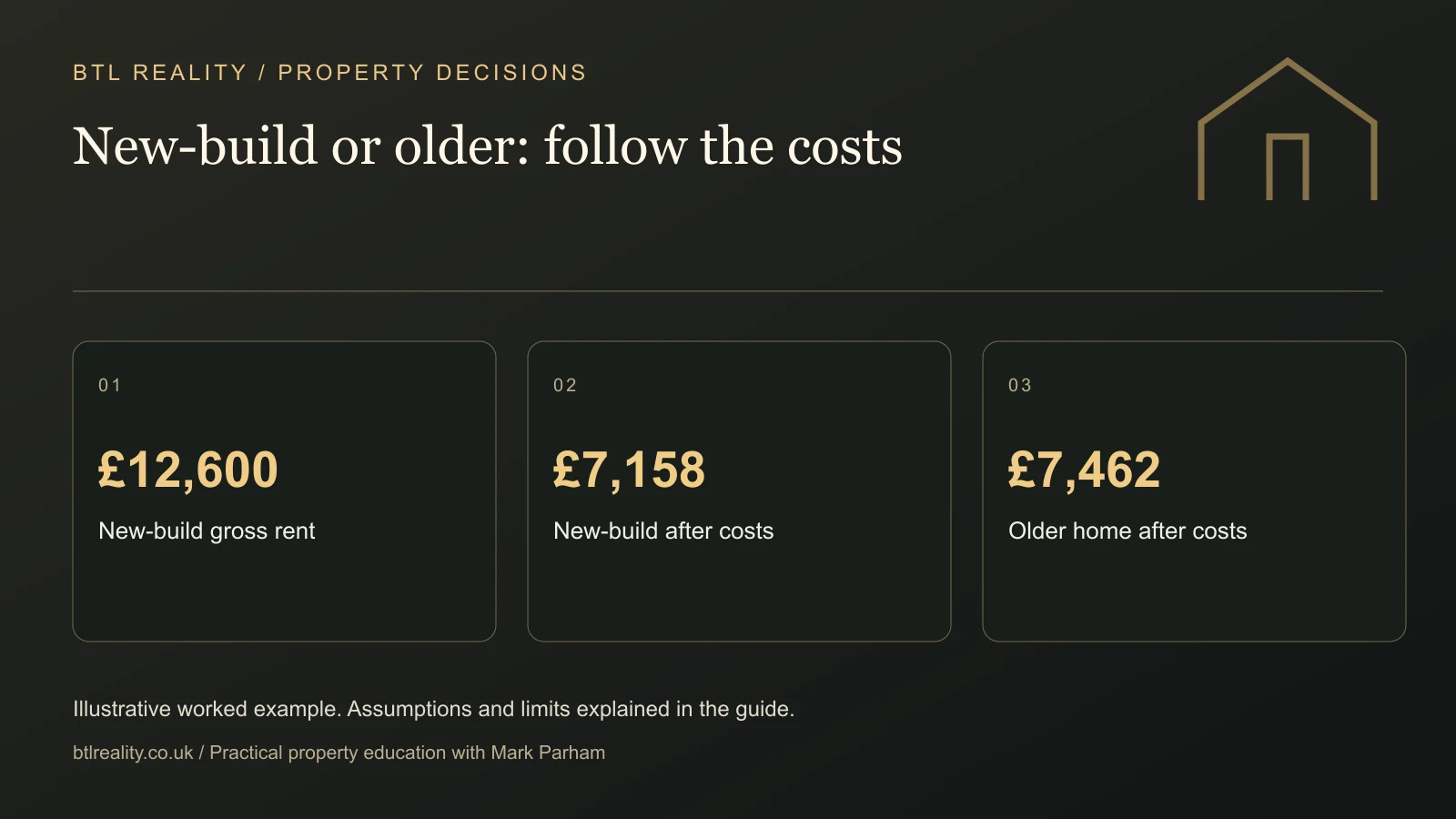
Consider two hypothetical purchases at £180,000 each. Property A is a new-build flat renting for £1,050 a month. Property B is an older house renting for £950 a month. Gross annual rent is £12,600 versus £11,400, so the flat initially looks £1,200 better.
For the flat, assume £1,512 management, £2,400 service charges, £600 maintenance allowance, £630 vacancy allowance and £300 of other costs. That leaves £7,158 before finance and tax.
For the house, assume £1,368 management, £1,500 maintenance, £570 vacancy allowance and £500 insurance and other costs. That leaves £7,462 before finance and tax. The lower-rent property has a £304 annual advantage under these assumptions.
These are deliberately simplified examples, not typical market costs. The maintenance allowance is not a prediction of the next repair bill. If the house needs a £12,000 roof, or the flat's service charge is materially lower, the comparison changes. That is the point of separating the inputs.
Make the example your own
Rent is only the first line
Compare annual income after operating costs, before debt and tax. The two properties both cost £180,000 in the example.
Upfront works, finance, tax and sale outcomes are separate. Illustrative only. Inputs stay in this page and are not saved or sent.
Now add the different cash commitments
Suppose the older house requires £10,000 of work before letting and the new-build needs £2,000 of initial spending. With the same deposit and other costs, the older property ties up £8,000 more cash initially.
Its £304 annual operating advantage would not quickly recover that difference. However, the work might preserve value, improve tenant appeal or reduce later repairs. Those possibilities need evidence and should not be quietly counted as guaranteed gains.
Use the buy-to-let deal calculator for both properties. Include initial works, any rent-free period before occupation, lender fees and your retained reserve. Compare cashflow and return on cash invested as well as headline yield.
Understand incentives without double counting them
Developers may offer cashback, contributions to costs, furniture or other incentives. Ask what the package is worth to you, whether you would have bought the items anyway and how the lender treats it.
An incentive may affect the lender's assessment rather than simply reducing your cash contribution. The Mortgage Works' new-build criteria provide one example of policy around financial incentives and property requirements. Other lenders differ, so disclose the complete package to your broker and solicitor.
Do not subtract a £5,000 incentive from the purchase budget and also treat the same £5,000 as extra equity. If furniture is included, do not count its retail price as a guaranteed resale uplift. Record what is actually provided and how it changes the cash paid.
New does not mean maintenance-free
A new property can still have defects, incomplete work or operating issues. Understand the warranty, its provider, what is covered, exclusions, reporting deadlines and who handles defects at different stages.
Commission appropriate inspection or snagging work and keep a record of outstanding items. A warranty is not a replacement for understanding the building, nor does it automatically cover inconvenience, lost rent or every finishing issue.
For leasehold property, look beyond the individual flat. The building's service budget, shared facilities, management arrangements and future obligations can affect your returns. Check whether the initial budget is realistic and which costs could change after occupation.
Older property needs a scope, not an optimistic allowance
For an older purchase, separate essential condition work from optional improvements. A fashionable kitchen is not more urgent than unsafe electrics, water ingress or a defective stair.
In the Rugby and Kettering case studies, I discussed whether additional refurbishment spending was justified by the likely rent. The useful lesson is proportionality: spending more is not automatically investing better. Those examples contain projections and changing assumptions, so they should not be treated as verified completed returns.
Get a written scope and comparable quotations. Allow for access, making good, waste removal, professional checks, delays and contingency. A cheap purchase becomes expensive when essential work is omitted from the appraisal.
Finance and completion timing can decide the outcome
A new-build purchase can involve a gap between reservation and completion. Clarify what happens if construction is delayed, the mortgage offer expires or the completed property differs from expectations. Ask your solicitor to explain the contract and relevant deadlines before commitment.
An older property may instead face condition-related finance restrictions or a chain. Neither route is automatically faster. Budget the actual sequence: when cash is committed, when borrowing starts, when work finishes and when rent can realistically begin.
The mortgage rate alone is not enough. Compare lender fees, valuation treatment, loan limits, incentives, tenancy restrictions and the intended exit. A seemingly suitable product can be unsuitable for the particular building or transaction.
Think about the future buyer as well as the tenant
Ask who is likely to buy the property when you eventually sell. Would the appeal extend beyond investors? What competing supply might exist? Are there lease, construction or service-charge issues that could narrow the market?
Do not assume the premium paid for a brand-new unit survives unchanged once it is an ordinary resale. Equally, do not assume an older property will rise in value merely because you have refurbished it. Sold comparables and realistic condition assessments matter for both.
Model a flat-value exit after selling costs. If the investment only looks attractive when you add strong annual growth, make that dependence explicit. Rental cashflow and capital growth are different parts of the return.
The decision I would make
I would choose the property that fits the brief after realistic costs, rather than declaring a winner by age. A newer property may suit someone who values a smaller initial work programme. An older property may offer a better purchase price or more control over improvements. Neither advantage should be assumed.
Write down the three facts that could change your preference, then investigate them. They might be the service-charge documents, the roof survey or evidence for the proposed rent. That gives the due-diligence process a purpose.
Use the free rental yield and cashflow calculator to compare the ongoing numbers. If you want a search focused on your budget and objectives, Done For You explains our sourcing service. The brief should drive the property choice, not the brochure.
Frequently asked questions
Do new-build buy-to-lets always need less maintenance?
They may require less immediate refurbishment, but they can still have defects and ongoing upkeep. Shared-building charges can also fund maintenance outside your individual flat. Inspect the property, understand warranty limitations and retain a reserve. Compare the actual condition and obligations rather than assigning zero maintenance because the building is new.
Is a developer's rental guarantee enough to prove the rent?
No. Separate any contractual payment promise from the rent ordinary tenants are likely to pay after it ends. Check local evidence, the guarantor, exclusions, duration and costs. A short guarantee can make early cashflow look attractive while concealing a weaker underlying rental position that matters for long-term ownership and refinancing.
Can a developer pay my buy-to-let deposit?
Incentives require full disclosure and lender-specific assessment. Their treatment may affect the accepted price, valuation or maximum advance. Do not assume a contribution removes your required cash deposit. Give the broker and solicitor the complete package, including cashback and included items, before relying on any advertised cash requirement.
Are older houses better than new-build flats for rental yield?
Not universally. You are comparing building age, tenure, location and property type at once. An older house may have fewer shared charges but larger individual repair obligations. A new flat may achieve higher rent but cost more to operate. Compare realistic net figures and the initial cash commitment for each specific property.
Should I include service charges in buy-to-let cashflow?
Yes, where you are responsible for them. Read the documents to avoid omitting charges or double-counting costs already included. Also investigate major works, reserve funds and potential changes. A current monthly payment is useful evidence, but it may not capture every future building obligation or the complete cost of ownership.
Can a new-build lose value when I resell it?
Yes, as can an older property. The next buyer assesses competing stock, condition, financing and market conditions at that time. Do not assume every incentive or specification premium is recoverable. Test a sale without capital growth after disposal costs so you understand how much of the investment case depends on appreciation.
Put the next step into practice
Use the free tools to test your numbers, then choose the level of support that fits your next decision.