When Will Interest Rates Come Down in the UK?
October 3, 2026
There is no confirmed date when UK interest rates will come down again. At its 17 September 2026 meeting, the Bank of England held Bank Rate at 3.75%, with six members voting to hold and three preferring an increase. The next scheduled decision is 5 November 2026. That is a review date, not a promised cut.
For a property investor, the more useful question is what borrowing costs your deal can sustain and which mortgage terms are actually available. Bank Rate, fixed mortgage pricing and your own product are related, but they do not move in a guaranteed one-for-one sequence.
This guide explains what could support lower rates, what could delay them and how to model the effect without building a purchase around a prediction. The examples are interest calculations, not current product quotations or personalised mortgage advice.
What has the Bank of England actually said?
The September 2026 decision and minutes show a hold at 3.75% and a divided committee. Energy-related inflation risks form part of the context. A decision to hold does not imply that the next move must be down, especially when some members preferred a higher rate.
The official MPC calendar lists the next meetings. A scheduled date tells you when a decision is expected, not its outcome. Markets, economists and lenders may form expectations before then, and those expectations can change as new evidence arrives.
For a live purchase, use the official decision as background and ask a broker about the available products and conditions. A headline about a future Bank Rate level is not a mortgage offer, and a quoted product can have fees or eligibility conditions that materially affect the comparison.
What could make rates fall?
A sustained easing in inflation pressures can support the case for lower rates, depending on the wider economic outlook. Policymakers consider evidence about prices, wages, demand and the risk that inflation remains persistent. One encouraging monthly figure is not the whole decision.
Mark’s view is that lower oil prices could help reduce inflation pressure and create room for lower borrowing costs. That is a plausible scenario to examine, but it is not a guaranteed chain of events. Exchange rates, other energy costs, domestic wage pressures and the wider economy can affect how it develops.
Use that view as an upside case in your property model. If the investment works at an available mortgage rate and becomes stronger when rates fall, the forecast is a possible benefit. If it only works after a specific reduction, the forecast is doing essential work that needs to be acknowledged.
What could keep rates higher for longer?
Inflation can remain persistent even when one input, such as oil, becomes cheaper. The broader price picture and expectations matter. Economic shocks can also change the balance between supporting activity and controlling inflation.
For an investor, this means retaining a scenario where refinancing is more expensive than hoped. A rate cut that arrives later than expected may be irrelevant if your existing mortgage deal ends first. The date of your own financing decision matters as much as the national forecast.
Avoid assuming that the next mortgage will replicate the unusually cheap borrowing available in an earlier period. A business model should be tested against a range of plausible costs, including one that leaves substantially less rental surplus. The purpose is resilience, not guessing the committee’s vote perfectly.
Why fixed mortgage rates can move before Bank Rate
A fixed mortgage locks a rate for a period, so its pricing reflects more than today’s overnight policy rate. Market expectations, funding conditions, competition, risk and the lender’s product decisions all play a role. A fixed rate can move while Bank Rate is unchanged.
That explains why waiting for an announced cut may not produce the exact bargain you expect. Some anticipated movement may already be reflected in product pricing, while other developments may offset it. Equally, a lender can change an offer for reasons that are not a simple response to the latest MPC vote.
Compare the full product: initial rate, arrangement fees, valuation and legal costs, early repayment charges, term and eligibility. A lower headline percentage with a substantial fee may not be the cheapest option over your expected holding period. A qualified broker can help compare the actual alternatives.
What a one-percentage-point change does to a buy-to-let
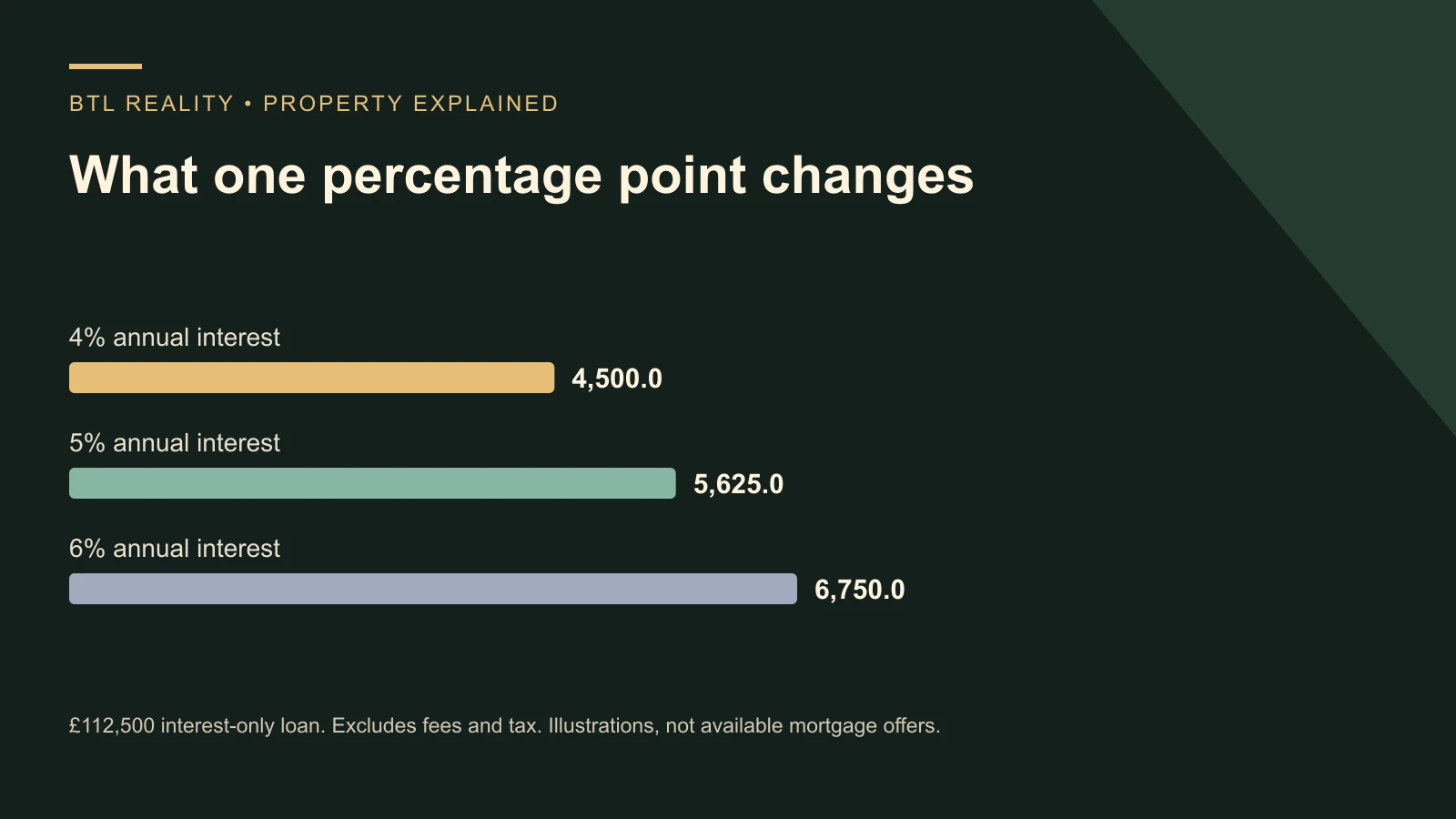
On a £112,500 interest-only loan, a 5% annual rate produces £5,625 yearly interest, or £468.75 monthly. At 4%, it becomes £4,500 yearly or £375 monthly. The difference is £93.75 a month, or £1,125 a year, before considering any fees or tax treatment.
At 6%, monthly interest would be £562.50. The same one-percentage-point move works in the opposite direction, reducing your surplus by £93.75 compared with 5%. The effect scales with the amount borrowed, which is why a heavily financed portfolio can be sensitive to relatively small rate changes.
This is interest-only arithmetic. A repayment mortgage includes capital repayment, so its monthly payment is calculated differently. A lower repayment instalment also changes the balance between interest and principal over time. Do not use an interest-only saving as the answer for every mortgage type.
Compare two interest-only mortgage rates
Interest-only arithmetic on a constant balance, not a mortgage quote. Excludes fees and tax. Repayment mortgages have a different payment calculation.
Lower interest is not the same as higher profit after every cost
Suppose a rental generates £250 monthly before tax after its existing operating costs and mortgage interest. An illustrative £93.75 monthly interest saving would lift that figure to £343.75 if everything else stayed unchanged.
But imagine the replacement product carries a £2,000 fee paid upfront. Spread over a two-year comparison period, that fee represents approximately £83.33 monthly, ignoring financing effects and tax. Much of the headline interest saving has now been absorbed in the comparison. This does not mean such a product is always poor value; it means fees belong in the calculation.
Repairs, insurance, management and voids can change too. The buy-to-let deal calculator helps examine the wider rental model. Keep the full mortgage quotation and tax assessment alongside it rather than treating the interest slider as a complete investment appraisal.
Should you buy now or wait for lower rates?
Start with a property that meets a defined brief and a price supported by evidence. Obtain an available mortgage quote and model the purchase costs, reserves and ongoing income. Then test lower and higher rate scenarios without replacing the actual quote with the most attractive assumption.
Waiting may improve the financing, but it can also change the purchase price, available stock or your own eligibility. There is no universal answer that follows from a forecast alone. A property bought poorly with cheaper debt can be less attractive than a well-bought property with more expensive but sustainable finance.
Read is now a good time to buy UK property? for a worked acquisition example. The aim is to separate what you can verify today from what you hope will improve later. That makes the decision easier to explain and stress-test.
What if your mortgage deal ends soon?
Write down the expiry date, outstanding balance, current payments and any early repayment charges. Ask the lender or broker about the options and the timescale needed to review them. Do not wait until the final week while expecting a favourable MPC decision to solve the process.
Compare the consequences of different product choices over a relevant period, including fees and flexibility. The appropriate answer depends on your finances, property, planned holding period and ability to absorb payment changes. A generic blog cannot decide whether a fixed, tracker or other arrangement is suitable for you.
If a payment increase would create difficulty, speak to the lender or an appropriately qualified adviser promptly. Avoid relying on a future rate cut as the sole repayment plan. Good information and early action are more useful than repeatedly refreshing a forecast.
How interest rates connect with house-price predictions
Cheaper borrowing can improve purchasing capacity for some buyers, which may support demand. But house prices also depend on incomes, supply, confidence, credit availability and local conditions. A particular rate cut does not mechanically produce a specified percentage increase in house prices.
The 2027 property-price predictions article compares published forecasts with Mark’s separate 5% growth scenario. Its inflation and earnings analysis provides historical context, not proof that either rates or prices must follow a chosen path.
Be careful about counting the same optimistic assumption several times. A plan that assumes cheaper debt, faster capital growth, stronger rent and easy refinancing may be attractive on paper because every variable improves together. Also run a case where those benefits do not arrive on your preferred schedule.
Turn the forecast into a practical plan
List the events you control: the maximum purchase price, cash committed, reserve retained, professionals appointed and type of property considered. Then list the events you do not control: future policy rates, lender pricing, market values and the timing of a buyer or tenant.
Build the base case around evidence and current terms. Use the optimistic case to understand possible upside and the downside case to check survivability. A sensible investment does not require certainty, but it does require knowing which assumptions could hurt you most.
If you want structured help developing that framework, explore Starter Club and the free resources. For an actual mortgage selection or affordability assessment, use a qualified broker. The most useful forecast is one that improves your preparation rather than persuades you to ignore the risk.
Frequently asked questions
When is the next UK interest-rate decision?
After the September 2026 meeting, the next scheduled MPC decision is 5 November 2026. A scheduled meeting is not a promise of a cut. Check the Bank of England’s official calendar and announcement for the actual decision, particularly if your own mortgage deadline is approaching.
Are UK interest rates guaranteed to fall in 2027?
No. Forecasts and market expectations can change with inflation, economic activity and other developments. A lower-rate scenario may be useful for planning, but it should not be treated as a guaranteed financing offer. Test whether your property remains sustainable if the expected reduction is delayed or absent.
Will lower oil prices automatically mean lower mortgage rates?
No. Cheaper oil could ease some inflation pressure, but the broader economic picture, market expectations and lender pricing also matter. The effect is neither guaranteed nor necessarily immediate. Keep the scenario separate from a current mortgage quotation and compare the full product costs.
Why can fixed mortgage rates rise when Bank Rate stays the same?
Fixed-rate pricing reflects expected future conditions, funding costs, competition and lender decisions, not only the current Bank Rate. Those factors can change between MPC meetings. The direction of a particular mortgage product therefore need not match the latest policy-rate announcement exactly.
How much does a 1% rate cut save on a £112,500 loan?
For an interest-only loan with the full balance unchanged, a one-percentage-point annual rate reduction saves £1,125 a year, or £93.75 monthly, before fees and tax effects. Repayment mortgages use a different payment calculation. Confirm the terms and amount of the actual loan.
Should I delay a property purchase until rates fall?
That depends on the property, price, finance, reserves and your objectives. Waiting changes more than the interest-rate assumption. Compare a verified deal today with clearly labelled alternatives, and avoid a purchase that only becomes sustainable after an uncertain future cut unless that risk is properly understood.