Making Tax Digital for Landlords: Do You Need It Now?
October 3, 2026
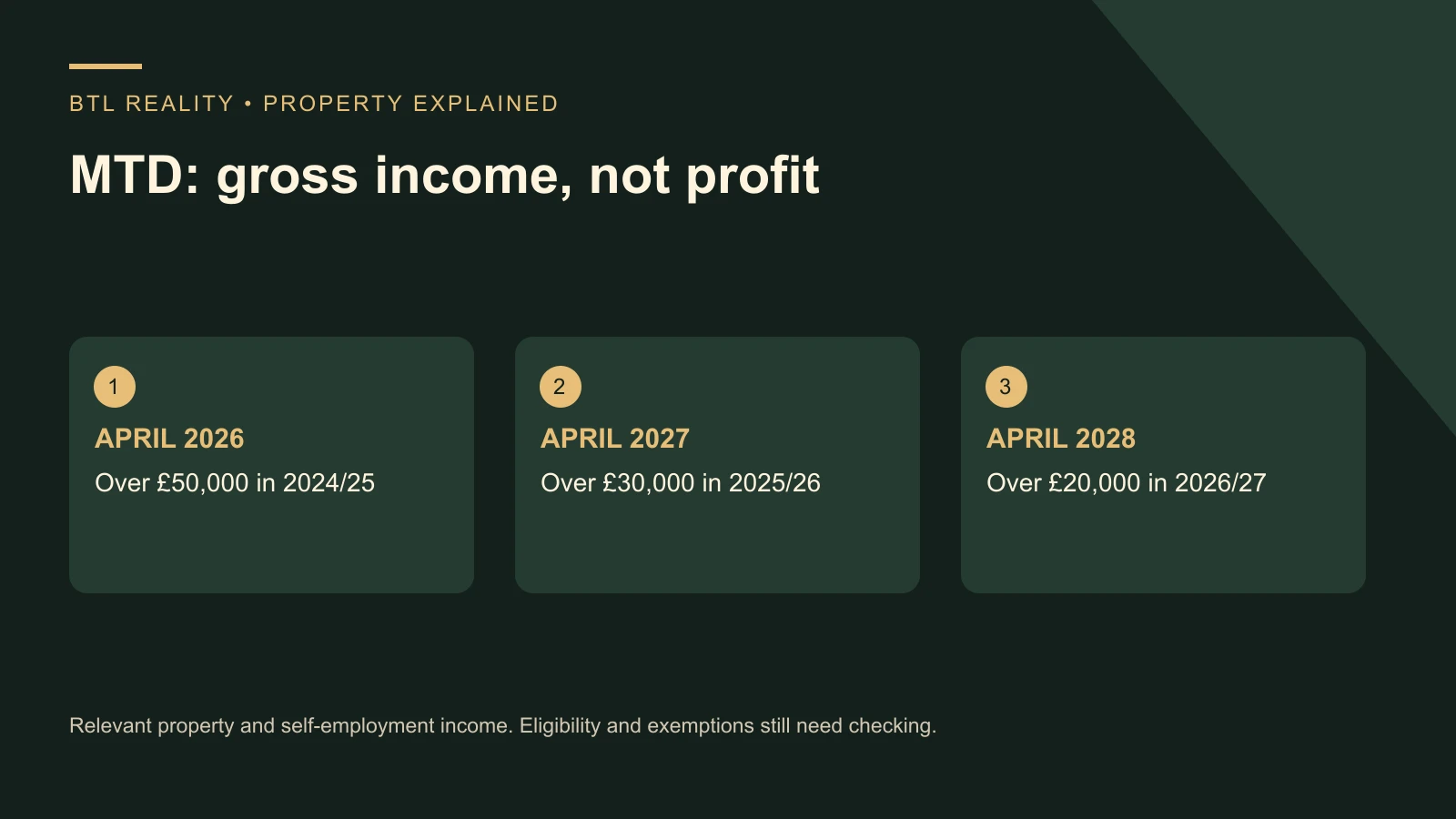
Making Tax Digital for Income Tax began in April 2026 for eligible sole traders and landlords with qualifying income over £50,000 in 2024/25. The important word is income: the threshold generally concerns gross property and self-employment income before expenses, not the profit left after mortgages, repairs and management. Lower thresholds bring more people into scope in later years.
For a landlord, the practical change is keeping the relevant digital records and sending updates through compatible software. It does not mean that every quarterly update is a separate tax return or a demand to pay the final annual tax bill four times.
This is a UK tax-reporting topic, distinct from England-only tenancy reforms. Eligibility, residence, exemptions and unusual income sources require their own checks. Use this guide to prepare the numbers and questions for HMRC or your accountant, rather than as a personal tax determination.
Who needs Making Tax Digital in 2026, 2027 and 2028?
HMRC’s eligibility guidance sets out the phased thresholds. Qualifying income over £50,000 in 2024/25 leads to the April 2026 start. Over £30,000 in 2025/26 leads to April 2027. Over £20,000 in 2026/27 leads to April 2028, subject to the applicable rules and exemptions.
These are tax-year tests, not a comparison with whatever arrived in your bank account last month. Use the correct year and relevant return. A threshold described as “over” is also not the same as “equal to or over”, so retain the actual figures rather than rounding a borderline case casually.
If you have not received a letter, do not assume you are outside the regime. HMRC says individuals remain responsible for checking whether and when they need to use it. Its official checker and a qualified tax adviser are the appropriate routes where your circumstances are uncertain.
What counts as qualifying income?
HMRC explains qualifying income as the relevant total from self-employment and property before expenses. Multiple relevant sources can combine. PAYE employment income, pensions and dividends are examples of other income that do not themselves count towards this particular threshold.
That creates an important distinction for a salaried investor. A large salary does not automatically put the person into MTD for Income Tax, while several modest rentals plus a self-employed business may do so. The tax due on the overall position is a separate calculation from this entry test.
Joint ownership also needs care. Your share of the property income is relevant, rather than automatically taking the entire property’s receipts as your own. HMRC describes special treatment where a joint owner only receives notice of a net share. Ask your accountant to confirm the correct figure for the actual reporting arrangement.
Three worked examples
Investor A has £32,000 of relevant gross property income and £21,000 of sole-trader income in 2024/25. The combined figure is £53,000. Assuming the other requirements are met and no exemption applies, that exceeds the £50,000 threshold for the April 2026 start. Deducting expenses first would produce the wrong threshold test.
Investor B earns £120,000 through PAYE and has £18,000 of relevant property income, with no other qualifying source. The salary does not turn that £18,000 into £138,000 for this purpose. B must still consider ordinary tax reporting and later-year changes, but the salary alone is not a reason to call the MTD threshold exceeded.
Investor C receives a 50% share of £60,000 of gross joint property income, with no other qualifying source. The illustrative share is £30,000. That is not above a £30,000 threshold merely because the whole property earns more. Confirm the actual ownership, reporting treatment, year and other income before drawing a conclusion.
Add relevant annual income
Arithmetic only. Use the correct tax year and your own share. Excludes salary, expenses and exemption assessment. Confirm eligibility with HMRC or an accountant.
What happens every quarter?
HMRC’s quarterly-update guidance explains that updates are cumulative from the start of the tax year to the end of the relevant period. They are not simply four disconnected three-month summaries. Your compatible software and accountant should handle the appropriate reporting structure.
The standard deadlines are 7 August, 7 November, 7 February and 7 May following the tax year. For standard periods, the November update covers the cumulative period from 6 April to 5 October. Calendar-period options have their own period ends but the same stated deadlines.
As at this article’s October 2026 check, the first 7 August deadline has passed and the next is 7 November 2026. If you should already be using the system but are not ready, speak to your accountant or HMRC promptly. Do not assume that waiting for the next annual Self Assessment deadline resolves the missing digital-record and update work.
Do quarterly updates mean quarterly tax payments?
The reporting timetable should not be confused with the tax-payment timetable. A quarterly update provides information from digital records; it is not the final annual tax calculation by itself. Existing payment obligations, including any applicable payments on account, need separate planning.
The annual return still matters. HMRC’s guidance explains that the return for the year before you start MTD is submitted through the normal process, while the later MTD year follows the compatible-software arrangements. Agree with your accountant which return and deadline each task relates to.
This is a common source of diary confusion. An investor can have a quarterly update for the current year and an annual return for the previous year approaching close together. Label the year clearly in your records so a completed November update is not mistaken for completion of the previous year’s tax return.
What software do landlords need?
Use HMRC-compatible software suited to the income sources and workflow involved. Confirm that it can handle what you and your accountant actually need, rather than selecting purely on a low introductory price or a general “digital accounting” description.
A spreadsheet may form part of a compliant workflow where appropriate compatible bridging arrangements are used, but an ordinary spreadsheet on its own is not the same as an authorised submission service. Ask the provider or accountant how records, links, corrections and submissions will work.
Before committing, check ongoing pricing, multi-property support, joint-ownership handling, accountant access, exports and the process if you change provider. Keep ownership and access permissions proportionate. Do not share your HMRC password informally with someone offering to “sort it all out”; use the proper authorisation arrangements.
A monthly routine makes the quarter easier
Reconcile rent receipts and the managing agent’s statement against the underlying records. Separate gross rent from the net amount transferred after fees and repairs. Otherwise the bank feed can hide important information by treating the agent’s net payment as the entire transaction.
Attach or retain supporting invoices, identify unusual items for review and distinguish transfers from income. A bank transfer between your own accounts is not a new rental receipt. A deposit may have different treatment from rent, so do not classify every payment from a tenant automatically in the same way.
Set a short monthly review with a clear cut-off for sending questions to your accountant. The aim is to resolve uncertainty while documents and memories are accessible. Four hurried reconciliations built from missing receipts are not an improvement on one hurried annual exercise.
What about limited companies, overseas landlords and exemptions?
MTD for Income Tax is not the same regime as a limited company’s Corporation Tax reporting. If a company owns the property, do not simply apply an individual landlord threshold calculator to the company’s turnover. Investors who own both personally and through companies need their records separated appropriately.
Residence and other circumstances can affect scope and exemptions. HMRC provides guidance on checking eligibility and exemptions. Do not assume living abroad creates a permanent exemption, or that one family member’s status determines another’s.
Digital exclusion and other specified exemptions require checking against the current conditions. Some arrangements are temporary and some require action rather than operating automatically. An exemption from MTD does not generally remove the underlying need to report taxable income correctly through the relevant route.
Budget for the service, then judge the property
Software and professional support belong in the operating budget. Suppose additional software costs £20 monthly and extra accounting support is £300 annually. The illustrative total is £540 a year, or £45 monthly. Those are assumptions, not market quotes or a statement that every investor needs that package.
If a property’s pre-tax surplus was £250 monthly before those additional costs, it becomes £205 under the example. The investment may still work, but the spendable cash has changed. Use the buy-to-let deal calculator to include realistic operating allowances and keep your tax calculation with an appropriately qualified adviser.
For structured investor education, Starter Club can help you understand the business behind the purchase and organise the questions for your team. The landlord rules hub connects this reporting change with separate tenancy and property obligations. Do not let several different reforms become one vague task called “compliance”.
Frequently asked questions
Is Making Tax Digital based on rental income or profit?
The threshold generally uses qualifying gross property and self-employment income before expenses, not the remaining profit. Joint ownership and particular reporting arrangements need care. Use HMRC’s qualifying-income guidance and the correct tax year, then have an accountant check any uncertain or unusual position.
Does my salary count towards the MTD landlord threshold?
PAYE employment income does not itself count towards qualifying income for this threshold. Relevant property and self-employment income can combine. Salary may still matter to your overall tax calculation, but that is a separate question from whether the MTD entry threshold has been exceeded.
What is the next quarterly MTD deadline in October 2026?
For those already within the regime, the next standard update deadline is 7 November 2026. The update is cumulative from the start of the relevant year or period arrangement. Check the official guidance and software setup rather than reporting only the most recent three months by assumption.
Will landlords pay tax four times a year under MTD?
Do not equate quarterly reporting with four new final tax bills. Updates and tax-payment obligations are different processes. Existing payment dates and any payments on account still need separate planning, and the annual return remains important. Ask your accountant to map both timetables clearly.
Can I keep using a spreadsheet for property records?
A spreadsheet may be part of an appropriate compatible-software workflow, but it is not automatically sufficient on its own. Check digital-record requirements, any bridging arrangements and the submission process with your provider or accountant. Choose a setup that supports your actual income sources and records.
Do I need MTD if I have not received an HMRC letter?
A missing letter is not a reliable exemption. HMRC says you must check whether and when the requirements apply. Use its official eligibility guidance and seek advice if needed. If you should already be using MTD, act promptly to establish the correct registration and reporting position.