Do Rental Properties Need EPC C by 2030?
October 3, 2026
The government’s January 2026 policy response sets a planned higher energy-efficiency standard for private rentals in England and Wales from 1 October 2030, with a £10,000 investment cap and revised EPC metrics. The legislative changes remain subject to Parliamentary approval. The current minimum EPC E requirement continues to matter in the meantime, unless a valid exemption applies.
That is more precise than saying “every landlord must spend £15,000 by 2028”. The earlier consultation included different proposals. Investors should use the final policy response for planning, then check the actual regulations and guidance as implementation progresses.
For a property purchase today, the practical task is to understand the existing rating, likely work, cash required and timing. A cheap building can become an expensive investment if the improvement route is uncertain. A sensible plan can also coordinate works, reduce disruption and improve the home for the tenant.
What changed from the original proposals?
The government response published in January 2026 selected a £10,000 cap rather than the £15,000 consulted on. It sets a single planned compliance date of 1 October 2030 for all tenancies, rather than the earlier proposed split between new and existing tenancies.
It also describes a revised assessment using new EPC metrics. The policy combines a fabric-performance standard with a secondary standard based on either smart readiness or the heating system. The intention is not simply to force every landlord to replace a working boiler with a heat pump.
The document is a policy response, and it explicitly says the legislative changes are subject to Parliamentary approval. Keep that qualification attached to the future requirements. Treat the direction of travel seriously without claiming that every final operational detail is already law today.
What is the minimum EPC rating right now?
The current domestic private-rented MEES guidance remains the starting point for existing obligations. Relevant privately rented properties in England and Wales generally need EPC E or better unless an applicable exemption has been properly established and registered.
The current regime and its expenditure rules should not be confused with the planned higher standard. A landlord cannot assume that because the future cap is £10,000, every present exemption or duty automatically operates on that number. Read the guidance for the obligation actually being assessed.
Check the certificate itself, its expiry and the property it describes. A listing’s “EPC pending” note or an agent’s verbal assurance is not the same as a valid assessment. If the property has materially changed since the certificate, discuss the implications with an accredited assessor and your advisers.
Will an existing EPC C still count?
The policy response recognises early action. It says properties achieving C or above on the existing Energy Efficiency Rating before 1 October 2029 will be considered compliant with the higher standard until that EPC expires. The detailed transition and any replacement assessment should be checked against the final rules.
This creates a planning question, not a reason to commission work blindly. Ask an assessor what can credibly be achieved with the building and the current certificate. Obtain a realistic scope and evidence of completed improvements rather than buying individual products based on a promised number of EPC points.
Keep the certificate, recommendations, invoices and installation evidence together. If you later sell, refinance or change agents, the next professional needs to understand what was done. A claim that “it should be a C now” is weaker than a valid assessment and a clear file.
Plan an improvement reserve
Budget illustration, not an EPC quote, legal deadline or confirmation of qualifying expenditure. Excludes savings interest and future cost changes.
How does the £10,000 cap work in the policy?
The response describes a maximum required investment of £10,000 per property over a ten-year period for the higher standard, with an exemption route where the conditions are met. It also includes specific exemption arrangements, including a property-value adjustment for lower-value homes.
The cap is not a prediction of what your property will need. Some homes may require less work; some may be unable to reach the standard within the applicable cap. Nor does it mean any expenditure of £10,000 on the building automatically qualifies. Relevant measures, evidence, timing and funding treatment matter.
Do not assume every exemption is automatic or permanent. The response describes different categories and durations, with registration and supporting evidence. If you think a property may need an exemption, obtain advice on the actual conditions instead of treating the cap as a general permission to ignore improvements.
Worked example: build a reserve before the work
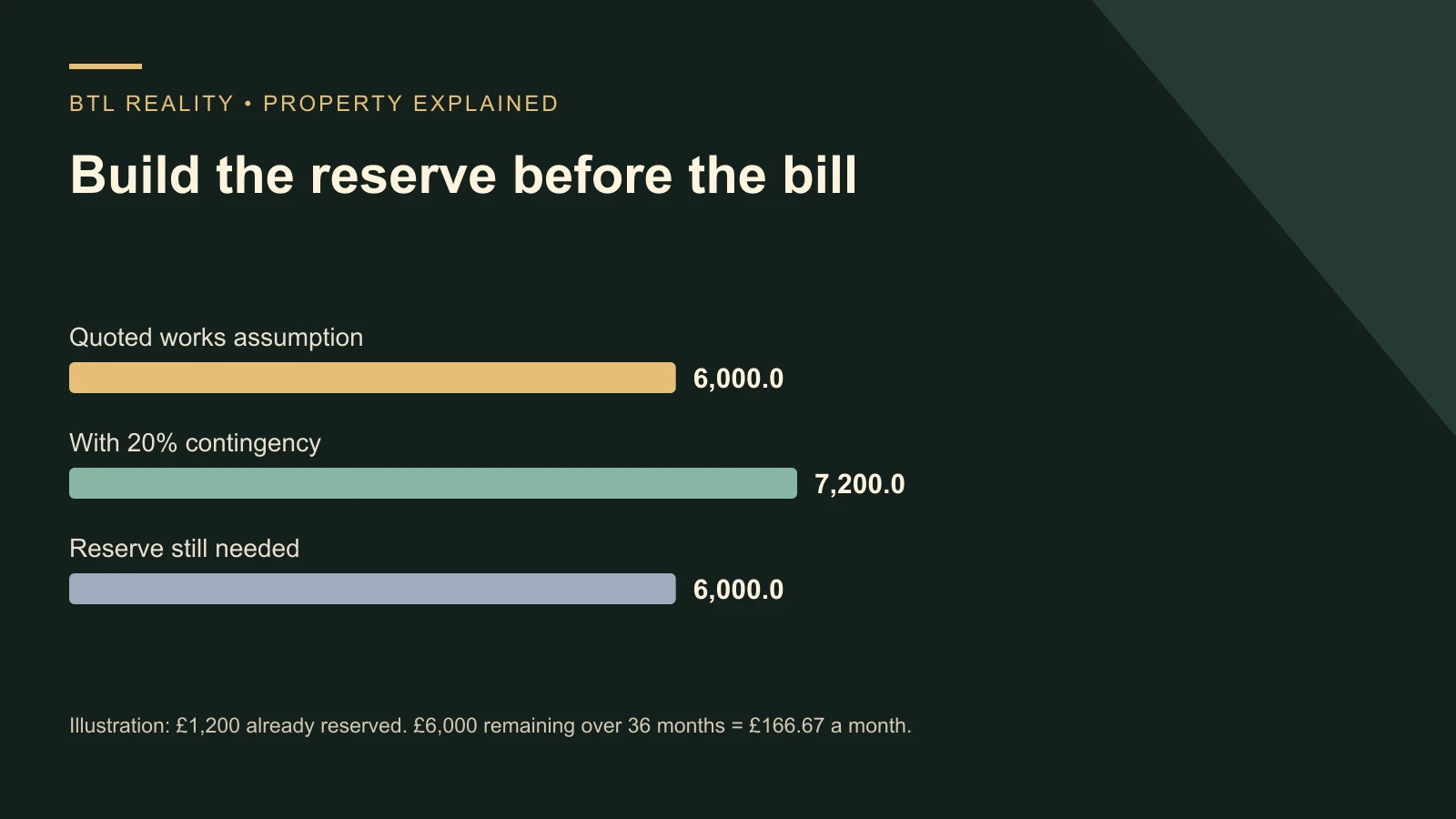
Suppose an assessor and contractors help you form an illustrative £6,000 improvement budget. You already have £1,200 ring-fenced and choose a 36-month saving period. The remaining £4,800 requires £133.33 a month, ignoring interest on savings and changes in the eventual cost.
Now add a 20% contingency to the works budget. The target becomes £7,200, and the amount still needed becomes £6,000. Over the same 36 months, the monthly saving rises to £166.67. That is an extra £33.34 a month in your planning allowance.
These figures are not quotes, a forecast of EPC costs or confirmation that the works qualify under a future cap. They show how an apparently distant capital expense affects today’s spendable rental income. If you withdraw every pound of surplus, the future bill has not disappeared; it has simply lost its funding plan.
Use the calculator to enter your own quoted budget, reserve and timeframe. The number of months is a planning choice, not an automatically calculated legal deadline. Include professional fees, access, making good and any other relevant costs in your estimate, then check their treatment separately for compliance and tax.
Why the cheapest measure may not be the best sequence
A building works as a system. Insulation, ventilation, heating controls, glazing and other improvements can interact. An apparently inexpensive change may be poor value if it has to be removed during later work or creates a ventilation problem that then needs correction.
Ask for an ordered plan based on the property’s condition and assessment. Coordinate suitable improvements with planned maintenance where sensible. If a roof already needs work, there may be practical reasons to assess insulation at the same time, but the correct design and permissions still matter.
Do not postpone a current safety or repair duty merely to combine it with energy work in 2030. Read the separate Awaab’s Law and private repairs guide for the distinction between future reforms and responsibilities that already apply.
What should buyers ask before making an offer?
Start with the current EPC and recommendations, then investigate the building rather than assuming the certificate answers every condition question. A survey and specialist advice may reveal issues that materially change the cost or feasibility of an upgrade.
For a leasehold property, establish who controls relevant parts of the building and whether consent is needed. For an older or protected building, consider planning and heritage constraints. For an occupied property, think about lawful access, disruption and how work can be delivered responsibly.
- What is the existing valid rating and expiry date?
- Which measures are recommended and technically suitable?
- What permissions, access or third-party consents are involved?
- What do itemised quotes include and exclude?
- How will the completed work be evidenced and assessed?
- What reserve remains after purchase and improvements?
Put the realistic acquisition and works costs into the buy-to-let deal calculator. A £5,000 purchase discount is not an automatic bargain if an unbudgeted £12,000 project is needed. Compare the total cash requirement, achievable rent and ongoing reserve with alternative properties.
Can you recover the cost through higher rent?
An improved home may be more attractive, and lower energy bills can matter to tenants. That does not establish a guaranteed rent premium or a right to increase rent by the amount spent. The market and the applicable rent-review rules still govern the decision.
Avoid a forecast that assumes every improvement produces an immediate uplift large enough to fund itself. Model a base case with no rent premium, then consider any supported upside separately. If the purchase only works after an unverified rent increase, the energy project is not the only uncertainty in the deal.
The rent-increase guide explains the relevant England process. Wales has its own tenancy framework, even where an energy-efficiency policy applies across England and Wales. Keep those jurisdictional differences visible in your plan.
Build a property plan that can absorb change
Rank your portfolio by evidence and urgency: current compliance concerns first, then certificates approaching expiry, then properties with uncertain or costly improvement routes. A vague portfolio-wide allowance is less useful than knowing which home needs investigation next.
If you are learning to assess deals, Starter Club can help you build a structured plan and ask better questions. If you want a property sourced against an agreed brief, discuss energy condition and works tolerance as part of the Done For You service. Neither route replaces an assessor, surveyor or legal adviser.
Keep the official policy response and current guidance in your review file. Update assumptions as legislation and practical requirements are confirmed. The aim is to plan early enough that a future standard becomes a manageable project, not a sudden cash crisis.
Frequently asked questions
Do all rental properties need EPC C by 2030?
The government’s stated policy is a higher standard for relevant private rentals in England and Wales from 1 October 2030, with exemptions and revised metrics. Legislative changes remain subject to Parliamentary approval. Check the final regulations, property scope and any valid exemption rather than assuming a universal rule without conditions.
Is the landlord EPC spending cap £10,000 or £15,000?
The January 2026 government response selected £10,000 for the future higher standard. £15,000 was an earlier consultation proposal. The existing regime has different rules, so use the correct guidance for the duty being assessed and check qualifying expenditure and exemption requirements.
Must landlords install a heat pump to meet the new standard?
The policy response does not describe a blanket requirement to replace every working heating system with a heat pump. It provides alternative secondary metrics alongside fabric performance. The appropriate route depends on the property, recommendations and final rules; obtain competent advice on the complete package.
Will my current EPC C certificate remain valid for compliance?
The policy recognises properties achieving C or above on the existing Energy Efficiency Rating before 1 October 2029, with compliance recognised until that EPC expires. Check transition and replacement-assessment details against the final rules. Keep the actual certificate and supporting improvement records.
Can I wait until 2030 to fix a property rated F or G?
Do not assume so. The current minimum standard and applicable exemption rules already matter for relevant private rentals. A future higher-standard deadline does not suspend present duties. Review the current MEES guidance and obtain advice on whether the property may lawfully be let today.
How much should I save each month for EPC improvements?
Start with a property-specific budget and contingency, subtract money already reserved, then divide by your chosen preparation period. The calculator above illustrates this arithmetic. A generic average cannot replace an assessment, quotations or checking which works are relevant to the applicable standard.