Does Awaab’s Law Apply to Private Landlords?
October 3, 2026
England has opened a consultation on extending Awaab’s Law to private rentals. It closes on 18 December 2026; it does not start a new repair deadline today. Scotland’s separate damp and mould rules already apply to covered private tenancies from 6 October. Check the location and tenancy before using either timetable.
England: consultation open from 9 October
The government announced the consultation on 8 October. The consultation published on 9 October confirms that responses close at 11.59pm on 18 December 2026. It covers English private tenancies and considers certain accommodation occupied under licence, including temporary and supported housing.
These are consultation questions, not new repair deadlines already in force. Further regulations are needed. Existing repair and safety duties continue, so do not wait for the outcome before responding to a dangerous condition.
Which decisions are still open?
- Starting date: question 30 offers 2027, 2028, 2029 or another suggested date. No option is a confirmed commencement date.
- Phasing: question 29 asks whether implementation should happen in stages.
- Leasehold repairs: question 6 considers what should happen when the freeholder is responsible for the underlying defect.
Read the full consultation questions. To contribute, use the official response routes; you can answer only the sections relevant to you.
Checked 9 October 2026. England’s social-housing regime and Scotland’s existing deadlines remain separate.
Turn the news into a practical check
Ask your managing agent to walk through a hypothetical Friday-evening report of recurring mould. Who receives it, who assesses urgency, who can authorise an investigation, and what happens if the usual contractor is unavailable? This is a process exercise, not a proposed legal deadline.
Follow the hand-offs rather than accepting “we deal with repairs”. Check that one person owns the next step, the tenant knows how to report a worsening problem, and records show both the diagnosis and the outcome. If the test exposes an unanswered inbox or unclear spending authority, resolve that weakness.
If you respond to the consultation, use evidence: anonymised response times, contractor availability, access difficulties and the difference between making a home safe and completing permanent works. Explain what would protect tenants and make the process workable. Do not include identifiable tenant health details in a public response.
Scotland: the deadlines from 6 October 2026
The Scottish Government’s guidance confirms that the Investigation and Commencement of Repair (Scotland) Regulations 2026 took effect on 6 October. They cover accommodation within the Repairing Standard or Right to Repair Scheme, including private and social tenancies within those regimes. This is a Scottish commencement, not a new UK-wide private-landlord deadline.
On a small screen, scroll the deadline table sideways to read all three columns.
| Stage | Time allowed | Clock starts |
|---|---|---|
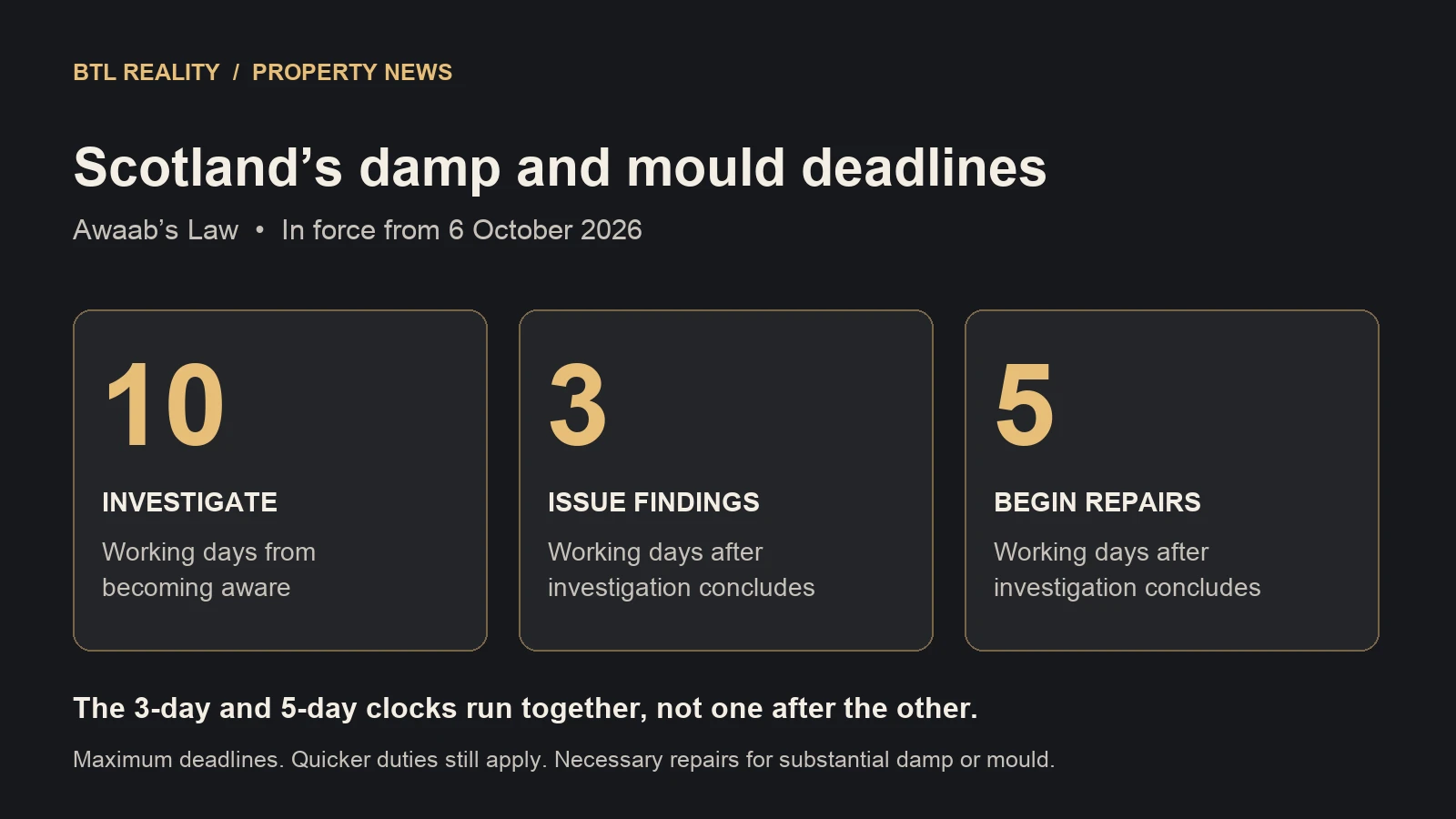
| Competent investigation | Within 10 working days | Becoming aware of damp or mould |
| Issue written findings | Within 3 working days | Investigation concludes |
| Begin necessary repairs for substantial damp or mould | Within 5 working days | Investigation concludes |
The three-day and five-day periods run from the same event. Do not add them together to create eight working days before starting work. These are maximum timescales, not permission to postpone urgent action. Quicker duties still apply where relevant.
The written-summary requirements mean the tenant should receive a clear account of who investigated, what they found, any work already undertaken and the intended repairs and timing. The three-day limit concerns issuing that summary. An agent can handle it, but the landlord retains responsibility.
Completion differs by sector. Under the Scottish repair guidance, private landlords must complete work as soon as reasonably practicable, within a reasonable time after the investigation. Social landlords have a maximum of 20 working days from starting the work. The five-day starting deadline is therefore not a five-day deadline to finish every repair.
The response also needs to deal with the cause and prevent recurrence as far as reasonably practicable. A mould wash without a suitable longer-term remedy may not achieve that. If the problem changes significantly or appears elsewhere, a fresh investigation and timetable can be needed.
For your property file, make two separate entries when an investigation closes: the deadline to issue findings and the deadline to commence necessary work. Give each task an owner. Record completion separately, with evidence that the outcome was checked. This small operational distinction helps prevent an administrative hand-off becoming a missed repair.
A separate Scottish change took effect on the same date: higher compensation for wrongful termination of a private residential tenancy. Our guide to Scotland’s new wrongful-termination awards explains the £840 calculation floor, tribunal discretion and worked examples. These possession-related rules are separate from the repair deadlines above.
What is Awaab’s Law?
Awaab’s Law is named after Awaab Ishak, the young child who died following prolonged exposure to mould in his social home. In England, the legislation establishes specified requirements for responding to serious hazards in the social rented sector. Its purpose is to address failures to act when residents are living in unsafe conditions.
The government’s social-landlord guidance explains that the first phase began on 27 October 2025. A further phase is due from 30 November 2026, subject to parliamentary approval, expanding the hazards covered. Those dates and requirements relate to England’s social-housing regime.
The Renters’ Rights Act implementation roadmap sets out the private-sector extension. The new consultation is the next step. Do not import a social-landlord timetable into a private tenancy without checking the relevant law and commencement position.
What must private landlords do already?
The government’s private-renting repairs guidance for England describes existing responsibilities for matters including the structure, exterior, heating, hot water and essential installations. Existing fitness and safety requirements also matter. A future reform does not suspend these obligations.
A tenant’s report of mould is therefore a prompt to investigate, not a reason to wait for a new national deadline. Establish the extent, any immediate risk and the likely causes with appropriate professional help. Tell the tenant what will happen next and keep a record of the action taken.
The required response depends on the facts and applicable duties. An urgent danger needs an urgent response. The Scottish damp and mould deadlines above are specific to that regime. They are not a universal countdown for every repair in every UK private tenancy.
Why painting over mould is not a full diagnosis
A visible patch tells you where a symptom appeared. It does not necessarily explain the cause. Possible issues include water penetration, plumbing defects, inadequate ventilation, cold surfaces or several factors interacting. A contractor needs to assess the actual building rather than guess from one photograph.
Imagine mould returns twice in the same corner after cleaning and decoration. A third identical treatment may produce another attractive photograph without resolving the condition. The better question is what the previous work established about moisture, temperature, ventilation and the building fabric, and what evidence supports the proposed remedy.
Avoid automatically attributing the problem to a tenant’s lifestyle. Normal occupation produces moisture, and the home needs to function as a home. Equally, do not promise that one generic product or a new fan will solve every case. Use competent assessment, a proportionate response and follow-up evidence.
Your preparation checklist
Tick the records you have checked. This is a working list, not a compliance certificate. Selections stay in this page only.
A practical response from report to resolution
When a report arrives, record when it was received and what was described. Ask for information that helps the responsible professional assess the issue, without expecting the tenant to diagnose the building. Identify whether the report suggests an urgent hazard and arrange the appropriate response.
Next, assign an accountable person. If an agent is managing the property, make clear who contacts the tenant, instructs a contractor, authorises work and checks progress. A forwarded email is not proof that anyone accepted responsibility for completing the task.
Keep the tenant updated about access arrangements and the next action. Access must be handled lawfully and respectfully. If an appointment cannot proceed, retain the factual record and rearrange appropriately; do not treat one failed visit as permanent permission to close the case.
Finally, check the outcome. Completion evidence should explain the cause identified, work undertaken and whether further monitoring or remedial work is needed. A paid invoice proves a payment, but it does not by itself prove the original problem has gone away.
Worked example: repeated treatment or investigation?
Consider two hypothetical approaches to a recurring problem. Option A involves three £180 cleaning and decoration visits over a year, costing £540, without establishing why the mould returns. Option B includes a £250 investigation and £500 of appropriate remedial work, totalling £750.
The example does not prove that Option B will solve any particular property’s problem. The costs are assumptions, and some cases will require far more substantial work. It shows why comparing only the first invoice can lead to the wrong commercial conclusion: a cheaper visit may leave the risk and future costs unresolved.
If a further two £180 visits occur under Option A, its spending reaches £900. That is before considering disruption, damage, complaints or any legal consequences. The most important issue remains the occupant’s safety and the suitability of the work, not simply which column is initially cheaper.
When you model a rental, reserve money for investigations and proper repairs. A maintenance percentage is a planning allowance, not a ceiling on your duty to act. If the necessary work exceeds the allowance, the property still needs the appropriate response.
What should be in the property file?
Keep evidence that lets someone reconstruct the problem and response accurately. Store it securely, limit access to people who need it and avoid collecting unnecessary personal or health information. The record should support managing the property, not become a collection of speculation about the resident.
- The original report and date, including relevant photographs supplied.
- The urgency assessment and any immediate safety action.
- Inspection findings and the professional recommendation.
- Access arrangements and factual records of attempted visits.
- Work authorisations, invoices and completion evidence.
- Follow-up checks and communication about any remaining issue.
Do not rewrite an earlier note to imply a faster response or a finding that was never made. If the record needs correction, make the correction transparently. Honest records help an adviser identify the real position if the matter becomes a dispute.
Buying a property with damp: what to check
A discounted purchase can still be poor value if the condition and remedial work are not understood. Ask the surveyor about visible concerns and whether specialist investigation is appropriate before committing. A seller’s reassurance that a room “just needs airing” is not a substitute for evidence.
Obtain quotes against a clear scope, consider access and occupation constraints, and allow a contingency appropriate to the uncertainty. Check whether work needs permissions or involves other owners, a freeholder or common parts. A flat can require coordination beyond your own front door.
Use the buy-to-let deal calculator to include refurbishment and purchase costs alongside ongoing reserves. A projected yield based on the asking price alone leaves out the capital needed to make and keep the property suitable for letting.
How management and energy improvements connect
Damp, ventilation, heating and energy performance can interact. An improvement should be designed for the building as a whole. Changing insulation or draught-proofing without considering ventilation may create a different problem, so seek competent advice on the package of works.
The proposed higher EPC standards for landlords have a separate policy and legal timetable. Do not assume that reaching an energy rating proves a home is free of damp, or that a future energy deadline postpones a current repair obligation.
A good long-term plan coordinates necessary repairs and sensible upgrades while the property is accessible. It also recognises that urgent safety work cannot be deferred merely to combine it with a later refurbishment or save a contractor’s call-out charge.
What to do this week
Review any unresolved damp or recurring repair reports first. Confirm the next action, responsible person and evidence of progress. Then review the reporting route so future concerns do not sit unnoticed in a personal inbox or an agent’s general queue.
For a first-time investor, this is part of understanding the operating business behind the purchase. Starter Club provides education and structured discussion, while building defects and legal duties require the appropriate professionals. The landlord rules hub places the future reforms alongside the rules already affecting a tenancy.
For Scottish properties, apply the new damp and mould process now. For English private rentals, follow the separate implementation announcements while meeting current duties. Wales and Northern Ireland have their own housing regimes; neither timetable above should be treated as their law. Take jurisdiction-specific advice where required.
Frequently asked questions
Does Awaab’s Law apply to private landlords in October 2026?
Yes for private tenancies in Scotland within the Repairing Standard from 6 October 2026. In England, the private-sector extension remains subject to a separate implementation process. Identify the property’s jurisdiction first; the answer is not the same across the UK.
Does the November 2026 Awaab’s Law expansion cover buy-to-let landlords?
The 30 November 2026 phase described in the official guidance concerns English social landlords and additional hazards in that regime. Do not treat that announcement as automatic commencement for every private buy-to-let tenancy. Check the tenancy type, jurisdiction and relevant implementing rules.
Can a private landlord wait for Awaab’s Law before fixing mould?
No. Existing duties already matter, and reports should be assessed and addressed appropriately now. A future extension does not authorise unsafe conditions or remove current repair obligations. Obtain competent advice on the cause, urgency and required action for the actual property.
When does the Awaab’s Law private-rental consultation close?
It runs from 9 October to 11.59pm on 18 December 2026. That is the response deadline, not the start of new English private-landlord repair timescales. The official consultation page explains how to respond.
Is repainting enough to deal with a damp complaint?
Decoration alone does not establish that the cause or hazard has been resolved. It may form part of suitable work, but the response should follow competent assessment. Keep evidence of the diagnosis, remedial action and follow-up rather than treating a fresh appearance as proof of a cure.
Does a Scottish private landlord have 20 working days to finish damp repairs?
No. The specified maximum of 20 working days from commencing repairs is for Scottish social landlords. Private landlords must finish as soon as reasonably practicable. Neither rule permits ignoring an urgent risk or merely disguising the symptoms with decoration.