Are Landlords Facing Bigger Fines Under Labour?
October 3, 2026
Landlords in England face stronger enforcement and potentially larger penalties under the Renters’ Rights Act. But “landlords are getting more fines under Labour” combines two different claims. The law provides new powers and penalty limits; proving that more fines have actually been issued requires enforcement data over a defined period.
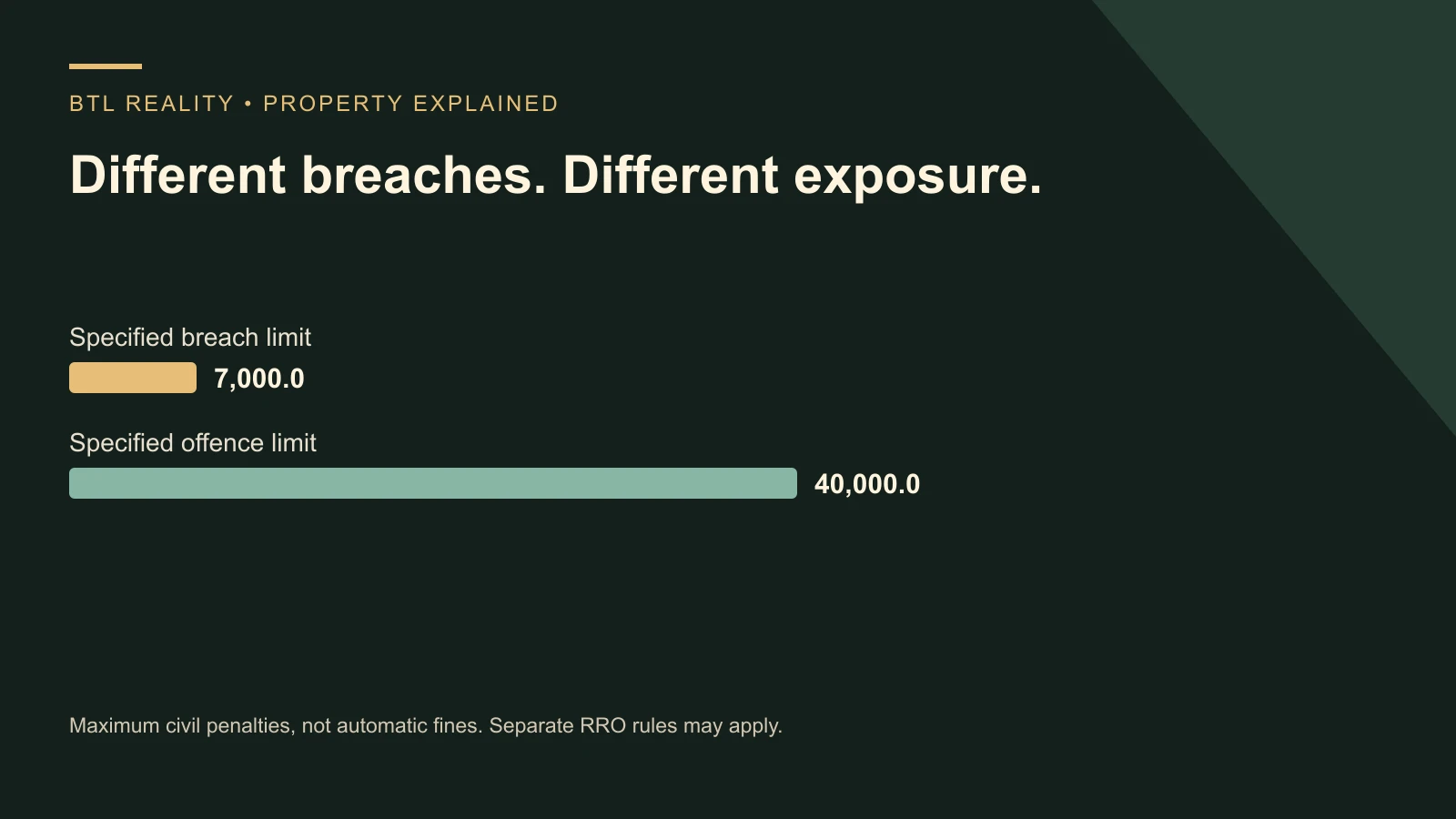
The headline figures are up to £7,000 for certain tenancy-reform breaches and up to £40,000 for certain offences as an alternative to prosecution. There are also expanded rent repayment orders. These are different legal mechanisms, not a single automatic tariff applied whenever a landlord makes a mistake.
My concern as an investor is how quickly a preventable problem can consume a rental’s profit. A landlord can have substantial equity and still find a large unplanned bill difficult to pay. That is why a compliance process belongs alongside the mortgage and maintenance budget.
What changed, and when?
The government’s enforcement guidance for landlords concerns the new tenancy-reform restrictions applying to covered private assured tenancies in England from 1 May 2026. New council investigatory powers began earlier, on 27 December 2025.
The Act adds to existing landlord obligations. It does not replace gas safety, electrical safety, licensing, deposit protection or repair duties with one new checklist. Nor does it mean older offences were harmless before Labour entered government. Property regulation has developed across several administrations.
When reading a fine headline, ask four questions: which law, which conduct, which date and which enforcement route? Without those answers, comparing one landlord’s reported penalty with another’s can be misleading. A prosecution, a civil penalty and a tribunal rent repayment order are not interchangeable outcomes.
The £7,000 category: process failures can matter
The official tenancy-reform guidance lists breaches that can attract a financial penalty up to £7,000. Examples include purporting to create a fixed-term assured tenancy, failing to provide required written information and using a possession ground without a reasonable belief that it can succeed.
That should change how landlords treat templates. An old agreement found online, an improvised possession message or a missing information sheet may have consequences beyond appearing unprofessional. The first control is to know which current process applies before communicating a decision.
The maximum does not establish the likely penalty in your case. Councils must follow the relevant legal process, consider the applicable circumstances and provide the required notices. If you receive an enforcement notice, get advice promptly and keep the response and appeal deadlines visible. Ignoring the letter is not a strategy.
The £40,000 category is not every repeated mistake
The same guidance identifies specified offences that may attract a penalty up to £40,000 instead of prosecution. These include certain knowing or reckless misuse of possession grounds, prohibited reletting or remarketing after using the moving-in or sale grounds, and defined repeated or continuing breaches.
The conditions matter. A headline saying “any repeat error means £40,000” would be too broad. Other parts of the Act, including rental bidding and discrimination, have their own enforcement provisions. Do not transfer one chapter’s escalation rules onto another without checking.
Nor should a landlord assume an unsuccessful possession application proves an offence. The official guidance distinguishes a reasonable attempt from knowingly or recklessly relying on a ground that will not be available. That is another reason to obtain advice and document the facts before serving a notice.
Rent repayment orders are a separate exposure
Under the new regime, a tribunal can order repayment of up to two years’ rent for qualifying offences. The official RRO guidance explains that offences before 1 May 2026 have different rules, including the earlier one-year maximum.
An RRO is not a general refund for an unhappy tenant. The applicant must establish a qualifying offence and satisfy the other requirements. Equally, a landlord should not assume there can be no claim because no criminal conviction has occurred. The tribunal process can establish the relevant offence itself.
Our two-years’ rent guide explains the distinction between the maximum possible amount, the period of relevant conduct and the amount ultimately ordered. For risk planning, keep the possibility separate from a prediction that the maximum will apply.
A worked example: the same fine, different financial impact
Imagine a hypothetical rental leaving £200 a month before tax and exceptional expenditure. Annual cashflow is £2,400. A £7,000 penalty is equivalent to 35 months of that cashflow. If the rental instead leaves £400 a month, the same amount represents 17.5 months.
This is not a forecast of a penalty or an invitation to compare breaking the law with its expected cost. It illustrates why “the property is worth £200,000” says very little about the owner’s ability to absorb a bill. Equity is not the same as cash available this week.
At £1,000 monthly rent, 24 months of gross rent is £24,000. That is a scale illustration for an RRO maximum, not a statement that a particular tenant could recover that amount. Do not automatically add every maximum together and present the total as an inevitable outcome.
Put a compliance cost in context
A cost scenario, not a prediction of a fine or legal liability.
If you are assessing the underlying investment, use the buy-to-let deal calculator. Enter proper running costs and keep a reserve. A spreadsheet can reveal weak cashflow, but it cannot tell you whether a legal breach has occurred.
Where I would look for avoidable problems
First, review the documents and messages sent to tenants. Is the agreement appropriate for the actual tenancy? Were the required terms or Information Sheet delivered to every relevant tenant? Are staff still describing a tenancy as ending automatically on an old fixed date?
Second, review the letting process. Does each advert contain a specific rent? Is anyone encouraging higher bids? Are benefits recipients or households with children being excluded through an automated instruction? These questions concern the agent’s actions as well as the owner’s intentions.
Third, review possession decisions. Selling, moving in, arrears and antisocial behaviour each need their own evidence and conditions. If the proposed reason is selling, understand the restrictions before assuming you can put the home back on the rental market if a sale disappoints.
Fourth, check existing duties such as licensing and safety. A beautifully updated tenancy agreement will not resolve an unlicensed property or an ignored repair notice. Prioritise actual hazards and formal deadlines rather than whichever topic is loudest online.
Using an agent does not eliminate the need to check
A managing agent can be valuable, particularly where they maintain a clear process and raise issues early. The question is what your agreement covers and what evidence you receive. “Fully managed” is a service description, not a guarantee that every responsibility has disappeared.
Ask who maintains the compliance calendar, who checks a rent review, who handles complaints and who authorises a possession notice. Agree how exceptions are escalated. If a certificate or legal document is missing, there should be a named person responsible for resolving it.
Our letting-agent-fees guide helps compare the service behind a fee. Saving a small monthly amount is not useful if it removes the oversight the property needs. Equally, a higher fee does not prove that the service is competent.
What to do if you find a problem
Stop any ongoing conduct that may be wrong, preserve accurate records and obtain advice appropriate to the issue. Do not backdate documents, rewrite the history or pressure the tenant to say something was delivered when it was not. Correcting a problem and documenting the correction are different from pretending it never existed.
If the issue is a missed Information Sheet, our deadline guide explains what to check. If there is a notice, threatened claim or active investigation, a qualified housing solicitor can assess the actual facts and deadlines.
The wider investment lesson is to build a business that can operate lawfully at the rent the market supports. Starter Club provides education and planning support, while legal advice belongs with the relevant professional. No membership removes liability for how a property is managed.
Frequently asked questions
Are landlords definitely receiving more fines in 2026?
The law has strengthened enforcement powers and introduced or increased relevant penalty limits. That is not itself evidence of the number of fines issued. A claim about rising enforcement volumes needs a reliable dataset, a time period and a like-for-like comparison. This guide does not claim to establish that trend.
Is every Renters’ Rights Act breach a £40,000 fine?
No. Different conduct falls under different provisions, with conditions and maximums. Some tenancy-reform breaches can attract up to £7,000; specified offences may attract up to £40,000 as an alternative to prosecution. The actual outcome depends on the law, evidence and enforcement process.
Can a landlord be fined for using an old tenancy template?
Potentially, if its use breaches an applicable requirement, such as purporting to create a fixed-term assured tenancy under the new regime. The issue is what the document and conduct do, not simply the file’s age. Have current templates checked for the actual tenancy type.
Can tenants claim rent back without a criminal conviction?
Yes, a conviction is not always required before an RRO application can succeed. The tribunal must be satisfied that the relevant offence occurred and the other conditions are met. A tenant’s allegation alone does not establish liability or the amount repayable.
Does landlord insurance cover regulatory fines?
Do not assume it does. Policies have exclusions and conditions, and some liabilities may not be insurable. Ask the insurer or broker about the actual wording and circumstances. Even where legal-expenses cover exists, that is different from a promise to pay a fine or repayment order.
What is the best first step to reduce avoidable exposure?
Check live hazards and deadlines, then the tenancy documents, required information, licensing and agent processes. Keep evidence of what was done and when. This is a practical review, not a certificate of compliance; get specialist advice where the facts or legal requirements are uncertain.