Are Professional Photos Worth Paying for on a Rental Property?
October 19, 2026
Professional rental photographs can be worth paying for when they present a suitable property clearly and help the right applicants understand it. They are not a guarantee of a faster let or higher rent. The useful financial question is how much the photography costs, what it improves and how few avoided empty days would be needed to recover that cost.
Good marketing removes avoidable uncertainty. It shows the actual rooms, layout and condition without making the home look like something it is not. This guide gives you a simple cost test, a practical photography brief and a way to judge results without claiming that the photographs caused every enquiry.
First check whether the current listing explains the property
Look at the advert as someone who has never been inside. Can you understand the main room sizes and how they connect? Are the bathroom and kitchen shown clearly? Is there enough information to decide whether the layout suits you?
Dark, blurred or badly framed images can make a perfectly suitable home difficult to assess. So can a gallery of near-identical living-room shots that omits storage, access or the second bedroom. More photographs are not automatically more useful.
The aim is an honest, legible presentation. A bright room should look bright, but a cramped room should not be stretched into an impossible shape. Applicants who feel misled at a viewing waste their time and yours, and may lose trust in the rest of the advert.
Calculate the break-even in empty days
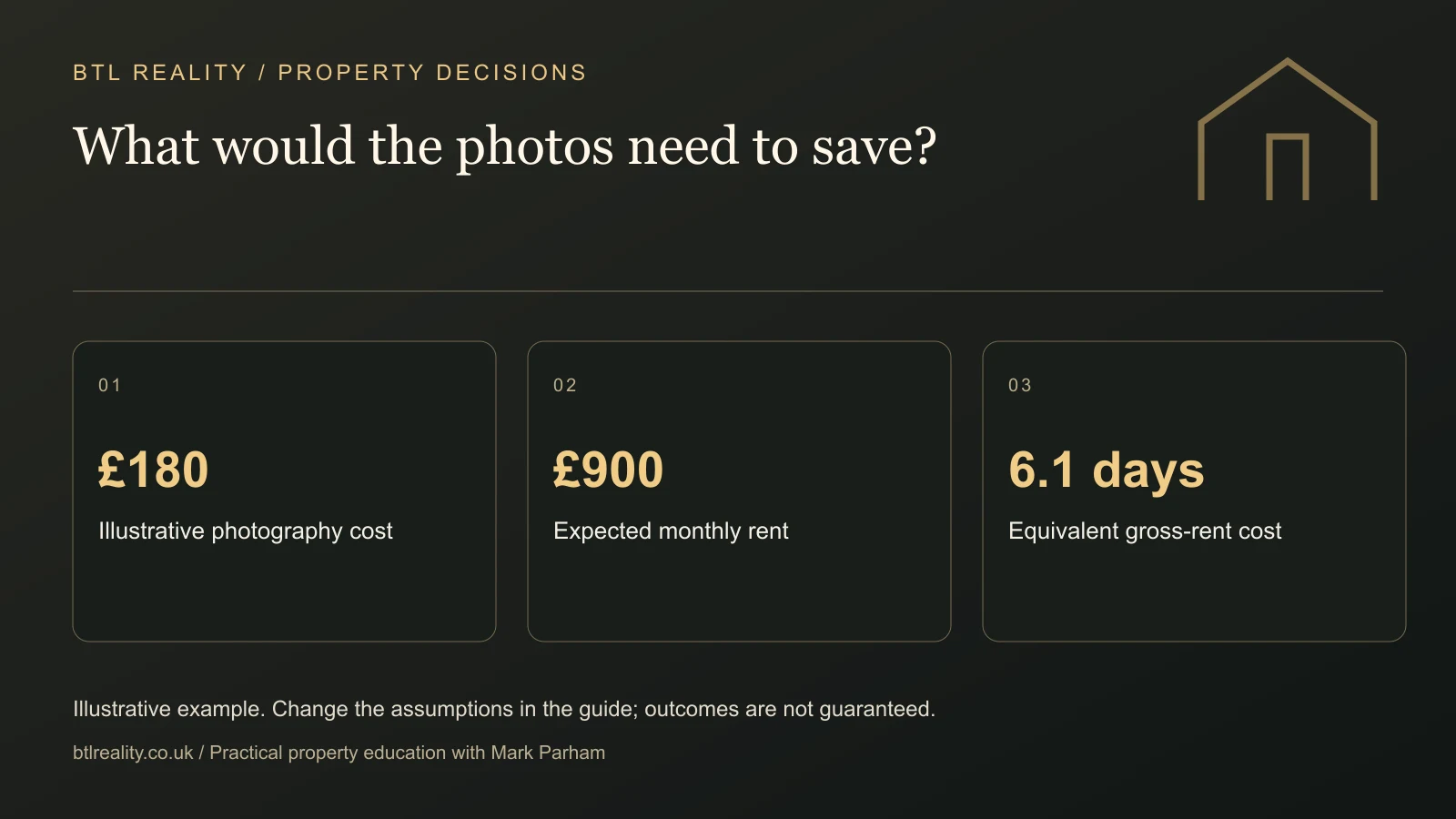
Suppose a photography and floor-plan package costs an illustrative £180 and the expected rent is £900 a month. Using annual rent divided by 365, the gross daily rent is about £29.59. The package costs the equivalent of approximately 6.1 days of rent.
That does not prove the photographs will save six days. It shows the size of improvement needed to recover the quoted expense on a simplified gross-rent basis. At £1,200 monthly rent, the same £180 cost equals roughly 4.6 days.
If the agent would supply suitable photographs within an existing fee, your incremental cost may be lower or zero. If you need to pay for preparation, access or a second visit, include those amounts. Compare the actual additional spending, not a headline package price that excludes necessary work.
Photography cost in context
Make the example your own
How many gross-rent days equal the photography cost?
Enter the additional cost of the images and related preparation, plus the achievable monthly rent.
Uses annual rent divided by 365. This is a cost comparison, not a promise of faster letting or higher rent. Excludes tax, variable expenses and any costs not entered. Illustrative only. Inputs stay in this page and are not saved or sent.
The tool converts a cost into equivalent gross-rent days. It does not predict letting speed or account for tax and variable expenses. Some property costs continue while empty, but avoid adding the same lost income twice when building your wider vacancy budget.
Photographs cannot repair the offer
Before commissioning images, check the rent against comparable achieved rents and the property's condition. An overpriced or poorly maintained home does not become a strong proposition because the photographs look expensive.
If the bathroom needs cleaning, a repair is unfinished or lighting does not work, address the problem rather than editing it out. The standard shown should be the standard offered at the viewing and tenancy start.
Ask the agent where the current marketing is failing. Few relevant views, few enquiries, weak viewing attendance and no applications are different problems. Better photographs may help one stage, while price, layout, availability or condition may explain another.
Give the photographer a useful brief
Identify the target tenant and the features that genuinely matter: natural light, work space, storage, transport access, parking or a garden. Tell the photographer about those features without asking for an exaggerated representation.
Request a balanced set of images covering the principal rooms and relevant external areas. Agree whether a floor plan is included, what measurements it uses and what checking is needed. Clarify the number of final files, turnaround time, usage rights and whether the agent can use them on the intended portals.
Ask how the photographer handles difficult light and reflective surfaces. A professional should be able to explain the approach without promising to make defects disappear. The final selection should help a viewer understand the home, not merely admire a collection of wide-angle compositions.
Prepare the property without creating a false impression
Clean, finish obvious repairs and remove temporary clutter where you have the right to do so. Open suitable curtains or blinds, ensure lighting works and present rooms in their normal intended use. Keep the preparation proportionate to the property and target market.
Staging should not imply that furnishings, appliances or garden features are included if they are not. Make the advert clear about what is offered. If virtual staging is used, it should be transparent and should not conceal the actual condition or dimensions.
Avoid removing permanent drawbacks through editing, such as an overlooking building, an essential fixture or visible damage. Photographs and descriptions work together to communicate the property accurately. The ASA's guidance for letting-agent advertising is a useful reference on misleading claims and omitted material information. A stronger click-through rate is not a worthwhile result if it is produced by misleading people.
Photographing an occupied rental needs care
Arrange access properly with the tenant and agree what will be photographed and published. Personal possessions, family photographs, documents and identifying details can reveal information the occupant would reasonably want kept private.
Do not assume ownership of the building gives unrestricted permission to enter, move belongings or publish images of somebody's home. Work with the tenant and agent on a suitable time and preparation plan, and obtain appropriate advice where permission or privacy is uncertain.
Where possible, use accurate images taken when the property was empty, provided they still represent its current condition and offer. Old photographs showing a newly refurbished interior can become misleading if substantial wear or changes have occurred since then.
A floor plan answers questions photographs cannot
A good floor plan helps applicants understand room relationships, circulation and approximate proportions. It can show whether a second bedroom is accessed awkwardly, whether there is space for a dining area and how storage fits into the layout.
Measurements should be checked and presented with the appropriate qualification. Do not use a floor plan to imply a room has a lawful use that has not been established. A labelled bedroom still needs to be suitable and compliant for the intended occupation.
For investors comparing layouts, our one-bed versus two-bed guide explains why usable space and tenant demand matter more than bedroom count alone. The same principle should guide the marketing images.
Use the first image and gallery deliberately
Choose a lead image that truthfully shows the strongest relevant feature. For a bright flat, that might be the main living space; for a house with useful outdoor space, it might be a suitable external view. There is no need to force every property into the same sequence.
Follow with enough information to understand the whole home. Include the kitchen, bathroom, bedrooms and important features without burying them behind repetitive angles. Avoid decorative close-ups that consume attention while leaving a practical room unseen.
Check how the gallery appears on a phone. A crop that works on a desktop may hide the useful part of the room on a mobile listing. Ask the agent to review the live advert after upload rather than assuming the supplied files display perfectly everywhere.
Measure useful enquiries, not just views
Record the date the new marketing goes live, the asking rent and any simultaneous changes. Track enquiries, booked viewings, attended viewings and suitable applications where the agent can provide the information.
If you reduce the rent, complete repairs and replace photographs on the same day, you cannot confidently attribute the result to photography alone. That does not make the work pointless. It means the evidence supports the combined improvement rather than a precise return on one component.
A practical review asks whether applicants understand the property better, whether avoidable questions have reduced and whether viewings are attracting suitable interest. Do not promise yourself a fixed rent uplift based on another landlord's anecdote.
Reuse suitable assets, but keep them accurate
Clarify whether you can reuse the images for later marketing and whether the licence covers different agents or portals. Store the files, floor plan and terms in the property record so a change of agent does not force unnecessary repeat work.
Review the images before every new listing. New flooring, altered layouts, removed furniture or significant wear can make an old gallery inaccurate. A selective update may be enough, but do not let convenience override a truthful presentation.
Budget marketing as part of the whole letting process in the buy-to-let deal calculator. Starter Club supports practical planning like this, while the calculators remain free without membership. Good presentation earns its place when it helps the right tenant make an informed decision and supports the real economics of the property.
Frequently asked questions
How many void days would professional photos need to save?
Divide the additional photography cost by daily gross rent, using monthly rent times twelve divided by 365. A £180 package at £900 monthly rent equals about 6.1 days. That is a break-even comparison, not evidence that photography will actually reduce the vacancy by that amount.
Can I take good rental photographs myself?
Yes, if you can produce clear, accurate images that explain the property well. Consider lighting, framing, consistency and the final portal display. Compare your likely result and time with a professional quote rather than assuming either paid or self-produced images are automatically better.
Should photographs show the property exactly as offered?
They should accurately represent its condition, layout and included features. Explain staging or furnishings that are not part of the tenancy, and avoid editing that hides material issues. A polished image is useful only if applicants can trust what they see when they arrive.
Do I need permission to photograph a tenant’s belongings?
Agree access and the photography arrangements with the tenant, including what may be published. Personal items can reveal private information. Do not enter, rearrange possessions or publish intrusive images on the assumption that ownership gives unrestricted rights. Seek appropriate advice if the position is unclear.
Are floor plans useful alongside photographs?
They can help applicants understand layout and approximate proportions that individual photographs do not explain. Check the measurements and labels, and ensure the plan reflects the current property. It should support accurate decision-making rather than suggest room sizes or uses that have not been established.
Can better photos fix an overpriced or unsuitable rental?
No. They may improve presentation, but the rent, condition, layout and location still need to meet the market. Review the whole offer and the stage where enquiries are being lost. Do not use an improved image gallery to postpone addressing a more fundamental problem.
Put the next step into practice
Use the free tools to test your numbers, then choose the level of support that fits your next decision.