Landlord Database in England: Dates, Costs and Your Checklist
September 12, 2026
UPDATE CHECKED 3 NOVEMBER 2026 · ENGLAND
What the new registration guidance means for landlords and agents
The government published detailed landlord guidance and agent guidance on 29 October. The first regional period still opens in the West Midlands on 15 December 2026, with registration due by 14 March 2027. This is preparation for that rollout, rather than a claim that the service is open today.
You must register yourself, start each property registration and pay its fee. You can invite your agent to supply specified tenancy, rent, licensing and safety-certificate details. That support is optional; it does not transfer your responsibility for completing the record.
Two 28-day checks matter. Complete the property record within 28 days of registration, including when an agent is helping. Missing information can leave the registration inactive. Changes or expired information must also be updated within 28 days. Agree who submits each item and how you will check completion.
The agent receives a separate property link and sets a password for that access. Store them securely and use that delegated route for the agreed work. If the password needs replacing, the landlord must cancel the link and issue another.
The £65 annual fee is not necessarily the first bill. During rollout, the calculation excludes days before 15 November 2027 and rounds down to the penny. For the government’s example of a property registered on 15 December 2026, £65 ÷ 365 × 30 chargeable days gives £5.34. The full-year budgeting examples below remain £65 per property. Updating records does not itself incur a service fee.
The initial rollout concerns occupied assured or regulated tenancies. The guidance describes registration before marketing unoccupied properties and mandatory numbers in adverts as future requirements. Keep those phases separate when planning your checklist.
England’s landlord registration service will charge £65 per property each year, according to the government’s current guidance. The regional rollout starts in the West Midlands on 15 December 2026. Our earlier fee wording is corrected below. Check the official registration guidance for your property’s deadline.
The useful questions are when your properties enter the rollout, what records you need and how another layer of administration affects a real rental business. Registration, licensing and tax reporting are separate obligations. Signing up to one system should not be assumed to complete the others.
This article updates my September discussion of the landlord database while keeping the practical point behind it: several small costs can combine with borrowing, repairs and tax to change the return. The answer is to measure that effect and prepare properly, rather than buy or sell a property in reaction to one headline.
When does the landlord register start?
The government’s 9 September 2026 announcement gives a 15 December launch in the West Midlands. Other areas follow through a phased programme. Landlords in a region called forward have a three-month sign-up period, and actively letting landlords are due to be registered by 14 November 2027.
The initial requirements concern properties under let or becoming occupied during rollout. Later legislation and the public interface are expected to extend requirements to unoccupied properties before marketing, with registration numbers in adverts. Those later requirements should not be described as if every part is already operating today.
If you own in several regions, track each address separately. Your home address is not the same as the location of the rental property. A portfolio spreadsheet should show the property, ownership arrangement, region, relevant rollout notice and action date once confirmed. Keep the official announcement linked in the file so the team checks the source when dates change.
How much will the landlord database cost?
The government’s registration guidance specifies £65 annually for each property, with yearly renewal. It also says the charge will be pro-rated during rollout. Check the service for the amount actually payable when registering.
Correction: this page previously said the £65 figure was unconfirmed. Current official guidance confirms it. My September video discussed that figure; the written guide now reflects the published terms.
Keep agent charges and your own administration budget separate. The government fee does not tell you what your agent will charge for helping, or what maintaining the records will cost your business.
For three properties, a full year at £65 each means £195 in registration fees. Spread across twelve months for budgeting, that is £16.25 for the portfolio, before any separate administration cost. This is a full-year illustration, not a quote for the initial pro-rated bill.
Budget additional operating costs
Before tax. These adjustable costs are assumptions, not announced registration fees or professional quotations.
Why I look at the combined cost
In my September video, I described investing in property for around 15 years and holding more than £3.5 million of UK property. A small standalone administration bill would not, by itself, make me abandon an otherwise sound investment. The concern is what happens when several changes arrive together.
I used an interest-rate example: moving from 3% to 6% on £2 million of interest-only debt increases annual interest by £60,000. That is arithmetic illustrating the effect of a rate change, not a statement that every investor has that debt or that all borrowing reprices at once.
Against a change of that size, a modest registration fee is not the main driver. But for a landlord already operating with a thin monthly margin, the cumulative effect of compliance costs, insurance, repairs and borrowing still matters. Focusing exclusively on one small charge can obscure the larger decision.
You can watch the original September discussion, with the current fee information above in mind. My practical approach is to keep the numbers current and judge the property as a whole, including the service provided to the tenant.
Worked example: three properties and additional costs
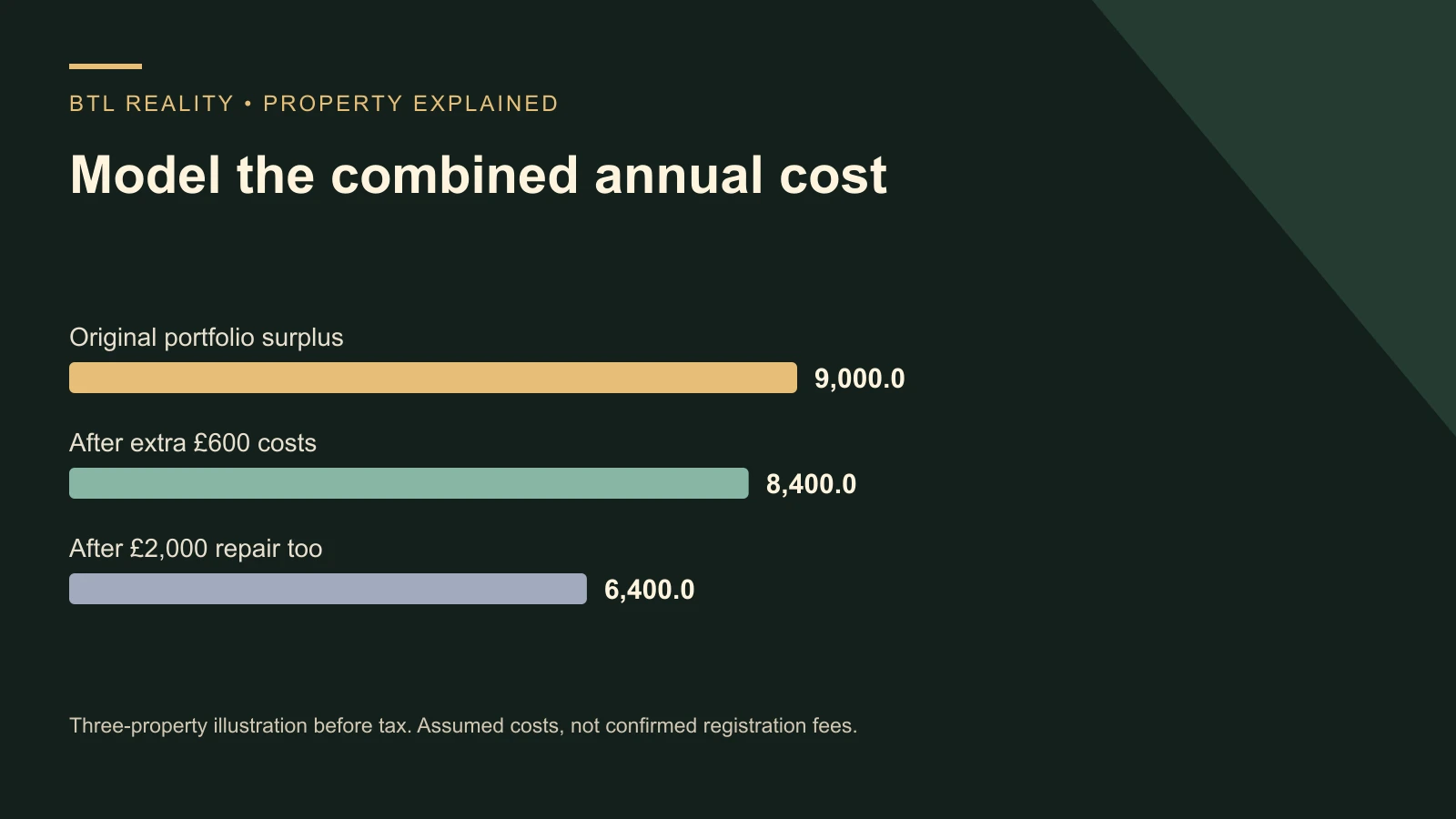
Suppose a three-property portfolio produces £250 monthly surplus per property before tax, after the ongoing costs already included in the model. That is £9,000 a year. Now model an additional £100 annual cost per property, plus £300 of annual administration across the portfolio.
The extra cost is £600 a year, reducing that modelled surplus to £8,400. It is a 6.7% reduction in the original surplus. The numbers are assumptions chosen to show sensitivity. Neither the £100 nor the £300 is an announced database charge or a quote for professional services.
Now imagine the portfolio also faces a £2,000 repair. The combined reduction becomes £2,600, leaving £6,400 before tax. The registration headline was only one part of the cash demand. The investor needs a repair reserve and a full operating forecast, not simply a plan to pass a guessed fee to the tenant.
Use the interactive example to change the assumptions. If you want to analyse one purchase in more detail, the buy-to-let deal calculator separates rent, borrowing, costs and cash required. Include realistic management and maintenance allowances before deciding a deal offers sufficient margin.
Can landlords simply increase rent to cover the cost?
A landlord’s costs do not automatically determine the market rent. Local incomes, competing homes, condition, location and demand all influence what a household can and will pay. The applicable rent-increase process also matters.
For England’s relevant assured periodic tenancies, use the current section 13 route and market-rent framework. A new operating cost does not remove the notice requirements or create a right to add an arbitrary surcharge. See the rent-increase rules guide before treating an annual cost increase as an immediate change to a tenant’s payment.
Some costs may affect supply and pricing over time, but that is a market argument rather than a guaranteed one-to-one transfer. A £100 increase in your costs does not prove that your specific property can command £100 more rent. Underwrite on achievable rent and allow for the possibility that your margin absorbs the cost.
What records should you prepare?
The 29 October landlord guidance now specifies the registration information, including ownership and contact details, tenancy information and safety evidence. The update above explains the agent’s role and the 28-day completion and update requirements. Organise accurate records before rollout and use the official service when it launches.
- Confirm the legal landlord and ownership details for each property.
- Keep the property address and occupancy information current.
- Locate relevant safety and energy-performance records.
- Record the agent or person responsible for updates.
- Track the official regional invitation and deadline when issued.
This is preparation, not a claim that the list reproduces every final statutory field. Use secure storage and appropriate access controls. Avoid emailing an entire portfolio’s identity and tenant records to a company merely because it claims to be helping with the new register.
Ask your agent how its registration service will work, what it costs and who remains responsible for correcting inaccurate information. Obtain a clear scope. A fee for “compliance” can cover very different services between firms, and an attractive headline price may exclude updates or ownership changes.
Does registration replace landlord licensing?
Do not assume so. A national database, a local selective or additional licensing scheme, HMO licensing and tax registration serve different purposes. A property may need several checks at once. The fact that your address appears in one database does not establish that its occupation, condition or management is lawful.
When buying, ask the conveyancer and local authority about the requirements relevant to that address and intended use. When operating, maintain the records and renewals applicable to the actual tenancy. A change from a single household to shared occupation can raise different questions even when the building itself is unchanged.
This distinction is particularly important for investors who live abroad or delegate management. Distance makes an organised professional team more valuable; it does not simplify the legal position. Put responsibilities in writing and request evidence at sensible intervals rather than relying on a general assurance that everything is handled.
Should the register change your investment strategy?
It should change the checklist and the forecast. Include the published registration fee and your own administration allowance. It need not determine the entire strategy. A well-bought property with a suitable tenant market, sustainable borrowing and adequate reserves may remain attractive after additional administration. A marginal property may require a more fundamental review.
If you are still learning how to judge the numbers, Starter Club offers structured education and discussion. If you want a property sourced against an agreed brief, the Done For You sourcing service is a different route. Neither replaces independent legal, tax or mortgage advice about the property and your circumstances.
Start with the 2026 landlord rules hub for the connected reforms. Then create one practical action list for the portfolio. The goal is a business that remains understandable when the rules change, rather than a spreadsheet built around permanent certainty.
Frequently asked questions
When must landlords register on the new England database?
The announced rollout begins in the West Midlands on 15 December 2026. Other regions follow, with a three-month sign-up period when an area is called forward. Actively letting landlords are due to be registered by 14 November 2027. Check the official instructions for each property’s region.
Is the new landlord registration fee definitely £65?
Yes. Current government guidance specifies £65 per property annually, renewed each year, with pro-rating during rollout. Separate agent or administration charges depend on your arrangements.
Will letting agents register properties for landlords?
You must start each registration and remain responsible for completing it within 28 days. You can invite an agent to provide specified tenancy, rent, licensing and safety information through a separate property access link. Agree the service and any agent charge in writing, including who keeps information updated.
Can I charge the database cost directly to my tenant?
Do not assume that a landlord’s administration cost becomes a permitted tenant charge. Tenant-fee and rent rules require separate consideration. Review any proposed charge with a qualified adviser, and use the lawful rent-review process rather than inventing a registration surcharge.
Does the database replace an HMO or selective licence?
Do not treat registration as a replacement for separate licensing obligations. Check the local authority’s current requirements for the property and its actual use. A database entry does not, by itself, prove that a property has the licences or permissions it requires.
Should I sell before the landlord register starts?
A sale decision should consider the full investment, including net income, debt, tax, repairs, alternatives and your objectives. The registration fee alone is not enough information. Model the costs, identify the operational work and obtain professional advice before making an irreversible decision.