Is a Guaranteed-Rent Property Investment Really Guaranteed?
October 7, 2026
A guaranteed-rent investment is only as useful as the actual promise, the party making it and the conditions attached. It may reduce some uncertainty, but the word “guaranteed” does not remove property, counterparty or financing risk. Read the arrangement as a contract with cash consequences, not as a substitute for due diligence.
I would still assess the property without the promise. What rent could it achieve normally? What costs remain yours? What happens when the guarantee ends or the payer cannot perform? Those questions reveal whether the underlying investment is sound.
Different products can use the same phrase
A company might rent your property and agree to pay a fixed amount while subletting it. A developer might advertise a rental return for an introductory period. An insurance policy might provide defined protection against tenant default. A letting agent might use “guaranteed rent” to describe a particular management package.
These arrangements are not interchangeable. Identify who owes you money, what event triggers payment, which documents govern it and whether an insurer or another third party is involved. Do not assume one product has the protections or terms of another.
Property Redress's explanation of rent-to-rent arrangements is a useful introduction to one common structure. The agreement for your property still needs its own assessment.
Trace the money before judging the percentage
Suppose the occupiers collectively pay an operator £1,400 a month and the operator promises the owner £1,000. The £400 difference is not automatically excess profit. It may fund management, empty periods, bills and the operator's margin, depending on the arrangement.
From the owner's perspective, the relevant starting receipt is £1,000. You then deduct costs that remain yours, such as mortgage payments, insurance, structural repairs or service charges where applicable. The promised receipt is not the same as net profit.
Draw the payment chain: occupier to operator, operator to owner, owner to lender and service providers. If one party fails to pay, identify which obligations continue. This simple diagram often exposes assumptions hidden by a headline annual return.
Make the example your own
What does the guarantee cost or add?
Use receipts after contract deductions. Compare like-for-like retained costs.
This does not measure counterparty failure or legal enforceability. Neither result is guaranteed. Illustrative only. Inputs stay in this page and are not saved or sent.
Compare the guarantee with ordinary letting
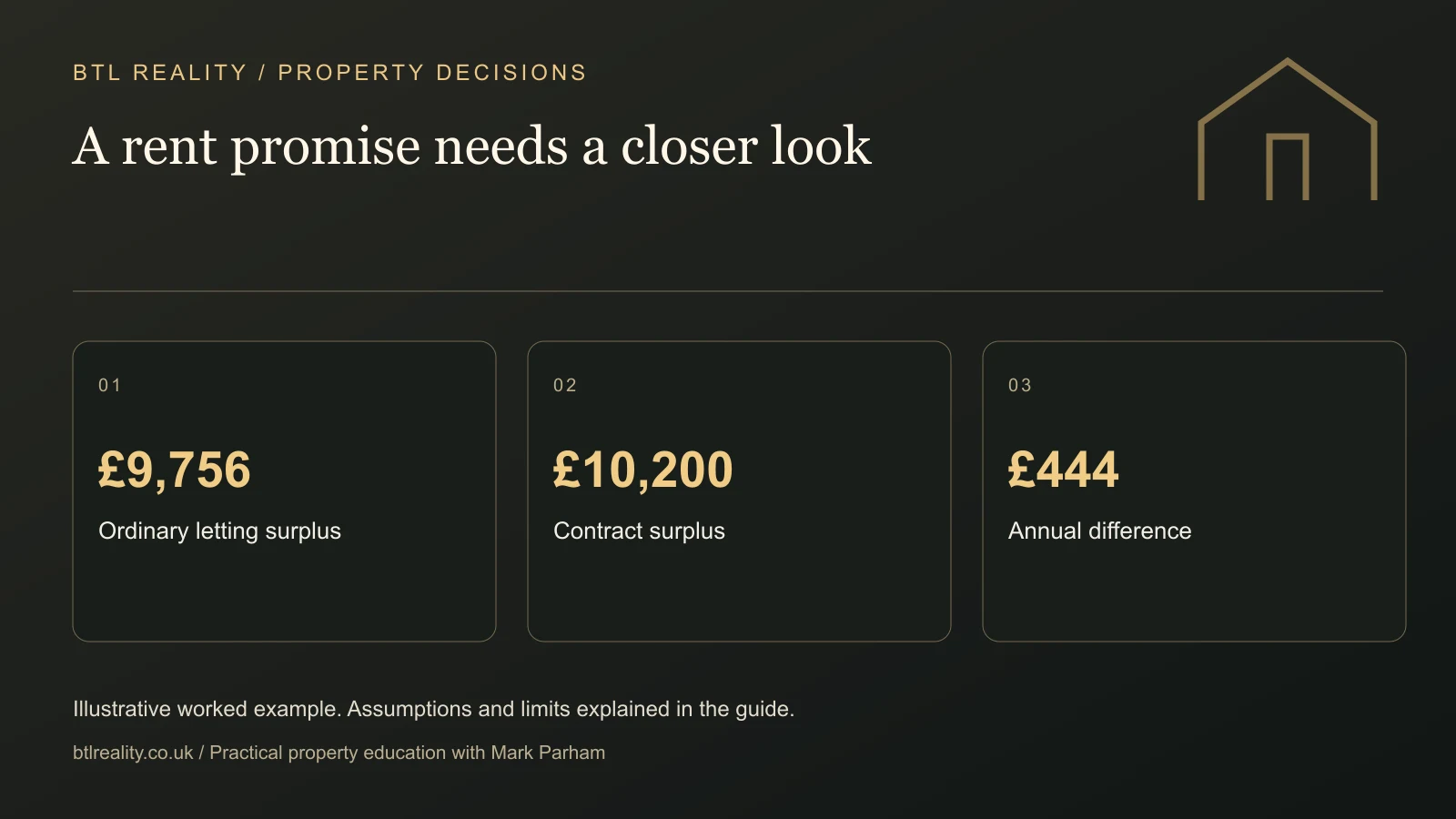
Take an illustrative property that could achieve £1,100 a month in a conventional letting. Annual scheduled rent is £13,200. Assume £1,584 management, £660 vacancy allowance and £1,200 of repairs and other operating costs. That leaves £9,756 before finance and tax.
Now suppose an operator offers £950 a month, or £11,400 a year. If £1,200 of owner costs still apply and no other deductions are assumed, the owner's operating surplus is £10,200 before finance and tax. The apparent advantage is £444 a year.
That comparison is only as good as the terms. A rent-free setup month reduces receipts by £950. An additional £1,000 repair obligation can reverse the advantage. An exclusion allowing payment to stop changes the risk again. Put the actual agreement into the calculation, not the marketing summary.
Who stands behind the promise?
Confirm the legal identity of the payer and investigate its ability to meet obligations. A trading name or polished website says little about available cash. Company accounts can provide information, but they may be historical and do not guarantee current solvency.
Ask whether the obligation is backed by security, a deposit, insurance or a separate guarantor, and have the legal effect explained. A parent-company reference is not necessarily a parent-company guarantee. A director's assurance on a call is not necessarily a personal commitment.
Consider concentration too. If one operator pays rent across your entire portfolio, several otherwise separate properties may share the same payment dependency. That risk is different from several independent tenant households paying through an agent.
Find the exclusions and pause clauses
Read when payment starts, when it can stop and whether the amount can change. Does the property need to meet conditions first? Are repairs, licensing issues, damage or a change in use grounds to suspend payments? Who decides when the condition has been satisfied?
Check whether the guarantee covers every month or includes initial and recurring rent-free periods. If a quoted annual return assumes twelve paid months but the contract provides eleven, the calculation is overstated from the outset.
Also examine how disputes affect cash. Even a valid claim can take time to resolve. Keep enough liquidity to meet the mortgage and essential costs while a payment problem is being addressed, rather than assuming legal rights turn immediately into cash.
Confirm the use is permitted
An operator wanting to sublet, house multiple unrelated occupiers or provide short stays may be proposing a different use from the one your mortgage, insurance or lease permits. Obtain the necessary written confirmations rather than relying on the operator's reassurance.
Planning, licensing and tenancy requirements depend on the location and arrangement. Ask appropriate professionals to assess responsibilities and documents. A commercial agreement with an operator does not automatically remove obligations connected with owning the building.
My rent-to-rent experience article discusses why the operational model needs scrutiny. The owner's risks and the operator's risks are related, but they are not the same business decision.
Look beyond the guarantee period
A two-year advertised return is only a short part of a long-term property investment. What happens in year three? Does the property return to ordinary market rent, continue under new terms or require work before reletting?
Model the post-guarantee position separately. Use supported market rent, normal costs and a realistic handover allowance. If the acquisition price only looks justified while temporary payments are included, ask whether the initial return is effectively being funded through a higher purchase price.
Do not double count incentives. A rent guarantee, cashback and furniture package may all be part of the same commercial offer. Their economic value should be assessed once, with the lender and solicitor aware of the full arrangement.
Plan the handover before signing
Establish how the agreement ends, what notice is required and how the property and records are returned. Consider occupiers, keys, deposits, condition, repairs and access. Do not assume vacant possession arrives simply because a contract date has passed.
Have the legal arrangements explained, including who has granted occupation rights and what process would apply if something goes wrong. Avoid relying on a promise that the operator will “sort everything” without defined responsibilities.
An exit plan matters even when you expect the relationship to succeed. It makes the arrangement easier to manage and gives you a way to compare offers beyond the monthly rent figure.
Assess the property before the promise
Run ordinary letting, the contracted arrangement and a payment-interruption scenario through your budget. Our rental yield and cashflow calculator helps separate receipts, costs and finance. Keep any assumptions about insurance or guaranteed payments explicit.
If you want a property sourced against your objectives, Done For You explains our service. That is not a claim that BTL guarantees investment income. A sound decision comes from understanding the asset and the agreement, including the circumstances in which the attractive promise might not deliver the cash expected.
Frequently asked questions
Is guaranteed rent the same as rent guarantee insurance?
No. A fixed-payment agreement with an operator and an insurance policy can have different parties, triggers, exclusions and claim procedures. Ask which arrangement is actually offered and read its documents. Do not assume the protection associated with one product exists because another product uses similar words in its advertising.
What happens if a guaranteed-rent company goes bust?
Payments may stop and recovery will depend on the agreement, security and insolvency position. You may still owe mortgage payments and other costs. Take legal advice on the property, occupiers and available remedies. The practical protection is to assess the counterparty and retain reserves before entering the arrangement, not after a failure.
Can I get a buy-to-let mortgage on a guaranteed-rent property?
The lender must accept the actual tenancy or operator arrangement and intended use. A standard product should not be assumed to allow subletting, corporate letting or short stays. Give the broker the complete agreement and any incentives. Approval of the borrower alone does not confirm that this particular rental structure is acceptable.
Should I accept lower rent in exchange for a guarantee?
Compare the reduction with the costs and uncertainty genuinely transferred, the exclusions and the payer's strength. A lower fixed receipt may suit some owners, but only if the agreement provides value they understand. Model an ordinary tenancy as the alternative and include your remaining responsibilities in both routes.
Does guaranteed rent mean I will never pay for repairs?
No. The contract determines which repairs and costs each party bears. Structural work, wear, damage, service charges and compliance spending may be treated differently. Read the responsibilities carefully and ask about approval processes and evidence. A guaranteed receipt is not a guarantee that the property will have no expenses.
Is a guaranteed return included in the property's market value?
Do not assume the promised payment establishes the underlying resale value. Assess comparable properties, ordinary market rent and the position after the promise ends. A future buyer or lender may evaluate the arrangement differently. Separate asset value from temporary incentives when deciding what purchase price and borrowing are justified.
Put the next step into practice
Use the free tools to test your numbers, then choose the level of support that fits your next decision.