Is Rent-to-Rent Worth It? My Experience and the Real Costs
July 27, 2026
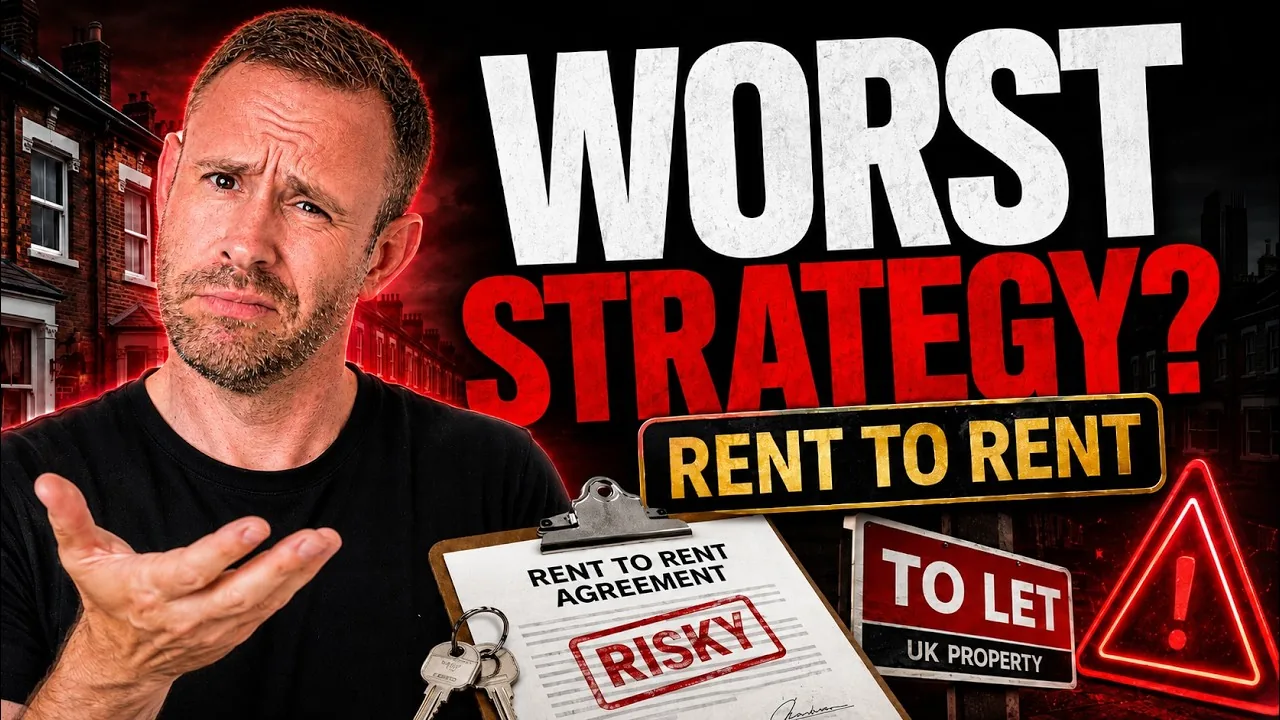
Rent-to-rent sounds attractive when someone explains only the easy part. You don’t buy the property or arrange a mortgage. You rent it from an owner, let it to other people under an appropriate arrangement and aim to keep what is left after your costs.
My concern is that beginners sometimes hear that description and think they are getting the benefits of property ownership without the difficult entry costs. In reality, they are usually setting up an operating business. That can make money, but it brings work, responsibility and contractual risk without ownership of the building.
I discussed this in my video published on 27 July 2026 after a consultation with someone whose rent-to-rent activity was producing very little once his time was considered. I’ve also experienced the arrangement from the owner’s side, through a five-bedroom HMO I owned in Didcot. That experience is a large part of why I’m cautious.
You can also watch my rent-to-rent video on YouTube.
What rent-to-rent actually involves
The operator agrees to pay rent to the property owner and seeks permission to earn income from letting the accommodation onward. The intended use might involve room lets or serviced accommodation, but the permissions, costs and management demands differ between those arrangements.
The gap between the income collected and the rent paid to the owner is only the starting margin. The operator may also be responsible for bills, furniture, cleaning, maintenance, advertising and a range of other costs, depending on the contract.
That makes the agreement important. I would want to understand exactly what is permitted, who is responsible for each cost and what happens if the arrangement ends early. A generic description of the strategy doesn’t tell me what a particular contract commits someone to doing.
I also want to know whether the income depends on the operator doing all the work personally. If the apparent profit disappears when a reasonable value is placed on those hours, the arrangement may be closer to a poorly paid job than an investment.
My Didcot HMO example
The five-bedroom HMO I described had combined room rents of approximately £3,200 a month. Council tax and bills were around £500 to £600, which could make it appear that about £2,650 remained.
But that wasn’t the full picture. Empty rooms, maintenance and management still needed allowing for. Once I considered those, I estimated the amount remaining was closer to £2,000 a month, before considering any owner-specific financing and tax position.
Three tenants who were friends gave notice at the same time. I decided it was a sensible moment to test demand for the house as a single let, because local single-let rents had moved towards £2,200 while room rents had not moved in the same way.
My agent advertised it around that £2,200 level. A rent-to-rent student approached the agency, willing to pay the rent and another £5,000 for the furniture. He would take on the management and bills under the arrangement.
From my perspective, I could see why accepting an agreed rent and reducing the operating work was attractive. From the operator’s perspective, however, there needed to be enough room between the total room income and every commitment he was taking on.
What happened afterwards
After about a year, payments started arriving a little late. Around eighteen months into the arrangement, I had the keys back and the operator had stopped. I described the broad conversation with the agent in the video: he had found the work much harder than he expected.
The agent had spent years developing processes for dealing with the problems that arise in letting property. Those systems aren’t visible when someone looks only at the difference between room rents and the payment to the owner.
The house subsequently became a single let. At the time of the video, the same tenant had been there for several years without significant issues. That experience reinforced my preference for straightforward ownership and management that fits the property and market.
It is one experience, not proof that every rent-to-rent arrangement fails. The point is that an apparently attractive income spread can be misleading if the operator underestimates the work and costs needed to maintain it.
Why £1,200 of margin isn’t £1,200 of profit
In the video, I used a separate example of paying an owner £1,500 a month and expecting to collect £2,700 from room rents. The initial difference is £1,200. It sounds appealing until the rest of the budget is included.
Utilities, council tax, broadband, cleaning, furniture replacement, repairs, advertising, accountancy and legal documents can all reduce that margin. Empty rooms and unpaid rent matter too. The exact allocation depends on the agreement, but the costs don’t vanish just because they are missing from the sales pitch.
I suggested that an apparent £1,200 spread might leave something closer to £400 after costs. That was an illustration, not a standard result for the strategy. A real arrangement could produce more, less or a loss.
The next question is how many hours the remaining £400 requires. Someone still has to organise viewings, answer messages, deal with complaints, coordinate work and keep records. If that person is you, the business is using your time as well as your money.
I would calculate the return after allowing for a realistic management cost, even if I plan to do the work initially. That tells me whether the business could eventually operate without depending on my unpaid labour.
The payment to the owner still needs covering
Room income can vary while the contractual payment to the owner remains due. A vacant room doesn’t necessarily reduce the amount the operator owes. That mismatch is one reason a cash reserve matters.
If several rooms become empty together, the income can change quickly. Repairs may also arrive before there has been time to build a reserve. The operator needs a way to cover those periods without assuming the property will always be fully occupied.
Serviced accommodation adds a different pattern of uncertainty. Bookings, seasonal demand, cleaning and platform costs can affect the result. I wouldn’t use a strong month as evidence that the same income will arrive every month of a multi-year contract.
The useful calculation is not just the best-case monthly margin. I would also want to see a weaker occupancy period, higher costs and the cash needed to continue meeting the agreement while dealing with them.
The legal position needs to match the actual use
Rent-to-rent is not automatically unlawful, but calling something a strategy doesn’t give permission to do it. The owner must permit the proposed arrangement, and any relevant lender, lease, insurance and planning conditions need to be checked.
Room letting can bring HMO and licensing requirements into the picture. Those depend on the property, occupation and local rules. Serviced accommodation can raise different issues. I would speak to the council and have the agreement reviewed for the actual intended use before taking on the commitment.
Safety requirements and responsibilities also need to be clear. I would want to know who arranges inspections, who funds necessary work and who is responsible if something is missed. A contract between owner and operator doesn’t necessarily remove statutory duties owed to occupants.
The same applies when the agreement ends. Occupiers can have rights that need to be handled lawfully. A break clause in the operator’s contract doesn’t mean everybody living in the property can simply be told to leave immediately.
This is where experienced operators and sound professional advice can make a significant difference. A beginner who has only seen a few promotional videos may not yet know which questions need answering.
The ownership difference matters to me
With a buy-to-let, the entry costs can be painful. I need a deposit, purchase costs and money to own the property properly. But once the purchase completes, I own the asset, subject to any mortgage and other legal interests.
I may benefit from rent and potential long-term growth, and I can investigate whether improvements or refinancing make sense. Those possibilities are a major part of why I invest in property. They come with risk, but they are connected to an asset I own.
With rent-to-rent, the operator normally has contractual rights for a period, rather than ownership of the building. If the property increases in value, that growth generally belongs to the owner. The operator’s business needs to justify itself through its operating profit and whatever durable business value it creates.
A successful operating business can have value, especially with strong systems and reliable contracts. My objection is to presenting that as identical to owning a property portfolio. The work, risks and sources of return are different.
My passive-income guide explains why I put ownership at the centre of my own approach. I want to understand what remains after the initial work and how dependent the income is on my ongoing involvement.
Can rent-to-rent work for an experienced operator?
Of course it can. Someone who understands the local demand, has strong systems, prices the costs properly and secures suitable agreements may build a profitable business. I wouldn’t claim that nobody makes money from it.
The operator still needs a genuine advantage. That could involve managing the accommodation effectively and keeping enough margin after paying for the work. Simply being enthusiastic doesn’t make a thin deal profitable.
Scale may help spread some overheads, but it can also multiply problems. Ten weak agreements don’t become a sound business just because the income figure is larger. I would want to understand the economics of each property before taking on more commitments.
For a beginner, the question is whether this is the business they actually want to run. If the goal is an active accommodation operation, evaluate it honestly on that basis. If the goal is long-term asset ownership, consider whether it moves you towards that goal or keeps postponing it.
The alternative I mentioned: a home with lodgers
For someone who needs a home as well as a way into ownership, I suggested considering an appropriate property with space for lodgers. Some residential mortgage products allow a 5% deposit, subject to eligibility and affordability, although the deposit is only part of the purchase budget.
This must be a genuine home purchase with the lender’s permission for the intended arrangement. It isn’t a way to obtain residential finance for a property you actually intend to run as a conventional investment let.
The government’s Rent a Room Scheme allows eligible income from furnished accommodation in your home up to £7,500 a year tax-free. The threshold is halved if the income is shared. It is a tax provision, not automatic permission for a particular layout or letting arrangement.
In the video I mentioned a possible layout using a living room as an additional bedroom. That would need proper checks on space, safety, ventilation, permissions and the mortgage or lease terms. I wouldn’t assume every two-bedroom flat is suitable or describe borrowing to buy a home as risk-free.
My conclusion for someone getting started
I would prefer to save towards an asset I understand and can own properly than rush into a contract simply because it avoids a large deposit. Rent-to-rent may suit a capable operator, but I don’t regard it as an easy substitute for learning how a property business works.
My £50,000 property plan shows the ownership approach I favour. If you’d like to discuss your own options, book a free strategy call, explore Starter Club or Done For You and a 20-minute suitability call. I want the choice to rest on real profit, realistic responsibilities and a clear understanding of what you will actually own.