Zoopla October 2026: Price Falls Reach More Local Markets
October 27, 2026
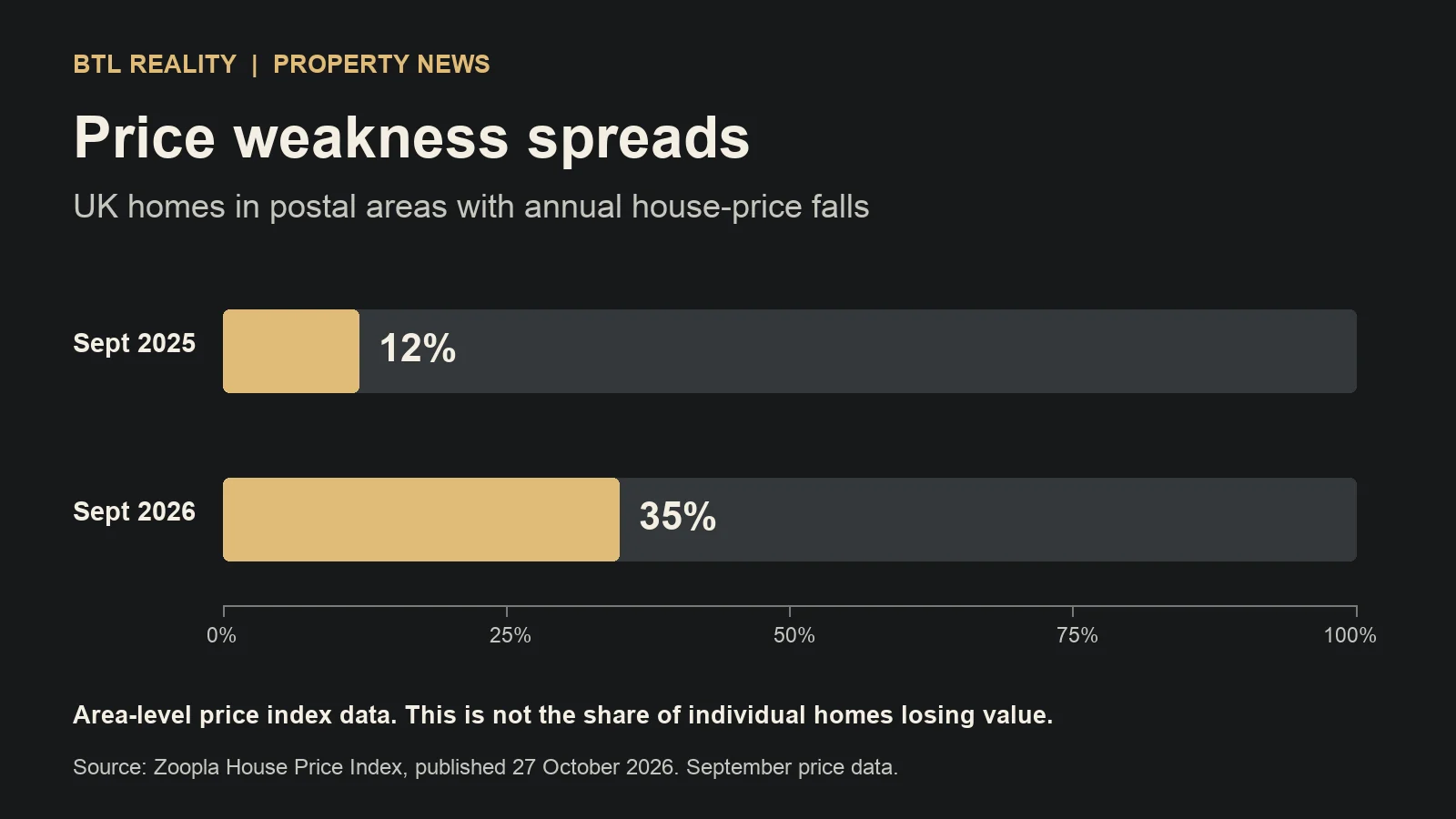
Zoopla’s 27 October report puts 35% of UK homes in postal markets with annual price falls, against 12% a year ago. This does not prove each home lost value or prices fell 35%.
For a buyer, the useful question is what this changes about the property under consideration. I would use the release to challenge the evidence behind an asking price, check competing options and revisit the cash available for the purchase. It is a reason to investigate more carefully, rather than assume a particular discount is waiting.
What does the new Zoopla report measure?
The October index shows annual UK price growth of 0.8% and an average of £273,100 for September. Available homes rose 7% and agreed sales fell 7% year on year in the four weeks to 18 October 2026. Those are different measures and periods.
The index uses achieved-price evidence. It is revisionary and not seasonally adjusted.
Zoopla tracks 119 postal areas, of which 37 recorded annual price falls in September. Those areas contain 35% of homes. The share of homes is different from the fraction of areas: the areas do not all contain the same number of properties.
The change from 12% to 35% is a rise of 23 percentage points in that share. It is not a 23% decline in property prices.
The practical distinction is between the national direction and the evidence for a specific purchase. A positive national average cannot settle a local valuation. Equally, a weaker local market does not establish that the home you want is overpriced. The asking figure might already reflect the condition and competing supply.
Start with the properties competing for the same buyer
Build a shortlist around the actual property type, price bracket and likely occupier. A family house with parking is not competing in precisely the same market as a flat with a large service charge. A postcode label can hide different streets, layouts and tenures.
Look at what a buyer could choose instead of the subject property today. Record asking prices, condition, accommodation and how long each listing has been marketed. Check whether apparent alternatives are genuinely available, rather than assuming an old portal advert represents current choice.
Then compare that selection with completed transactions. An unsold home shows what its seller wants, not what a buyer has paid. A recent completion is useful, but investigate its condition and when the price was agreed. Do not give every piece of evidence equal weight simply because it is nearby.
When comparing alternatives, keep the same appraisal rules. Do not give one a full repair allowance and the other only cosmetic spending because its photographs look better. Check the lease and recurring charges for each flat, and the relevant investigations for each house. A lower purchase figure may buy you a different set of obligations. Record unresolved items before calling one option cheaper.
Also ask whether a claimed comparable was an ordinary sale. An auction, a sale with a tenant remaining or a materially different lease can answer a different pricing question. Investigate those differences with advisers before using the number to support your offer.
The sold-comparables guide explains how to organise that evidence. For this news release, the immediate job is to check whether your offer still stands up against it. If the comparisons are weak, acknowledge the uncertainty instead of inventing a precise market value.
Separate a supported value from the price you can afford
A property can be reasonably priced and still unsuitable for your investment budget. Work, finance, ownership costs and the cash buffer you need may leave your maximum offer below the figure another buyer will pay. Your budget does not oblige the seller to accept it.
I would keep two notes. One explains the local evidence for a valuation range. The other explains the price at which the purchase works for me. Combining those into one convenient number can disguise the difference between a market conclusion and a personal spending limit.
Challenge any assumption that needs several favourable events to happen together. A purchase that depends on winning a discount, achieving an untested rent and obtaining a generous mortgage valuation has several separate uncertainties. Reducing one does not resolve the others.
A lower valuation can require more cash, even in a softer market
Here is an original hypothetical purchase, not a lender offer. Assume a 75% borrowing cap against the lender’s accepted value. Compare the initial plan with a lower valuation, then a price renegotiation that the seller actually agrees.
| Scenario | Agreed price | Accepted value | Modelled loan | Cash towards price |
|---|---|---|---|---|
| Initial assumption | £250,000 | £250,000 | £187,500 | £62,500 |
| Same price, lower valuation | £250,000 | £240,000 | £180,000 | £70,000 |
| Price also agreed lower | £240,000 | £240,000 | £180,000 | £60,000 |
At the unchanged price, the lower valuation needs another £7,500 of cash. If the price becomes £240,000 and the same loan remains available, the contribution towards the price is £60,000. These are different scenarios, not two savings to add together.
Actual mortgage borrowing can be lower because of rental coverage, property acceptability or other underwriting conditions. Include all remaining purchase costs before deciding whether a funding gap is affordable. Our purchase down-valuation guide covers the detailed responses; use the deal calculator to test the whole cash requirement.
Give an offer reasons that relate to the property
Instead of sending an agent a national headline and demanding money off, explain the evidence for the figure you can support. Identify relevant transactions, meaningful differences and any properly investigated work. Separate a contractor’s estimate from a guess made during a viewing.
Be clear about what you can deliver as a buyer. Give accurate information about your funding position and unresolved conditions. Do not promise a completion date that depends on work your solicitor, broker or surveyor has not yet assessed.
Ask useful questions about the listing history. Has a previous transaction fallen through, and why? Has a survey identified something that still needs investigation? Is the seller considering other offers? The answers need checking, but they are more relevant than assuming a long marketing period proves financial distress.
Decide your limit before becoming attached to the property. If the seller declines, compare the next suitable opportunity using the same standards. Quietly raising your assumed rent or reducing the repair allowance to justify a higher offer changes your appraisal, not the evidence.
Check the rental decision separately
More purchase choice does not establish the rent a particular home will achieve. Investigate comparable lettings, the likely tenant, competing rental supply and any features that affect demand. An attractive purchase price cannot compensate for an income assumption that has no support.
Keep costs specific to the home. Service charges, maintenance, insurance, management and periods without collected rent affect what remains available. Consider when bills might arrive, rather than treating an annual reserve allowance as cash already sitting in the account.
For an existing landlord, a proposed refinance deserves the same discipline. Check what a lower accepted value would do to the required loan and any planned equity release. A national price figure cannot confirm the lender’s assessment or the cash available for a second purchase.
A first-time buyer faces a different income and repayment assessment, but the price-versus-finance distinction still matters. Confirm the actual loan terms and total purchase cash for your circumstances rather than treating the illustrative borrowing percentage above as an available product.
What I would do before making the next offer
Update the local comparison file, obtain a current funding illustration and rebuild the purchase budget. Record which figures are evidenced, which are estimates and what could change them. That creates a useful discussion with the professionals handling the purchase.
Then test the property at the supported starting rent and with a less favourable cost or finance assumption. If the result requires an immediate improvement that has not been secured, identify that dependency before committing more money.
There is no need to predict the bottom of a market to reject a weak purchase. Equally, a suitable home does not become unsuitable solely because a headline sounds negative. If you want help structuring the property decision, a strategy call is a next step. Keep the actual valuation, mortgage and legal questions with the appropriate professionals.
Frequently asked questions
Does a falling postal market prove my home is worth less?
No. The measure describes a wider market. The condition, tenure and evidence for your particular address still need checking.
Can I apply the headline percentage as a discount to an asking price?
No. A seller’s price and your supported offer need property-specific evidence. Check competing homes, completed transactions, condition and your budget. The report does not entitle a buyer to a particular reduction.
Is a reduced asking price the same as a lower lender valuation?
No. The seller’s revised figure and the lender’s assessment are separate. Check the proposed mortgage against the price and accepted valuation, then confirm the actual funding conditions with your broker.
Does more sale stock mean rental demand is falling?
Not automatically. Sale availability and demand for a particular letting are different questions. Research the tenant market for the home instead of converting a purchase-market headline into a rent forecast.
Must the seller accept a lender’s lower valuation?
No. Revisit the evidence and discuss your options with the broker and conveyancer. A lender’s funding decision does not itself rewrite the agreed price or resolve your contractual position.
Should I wait until local prices stop falling before buying?
There is no guaranteed signal that identifies the best buying date. Compare the actual purchase with your alternatives, funding and reserves. Do not rely on a recovery or a further fall to make the starting figures work.
The worked purchase is illustrative. It excludes tax, fees, works and reserves and is not a mortgage offer or forecast.