What Happens If a Buy-to-Let Is Down-Valued Before Purchase?
October 13, 2026
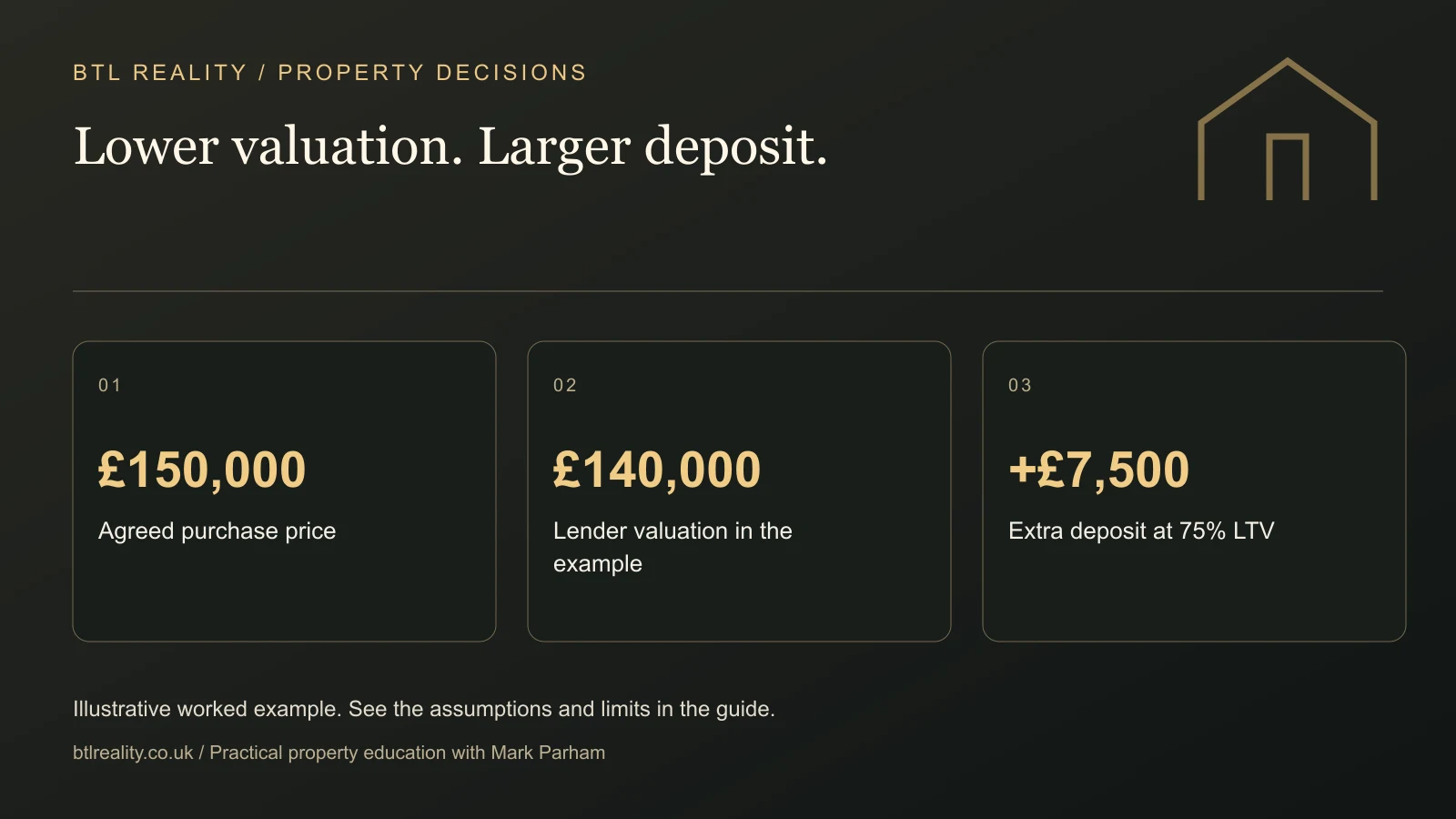
A buy-to-let down-valuation can increase the cash you need, reduce the loan available or make the purchase unsuitable for your budget. It means the lender's valuation is below the figure on which you were expecting the financing to work. The first response should be to rebuild the numbers, not automatically to find more deposit money.
Imagine agreeing £150,000 for a rental, expecting a £112,500 mortgage, then hearing that the lender accepts a value of £140,000. If the loan is limited to 75% of that lower figure, it falls to £105,000. Keeping the same purchase price requires another £7,500 from you before accounting for other costs.
That gap is manageable for some buyers and a reason to stop for others. Here is how to understand it, examine the evidence and choose your next step without letting money already spent dictate the decision.
Understand what the valuation is telling you
A lender's valuation supports its decision about the property as security. It is not a guarantee of the price you could achieve in a future sale, and it is not a full building survey. Those are different assessments with different purposes.
Ask your broker exactly what changed. Was the capital value lower? Was the rental assessment lower? Were there condition concerns, a retention, or an issue that made the property unacceptable? Each can affect funding differently. “The valuation was bad” is too vague to support the next decision.
RICS explains the distinction between a lender valuation and a buyer's survey. If the valuation raises a condition concern, arrange the appropriate investigation. A revised mortgage figure does not tell you the full repair cost or resolve a defect.
Recalculate the deposit from the actual lending basis
In the opening example, the original model was £150,000 purchase price minus £112,500 borrowing, leaving £37,500 deposit. The revised model is £150,000 minus £105,000, leaving £45,000 deposit. The valuation fell by £10,000, while the loan fell by £7,500 at the assumed 75% limit.
Now add purchase costs, initial work and a reserve. If those total £15,000 in the illustration, the initial cash requirement rises from £52,500 to £60,000. A buyer with £60,000 available would be committing every pound if they had no separate household savings. Passing a completion funds check is not the same as retaining a comfortable buffer.
Actual borrowing may also be limited by rental coverage or other underwriting criteria. Use the lower amount the lender is willing to offer, not just a headline loan-to-value percentage. Product fees, retentions and conditions need to be reflected in the cash calculation too.
Cash required at the same £150,000 price
Make the example your own
What does a lower valuation do to your deposit?
Model the loan against the lower of the purchase price and accepted value, then include the other cash required.
A simplified lending basis, not an offer. Rental coverage, fees, retentions and other criteria may reduce borrowing. Costs stay fixed in this example even if the price changes. Illustrative only. Inputs stay in this page and are not saved or sent.
Compare three responses to the same down-valuation
The first response is to pay the original £150,000 price with more cash. Under the simplified example, that needs £45,000 deposit plus the other £15,000. It preserves the agreed deal but commits more of your resources to the same property and rent.
The second is to renegotiate to £140,000. If the £105,000 loan remains available, the deposit becomes £35,000 and the illustrative total cash requirement is £50,000. That is a different investment proposition, but the seller does not have to agree and the revised terms must be communicated to the professionals handling the purchase.
The third is to withdraw before becoming legally bound, accepting any non-refundable costs already incurred. Ask your conveyancer about the legal stage and consequences. A standard private-treaty transaction and an auction commitment can leave you in very different positions. Do not assume you can walk away simply because finance has changed.
A lower loan can improve monthly cashflow but reduce flexibility
Less borrowing may mean a smaller monthly interest payment. At an assumed 5% interest-only rate, £112,500 costs £468.75 a month, while £105,000 costs £437.50. The difference is £31.25 monthly, or £375 a year before tax.
That improvement does not make the additional £7,500 deposit irrelevant. You have exchanged accessible money for equity in a property. It may reduce the reserve, delay another investment or limit your ability to deal with repairs elsewhere. Evaluate both the income result and the liquidity consequence.
Do not count the £375 as a free extra return while ignoring the capital required to obtain it. Compare your full cash committed, recurring cashflow and remaining reserves. The buy-to-let deal calculator helps keep those figures together rather than focusing only on the mortgage payment.
Check the evidence behind your original price
Return to the comparable sales used to justify the purchase. Are they completed transactions or asking prices? Are the properties similar in location, size, tenure, condition and layout? A renovated house on a better street may not support the value of a tired flat with substantial service charges.
Separate genuine differences from hopeful adjustments. If a comparable has an additional bedroom, parking or a longer lease, explain how that affects the comparison. Do not select only the highest figures and ignore lower transactions that resemble the subject property more closely.
Also examine incentives or bundled costs. A seller offering furnishings, fees or other extras may make the headline price harder to compare with an ordinary sale. Provide the full information to the broker and conveyancer. The task is to understand the transaction accurately, not to persuade a valuer with an incomplete picture.
An appeal needs evidence and a process
Ask your broker whether the lender accepts valuation appeals and what its requirements are. Some have deadlines, evidence standards and limits on further review. For example, The Mortgage Works publishes an appeal process requiring suitable comparable evidence and submission within a specified period. Check the current details for the lender handling your case.
An appeal is strongest when it identifies relevant facts or comparable evidence that were missed or misunderstood. “I need a larger loan” is a funding problem, not evidence of market value. Similarly, a seller's unwillingness to reduce the price does not establish that the lender's assessment is wrong.
Keep the cost and timetable proportionate. If the appeal fails, know what you will do next. Repeated applications can involve further expense and delay without producing a different valuation. A new lender makes its own assessment; it is not obliged to validate the first purchase price.
Do not confuse sunk costs with a reason to complete
Survey fees, legal work and application expenses can make it emotionally difficult to stop. But money already spent cannot be recovered by paying too much for the next stage. Compare the costs still ahead and the investment you would own after completion.
Suppose £1,800 has already been spent and the revised deal requires another £7,500 deposit while exhausting your buffer. The question is not whether losing £1,800 feels unpleasant. It is whether proceeding remains the better use of your money given the new evidence, contractual position and available alternatives.
Set a decision limit before negotiations restart. Write down your maximum price, maximum total cash commitment and minimum reserve. If the revised transaction breaches those limits, pause and obtain advice rather than shifting every boundary because the purchase is nearly finished.
Check whether rent creates a second funding gap
A capital valuation problem can arrive alongside a lower rental estimate. If you expected £1,100 monthly rent and the lender assesses £950, that may affect its rental coverage calculation. Your own income forecast also needs revising, even if some borrowing remains available.
Ask a local letting agent for evidence supporting a realistic rent in the property's actual condition. Avoid substituting the maximum advertised rent for a sustainable assumption. Vacancy periods, management, maintenance, insurance and compliance still reduce what you keep.
Use the mortgage stress calculator to test the revised rent and finance cost. A property that needs both a valuation appeal and an optimistic rent assumption to work deserves closer scrutiny before you commit further money.
Use the result to strengthen the buying brief
A down-valuation is useful feedback even if the purchase does not proceed. Record which assumption failed and whether your next search should change: property type, lease length, renovation requirement, local comparables, price ceiling or available cash.
BTL Reality's Done For You service sources property against an agreed brief. A clear brief should include the funding constraints and the evidence needed to support a deal, while the lender, surveyor and conveyancer retain their own roles. Sourcing support does not guarantee a valuation or mortgage offer.
The objective is a property that remains worth buying after the checks. A purchase is not a success merely because every obstacle was overcome and the keys arrived.
Before commissioning another inspection, read our mortgage valuation versus survey guide to understand which professional can answer the outstanding question.
Frequently asked questions
Does a down-valuation mean the property is overpriced?
It means the lender's accepted value is below the figure expected for the financing. That deserves investigation, but it is not an infallible statement about every buyer's view of value. Review the comparables, condition and transaction details before deciding whether to renegotiate, appeal or stop.
How does a lower valuation change my deposit?
If borrowing is limited to a percentage of the lower valuation, the loan falls and you must cover more of the unchanged purchase price. At 75%, a £10,000 valuation reduction lowers the illustrative loan by £7,500. Other underwriting limits can reduce it further.
Can I appeal a buy-to-let mortgage valuation?
Possibly, under the lender's own process. Ask your broker about deadlines and the evidence required. Suitable comparable transactions or a material factual correction may help, but there is no guarantee of a revised valuation. Keep an alternative plan if the original result stands.
Should I pay the extra deposit after a down-valuation?
Only after reassessing the complete investment and your remaining liquidity. A smaller loan can reduce interest while tying up more cash. Check repairs, reserves, expected rent and other commitments. Do not use the money needed for foreseeable costs merely to preserve the original purchase agreement.
Can the seller reduce the price to close the gap?
Yes, if a reduction is agreed, but the seller is not obliged to accept it. Have the broker and conveyancer confirm how revised terms affect financing and the transaction. A lower price may improve the cash requirement, while unresolved condition or title issues still need attention.
Will another lender necessarily value the property higher?
No. Another lender may reach a similar result, a different result or decline the property for separate reasons. Further applications can incur costs and delays. Discuss the evidence and likely options with your broker before treating a change of lender as the solution.
Put the next step into practice
Use the free tools to test your numbers, then choose the level of support that fits your next decision.