Can a Landlord Put a Second-Hand Sofa in a Rental?
October 22, 2026
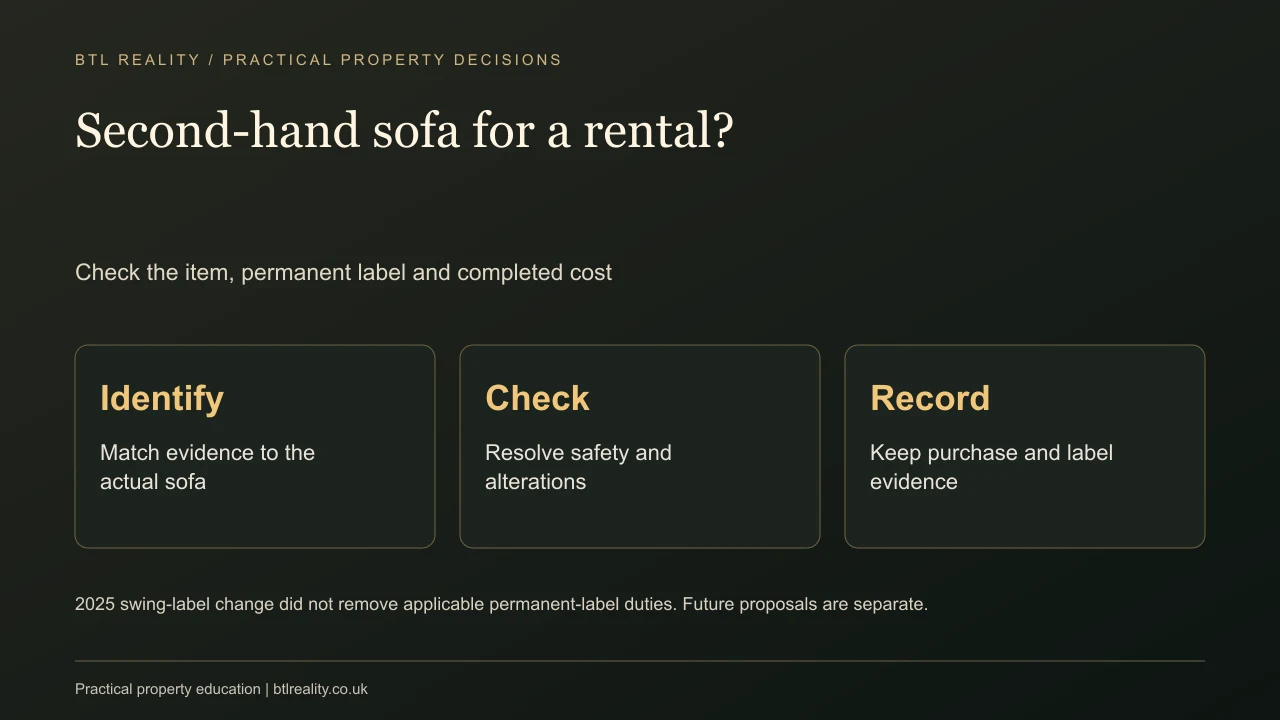
A second-hand sofa can be a sensible furnishing purchase, but “it looks nearly new” is not a fire-safety check. Before putting it into a rental, establish what the item is, whether the applicable requirements are met and what evidence you can keep.
There is also a current detail worth getting right. The removal of a swing or display-label requirement does not mean permanent labels were abolished. Nor does a proposal for future second-hand furniture reform mean the proposed rules already apply.
This guide uses UK product-safety guidance checked on 19 October 2026, with an ordinary English furnished rental as the example. Particular products and exemptions need checking. It is not a method for testing furniture at home or certifying an unknown sofa yourself.
What changed in 2025?
The Office for Product Safety and Standards guidance says the amendments effective from 30 October 2025 removed display-label requirements but retained permanent-label obligations. It specifically says second-hand supply still requires the applicable permanent label and identifies separate changes for certain baby and children’s products.
For a sofa purchase, distinguish the removable sales information from the durable product label. A seller saying “the tags were removed” does not answer which kind of label was removed or whether the item can properly be supplied.
Do not buy first and assume a generic label can be added afterwards. The label is supposed to relate to the actual product and compliance information. Printing a reassuring phrase does not establish how the furniture was made or tested.
Do the 2026 proposals remove the need to check second-hand furniture?
No conclusion of that kind follows from a consultation. The government’s 2026 furniture consultation proposed changes including the treatment of second-hand supply under a future framework. The published material describes proposals and a later implementation process, not permission to ignore current requirements.
This distinction matters when an online listing confidently says “new law means no fire label needed”. Ask which enacted rule, effective date and product scope supports that statement. An old consultation headline is not adequate evidence.
Product rules can change, so check the live government guidance when making a purchase. Keep the dated supplier evidence rather than relying on a screenshot of an undated social-media claim.
Check the actual sofa before arranging collection
Ask for clear photographs of the whole item, the permanent label and any alteration or damage. Match the label to the sofa you will receive. A cropped label photograph forwarded from another listing should not be treated as proof.
At inspection, look for changes to covers, upholstery or filling and ask what work has been done. A re-covered sofa may need more investigation than an unaltered item with an identifiable history. Obtain competent product-safety advice where the evidence is unclear.
Fire compliance is not the only consideration. Check stability, damage, cleanliness and whether the sofa can be moved into the room without unsafe improvisation. A compliant item can still be a poor purchase if its frame is broken or it cannot fit through the entrance.
| Check | Evidence to obtain | Decision if unclear |
|---|---|---|
| Identity | Whole-item photographs and supplier details | Confirm the actual item |
| Applicable label | Readable permanent-label image | Seek advice before supply |
| Alterations | History of re-covering or repair | Resolve compliance questions |
| Condition | Frame, upholstery and hygiene observations | Reject or obtain suitable assessment |
| Delivery | Dimensions, access and costs | Check completed cost before paying |
What if the label is missing?
Do not assume appearance, a seller’s reassurance or a receipt for the original purchase resolves the issue. Check the product category and applicable requirements with Trading Standards or a competent supplier before putting it into the letting.
Bromley’s Trading Standards guide to second-hand upholstered furniture explains the continued importance of the permanent label under the amended framework. It is a useful starting point for understanding why a durable product record matters.
The practical purchasing option may be to choose an item with clear, relevant evidence rather than taking on an uncertain product. A cheap sofa is not a saving if it cannot appropriately be supplied and must be removed before the tenant moves in.
Do not improvise flame tests, apply a treatment yourself or attach a label from another item. Those actions do not establish product compliance and can create additional risk.
Compare the completed furnishing cost
Suppose an illustrative used sofa costs £120, collection is £50 and appropriate cleaning is £45. The completed cost is £215 before any repair or removal of the old item. A suitable alternative costing £260 delivered is £45 more on those assumptions.
If the used item then needs an additional £70 repair, its cost becomes £285. The £120 listing was never the whole decision. These figures are invented to show the comparison, not a market-price survey.
Keep compliance as a threshold question before doing the financial comparison. A £45 saving cannot justify supplying an item where the required evidence remains unresolved.
The HMO furnishing-cost guide helps think through the wider room budget. Its numbers and property model do not remove the need to assess each item you actually supply.
Record the item when it enters the property
Add the sofa to the inventory with its location, visible condition and identifying details. Save the purchase and delivery records and relevant compliance evidence in the property file.
Photograph the permanent label in a way that makes clear which sofa it belongs to. Keep the whole-item image with it. A folder of disconnected label photographs is difficult to use when several similar sofas are moved between properties.
If the sofa is later replaced, update the record. Do not carry an old label photograph forward as though it describes the new item. The same applies if covers or upholstery are altered during a refurbishment.
Keep the inventory’s condition statements separate from the safety evidence. “Clean grey sofa, minor mark on left arm” describes the visible state. It is not a competent certificate that the item meets every product rule.
What about furniture left by a previous tenant?
Do not casually adopt an abandoned or offered sofa into the next letting without checking its ownership, condition and applicable safety position. Resolve permission and lawful disposal separately from whether it would be useful.
A message saying “you can keep it” may clarify ownership but does not provide product compliance evidence. If you decide to supply it to the next tenant, assess it as an item entering your furnishing stock.
Keep any decision not to use it clear to the agent and cleaner. An item intended for removal should not accidentally appear in the next inventory because it was still in the room during photography.
For a future furnishing strategy, compare the whole rental proposition rather than accumulating whatever furniture happens to be available. Durable, replaceable items with clear records can be easier to manage than a collection of untraceable bargains.
Plan the next replacement before it is urgent
Keep an allowance for normal wear and replacement in the maintenance budget. A sofa reaching the end of useful service should not force a rushed purchase the evening before check-in.
For an assumed £300 replacement fund built over five years, the simple saving target is £60 a year or £5 a month. That is a cash-planning assumption, not a product lifespan rule or a charge to the tenant.
Where furniture is damaged at check-out, keep the fair claim assessment separate from the new purchase. The rental finish guide illustrates the wider idea of choosing for use and maintenance; the same discipline applies to furnishings.
Make a clear buying decision
Before committing, you should know the item, the applicable compliance evidence, its condition, the complete delivered cost and how it will be recorded. If one is unresolved, deal with that point before the sofa is supplied.
Second-hand does not automatically mean unsuitable, and new-looking does not automatically mean safe. A considered purchase with a traceable record is what gives the bargain a chance to remain a bargain.
Your questions answered
Did the 2025 change abolish permanent fire labels?
No. OPSS guidance says the display or swing-label requirement was removed from 30 October 2025, while applicable permanent-label obligations remain.
Can I rely on the 2026 second-hand furniture proposals?
A consultation proposal is not a rule already in force. Check the enacted requirements and implementation dates before buying or supplying the item.
Can I attach a replacement label myself?
Do not improvise a compliance label or transfer one from another item. The information must relate to the actual product and applicable requirements. Seek competent advice if evidence is missing.
Does a receipt prove the sofa is safe?
A receipt helps identify the purchase but does not alone establish current condition, alterations or all applicable compliance requirements. Keep relevant product evidence and inspect the actual item.
Can I keep a sofa a previous tenant leaves behind?
Resolve ownership and any disposal or gift agreement first. If you will supply it in the next letting, assess condition and safety evidence rather than automatically adopting it.
Is the five-year replacement example a legal lifespan?
No. It is an assumed cash-saving period for a hypothetical £300 replacement. Actual condition, use and product requirements determine the real decision.