Carpet or Hard Flooring: What Works Better in a Rental Property?
October 19, 2026
The best flooring for a rental property depends on the room, building, expected use and whole-life cost. Hard flooring is not automatically more durable, and carpet is not automatically a false economy. A suitable, well-installed surface that can be maintained and repaired often matters more than choosing one material everywhere.
Start with practical constraints, then compare installation, cleaning, repair and replacement over a realistic period. This guide includes an adjustable cost model and the questions to ask an installer before a cosmetic decision becomes an expensive recurring problem.
Choose for the room and the people using it
A kitchen, bathroom, hallway and bedroom face different moisture, traffic and comfort demands. A surface suitable for one room may be unsuitable for another, even if the colour scheme would look more consistent across the property.
Ask about slip resistance, cleaning requirements, water exposure, compatibility with the subfloor and any heating system. Consider transitions between rooms and the potential for edges, lifting or changes in level to create problems.
Think about the tenant's experience too. Warmth, noise and comfort matter alongside maintenance. An investment specification should create a decent, usable home rather than simply minimising the initial invoice. A cheap product that wears badly or feels unsuitable can create both repair work and dissatisfaction.
Check the lease before buying hard flooring for a flat
Some leases contain restrictions or requirements relating to floor coverings, acoustic performance or alterations. Do not assume a hard surface is permitted because another flat has one or because the installer says it is commonly fitted.
Ask your conveyancer or managing agent to identify the relevant lease terms and consent process. GOV.UK's leasehold guidance explains why the lease and responsibilities need checking. The actual document governs your situation.
Where acoustic performance matters, obtain advice on the complete system, including underlay, subfloor and installation. A product marketed as quiet does not automatically satisfy a building's requirements. Resolving the question before fitting is usually easier than dealing with a complaint and possible removal afterwards.
Compare the full installed price
A flooring quotation should make clear what is included: removal and disposal, subfloor preparation, moisture assessment where relevant, underlay, trims, thresholds, fitting and any work to doors or skirting. The price of the visible material is only one part of the job.
Two quotes can look very different because one includes preparation and the other assumes a ready surface. Ask the installer to inspect rather than relying solely on an online price per square metre. Clarify how unexpected subfloor problems would be handled and charged.
Keep the specification precise. “Laminate” or “carpet” covers a broad range of products, wear characteristics and warranties. Compare actual products suited to the room, and check whether warranties apply to a rental setting and the expected level of use.
Eight-year flooring comparison
Make the example your own
Compare the cost over your ownership period
Enter full installed prices and your own lifespan and annual maintenance assumptions. These are scenarios, not warranty periods.
Includes initial installation and replacements strictly before the end of the period. Negative saving means hard flooring costs more. No inflation, discounting, residual value, downtime or unentered repairs. Not a tenant-deposit deduction model. Illustrative only. Inputs stay in this page and are not saved or sent.
The model counts an initial installation and replacements before the end of the chosen period. It does not buy a new floor on the final day merely because its assumed life ends then. Lifespans are your scenarios, not product guarantees or rules for tenant deposit deductions.
An eight-year cost example
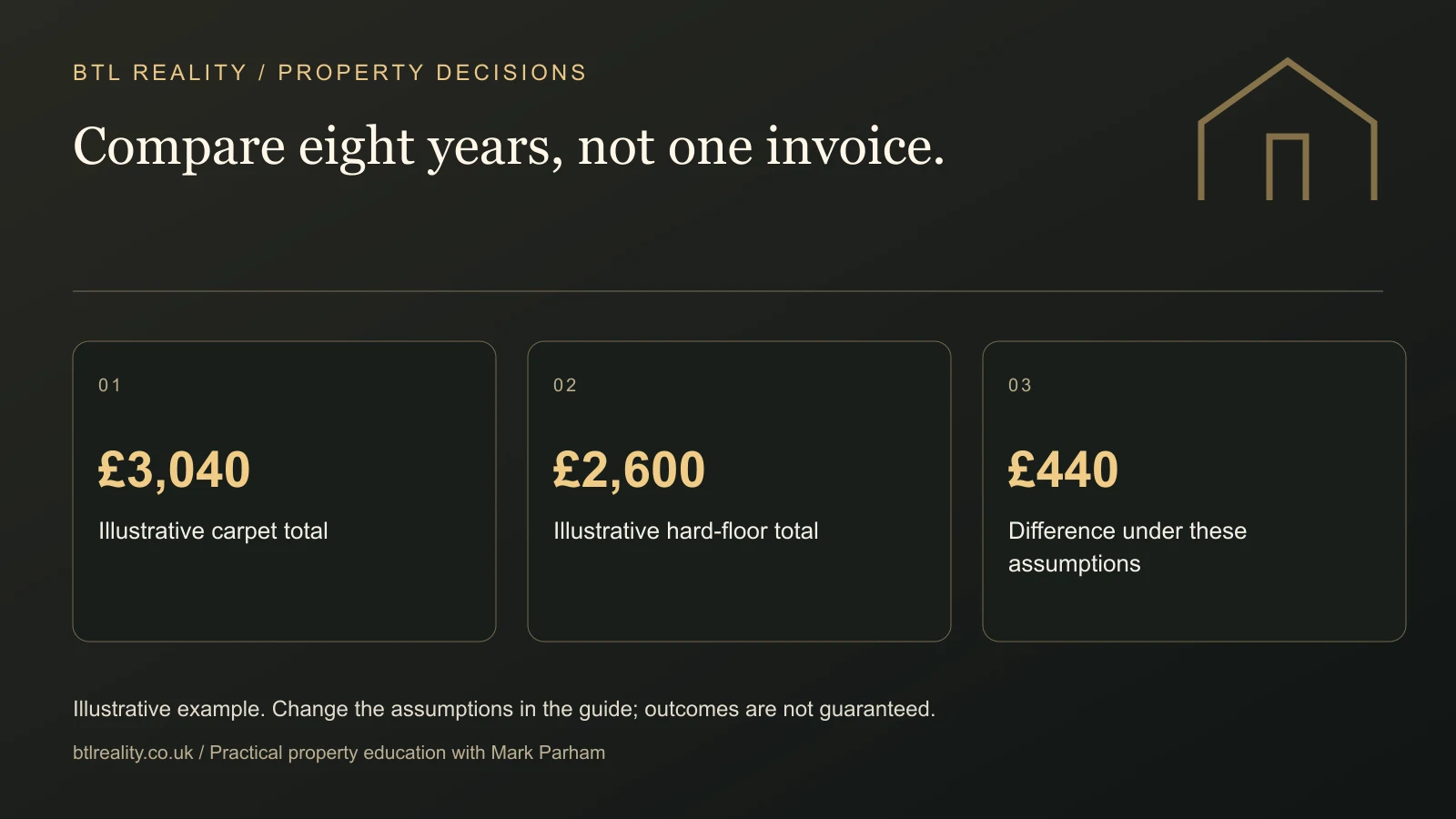
Suppose a carpet installation costs £1,200 and you assume it needs replacing after four years. Over eight years, you pay for the initial installation and one replacement at year four, totalling £2,400. Add £80 annual cleaning or maintenance and the eight-year total is £3,040.
Now compare hard flooring costing £2,200 with an assumed eight-year life and £50 annual maintenance. With no replacement before the end of the period, the total is £2,600. On those assumptions, the more expensive installation costs £440 less over eight years.
Change the hard flooring's life to four years, perhaps to test a less favourable outcome. The initial installation and year-four replacement total £4,400, plus £400 maintenance, giving £4,800. It now costs £1,760 more than the carpet scenario.
These are invented figures to illustrate the method. They do not claim that either material normally lasts a particular number of years. The result is highly sensitive to quality, installation, maintenance and actual damage.
Repairability can matter more than nominal lifespan
Ask whether a small damaged area can be repaired without replacing a whole room. With some systems, spare planks or tiles can help, but the ability to replace a section depends on the installation and product. A glued surface and a floating click system do not necessarily have the same repair process.
For carpet, consider whether a stained or damaged area means replacing one room or a much larger continuous run. Colour matching, joins and availability can affect the result. Retaining product details and suitable spare material may be useful where storage allows.
Ask the installer what common failures look like and what a typical repair involves. A long advertised warranty is not as useful as understanding what it covers, what it excludes and whether labour or consequential work is included.
Installation and moisture problems can defeat either choice
A good material installed on an unsuitable base may fail early. Uneven surfaces, moisture, inadequate preparation or incorrect expansion provision can create issues that no amount of ordinary cleaning will solve.
Do not treat visible damage as proof that the tenant caused it. Investigate the underlying issue before replacing the finish. If a leak, ventilation problem or defective installation remains, the new surface may deteriorate in the same way.
Ask for the relevant installation and maintenance instructions and retain them. Give tenants clear, reasonable guidance on cleaning and reporting problems. A simple explanation of what products to avoid and when to report lifting or water ingress can be more useful than a lengthy generic handbook.
Include downtime in the refurbishment plan
The direct flooring invoice may not be the only cost. Access, furniture movement, preparation, drying or curing time and other trades can affect when the property is ready. Obtain a realistic programme and coordinate it with cleaning and final checks.
If the property is empty, a delay can postpone rent. At £900 monthly rent, seven days represent about £207 of gross rent on an annual-rent-divided-by-365 basis. That is not automatically an additional charge caused by the floor, because some work may fit within an existing void, but the timing should be considered.
Use the free buy-to-let deal calculator to include the whole preparation budget. Avoid saving £100 on a product choice if the associated delay or repeat work is likely to cost more.
Do not budget on recovering replacement costs from deposits
Ordinary wear is part of providing a rented home. A tenant deposit is not a maintenance fund or an automatic right to a new floor at the end of a tenancy. Claims depend on the evidence, condition, age, responsibility and applicable process.
The Deposit Protection Service explains fair wear and tear and betterment. A claim should not put the landlord in a better position by charging the tenant the full price of replacing an already aged item with a new one.
Keep a detailed inventory and dated condition evidence, while treating tenants fairly. If genuine damage occurs, assess a proportionate supported claim through the appropriate process. Do not use the lifespan assumed in this calculator as a legal depreciation schedule or an automatic deduction formula.
A mixed specification may be the sensible answer
You do not need one flooring type across the whole rental. A suitable easy-clean surface in wet or high-traffic areas and a different finish in bedrooms can reflect how the rooms are used. The right combination depends on the building and constraints.
Keep transitions tidy and specify a coherent appearance without sacrificing function. A neutral, replaceable product may be more practical than an unusual finish that is difficult to match later. At the same time, choosing the lowest-cost item without considering comfort or quality can be a false saving.
Ask the letting agent what comparable tenants expect, but use that feedback alongside technical advice. An agent can discuss presentation and demand; an installer or relevant professional should assess suitability and installation requirements.
Record the decision for the next refurbishment
Keep the quotation, product name, installed date, warranty, photographs and maintenance instructions in the property file. Record repairs and costs as they happen. At the next replacement, you will have evidence of performance rather than a vague impression that one material lasted “ages”.
Compare your actual experience with the original model. If annual cleaning was higher or a repair was easier than expected, update the assumptions for the next property. This is a practical way to improve a portfolio's specification over time.
Starter Club supports planning decisions like these, with access to the free resources available whether or not you join. The objective is a home that works well and a budget based on realistic ownership costs, not a universal rule that every landlord should install the same floor.
Frequently asked questions
Is hard flooring always cheaper over the life of a tenancy?
No. It depends on installed cost, suitability, maintenance, repairability and how long it actually lasts. Compare specific products over the same period and test shorter lifespans. A more expensive installation can be economical, but only if the assumed durability and costs are realistic.
Can the lease restrict hard flooring in a flat?
Yes, a lease may contain floor-covering, acoustic or consent requirements. Check the actual terms with your conveyancer or managing agent before ordering. The fact that another flat has hard flooring does not prove your proposed installation is permitted or meets the relevant requirements.
Should bedrooms and kitchens use the same flooring?
Not necessarily. Moisture, traffic, comfort and cleaning needs differ by room. Choose suitable products and consider how they connect safely and neatly. A mixed specification can be sensible where it meets the building's requirements and provides a coherent, comfortable home for the intended occupants.
How should I compare replacement and repair costs?
Use full installed quotes, realistic lifespan scenarios, annual maintenance and the cost of repairing a limited damaged area. Include preparation and disposal, and consider downtime. The calculator provides a simple comparison, but actual product performance and repair methods need checking with the installer.
Can I charge tenants for replacing old flooring?
Not automatically. Fair wear and tear, age, condition and responsibility must be considered, and a claim should not produce betterment. Keep evidence and follow the appropriate deposit process. Do not assume a tenant owes the full cost of a new floor because the old one needs replacing.
What should I ask an installer before choosing?
Ask about room suitability, subfloor preparation, moisture, acoustic performance, fitting method, maintenance, repairs and warranty exclusions. Request an itemised installed quote and programme. Confirm lease or consent requirements separately where relevant, and retain the product details for future repairs or replacement.
Put the next step into practice
Use the free tools to test your numbers, then choose the level of support that fits your next decision.