Rental Yields Hit 7.9%: Why Landlords Can Still Make Less
October 6, 2026
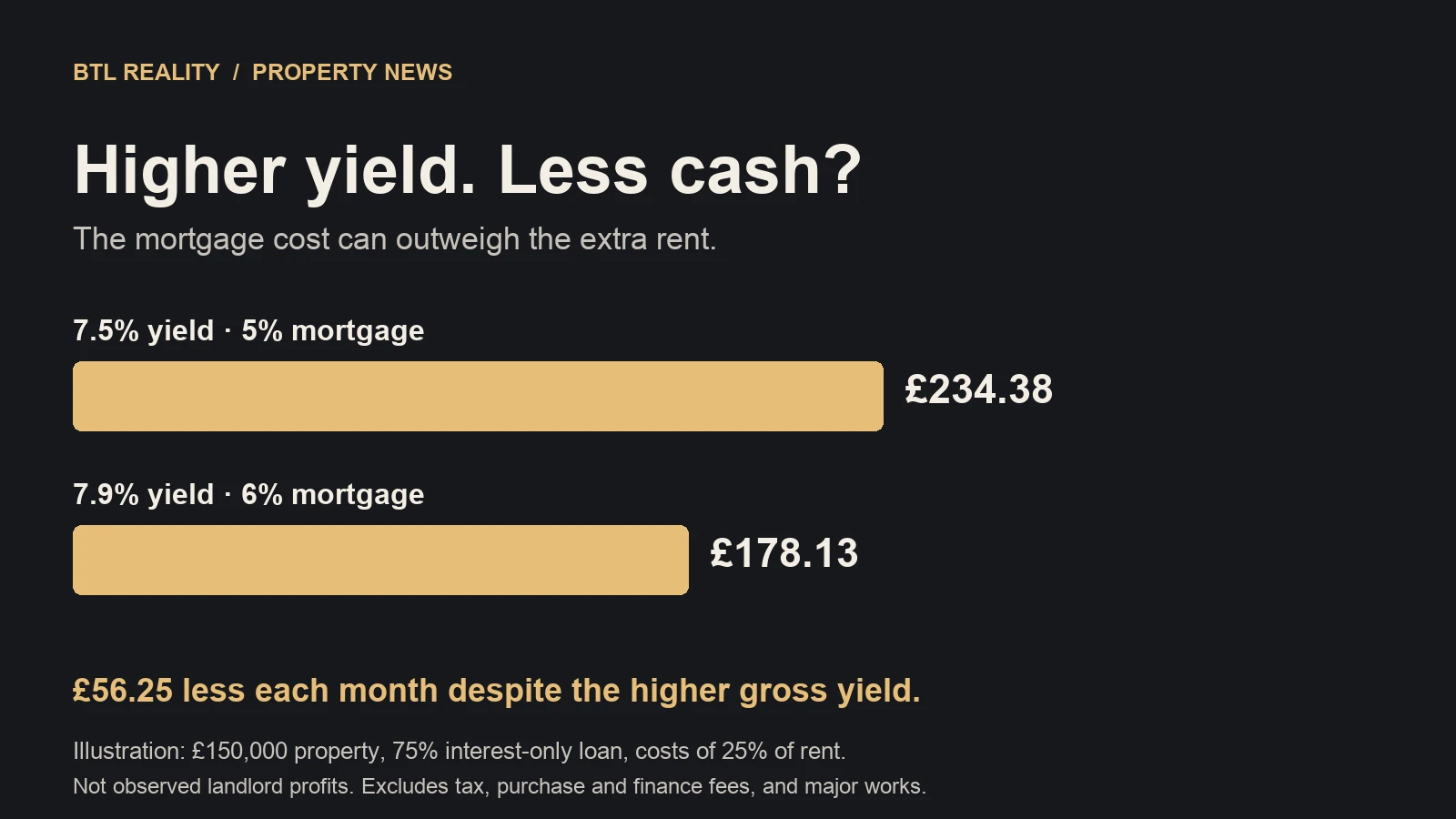
A bigger rental yield does not automatically mean a bigger monthly profit. Fleet Mortgages’ new Q3 2026 Rental Barometer puts the England and Wales average at 7.9%, up from 7.5% a year earlier. Yet its average rental cover at origination fell from 144% in Q2 to 132% in Q3. That is the useful tension for an investor: the rent can look stronger while the finance leaves less breathing room.
The release was published on 5 October 2026 and covers July to September. This is a lender’s regional snapshot and borrower data, not a census of every UK landlord. It excludes Scotland and Northern Ireland. Read Fleet’s original announcement.
What has actually changed in the rental data?
The annual movement from 7.5% to 7.9% is 0.4 percentage points. It is not a promise that your rent has risen by that amount, or that your property now makes a 7.9% profit.
Fleet’s regional table puts Yorkshire and Humberside at 9.3%, the North East at 9.2% and Greater London at 6.4%. Those figures help frame a search, but a regional average cannot price a particular street, building or tenant market. The full table is in Fleet’s Q3 report.
Think about two neighbouring houses. One might have a straightforward layout, predictable running costs and a sound roof. Another might need expensive work and have a less attractive layout. If their advertised rents and purchase prices produce the same gross yield, the headline number has not told you which is the better purchase.
Nor does a higher regional yield prove stronger capital growth. Yield measures the relationship between rent and value. It can move because rents change, prices change or the mix of properties in the sample changes. It is not a forecast of your eventual selling price.
Gross rental yield is the start of the calculation
Gross yield is annual rent divided by the property price or value used in the calculation, multiplied by 100. On a £150,000 purchase, a 7.9% gross yield implies £11,850 annual rent, or £987.50 a month.
That figure comes before management, maintenance, insurance, voids, compliance spending, service charges where relevant, borrowing and tax. It also ignores the extra cash needed for the purchase and any refurbishment. Gross yield is useful for an initial comparison. It is a poor substitute for a budget.
A practical assessment has three separate questions. How much cash does the purchase require? What cash can the property produce after its operating costs and finance? What happens when one of the assumptions disappoints? The buy-to-let deal calculator helps put those questions into one worked model.
Worked example: a higher yield, but £56.25 less each month
Here is an illustration, not Fleet’s measured profit data or a mortgage offer. Keep the property value at £150,000 and the interest-only mortgage at 75% of that value: £112,500. Allow 25% of rent for operating costs and reserves. Then compare two sets of assumptions.
| Monthly item | 7.5% yield / 5% rate | 7.9% yield / 6% rate |
|---|---|---|
| Gross rent | £937.50 | £987.50 |
| Operating allowance: 25% of rent | £234.38 | £246.88 |
| Mortgage interest | £468.75 | £562.50 |
| Cash before tax | £234.38 | £178.13 |
In the first scenario, 7.5% yield produces £937.50 monthly rent. Take away £234.38 for the cost allowance and £468.75 mortgage interest. The unrounded monthly cash figure is £234.375.
In the second, the yield improves to 7.9%, bringing rent to £987.50. The cost allowance becomes £246.88, while a 6% mortgage rate makes interest £562.50. Monthly cash before tax falls to £178.125, shown as £178.13 after rounding.
The extra rent is £50 a month. The higher interest costs £93.75 more, and the percentage-based cost allowance rises by £12.50. Put those together and the property produces £56.25 less cash each month, or £675 less across a full year on unchanged assumptions.
The lesson is not that a higher yield is bad. It is that borrowing and expenses can move faster than rent. Always compare complete cashflows. Do not compare the biggest attractive number in one deal with the smallest unattractive number in another.
Try the cashflow assumptions yourself
Use a price you are actually considering, a plausible rent expressed as a yield, and the borrowing terms you want to test. Move the rate up as well as down. The result is a simplified monthly cash figure before tax, rather than a guaranteed income.
Your yield-to-cashflow calculator
Change the inputs to see what remains after an operating allowance and interest.
Illustration only. Constant rent, rate and costs, interest-only borrowing, no capital repayments. Excludes tax, purchase and finance fees, and major works outside the allowance. Do not double count costs already reserved. Inputs remain on this page.
The cost percentage combines operating spending and reserves for this illustration. It is not a recommendation that every rental costs 25% to run. A flat with a large service charge or a property needing substantial repairs may need a very different budget. Use actual quotes and individual cost lines in the full deal calculator before committing.
Why rental cover and cashflow are different tests
Rental cover is part of the lender’s affordability assessment. Your own cashflow is a wider business calculation. A lender’s test can use a stressed interest rate and a required coverage ratio which differ from the payment on your selected product. Passing that test does not establish how much you can safely spend personally each month.
For a simple illustration, rent of £1,000 divided by £750 interest gives 133.3% cover. It does not give you a 33.3% profit margin. There is only £250 left before other costs, and a £250 operating budget would absorb all of it. This example is not intended to reproduce Fleet’s underwriting calculation.
Ask your broker which rent, stress rate and coverage requirement apply to your own application. Ask separately about the product fee, whether it is added to borrowing, and what that does to the balance and total cost. Our mortgage stress calculator is useful for exploring scenarios, but it cannot confirm an individual lender’s decision.
What if the property is empty for a month?
Return to the second scenario. The model produces £2,137.50 annual cash before tax. Now imagine losing one month’s £987.50 rent while keeping the original operating budget and mortgage payments unchanged. Cash falls to £1,150 for the year. Add an unexpected £1,200 repair outside the allowance and the year is £50 short before tax.
This deliberately holds the original cost budget constant to avoid assuming that every expense disappears during a vacancy. In practice, some percentage fees could fall with collected rent, while other bills continue or rise. It is a stress scenario, not a forecast, and should not be added blindly to a budget that already includes the same void and repair costs.
Keep a separate cash reserve. A spreadsheet showing an annual surplus does not help if the contractor needs paying before the next rent arrives. Check the timing of costs as well as the eventual total.
Does this make northern property the best choice?
For a broader comparison, read our guide to UK locations, yield and capital growth. A higher rent-to-price ratio can provide a stronger starting cushion. It does not remove property-specific risk. Before using a regional figure to shortlist a town, establish local achieved rents, realistic letting times, comparable sold prices and the condition of the homes actually available within your budget.
Then check what could change the cost base: the building’s repair needs, lease terms, service charges, management arrangement and any applicable licensing requirements. A low price can be an opportunity, but it can also be a warning that a cost or constraint is not reflected in the headline presentation.
Two independent local letting opinions are more useful than one optimistic agent estimate attached to the sales listing. Ask what comparable homes actually let for and when, rather than relying only on advertised rents. Inspect or commission the right professional checks before treating the numbers as dependable.
A five-step check before making an offer
- Verify the rent. Use comparable properties with similar size, condition and location. Record the evidence and its date.
- Build the full cash budget. Include deposit, purchase taxes, professional fees, finance costs, refurbishment and a reserve. Do not calculate your return on the deposit alone.
- Get finance terms checked. Compare fees and total cost as well as the headline rate. Confirm that the property and ownership structure are acceptable.
- Test a weaker outcome. Model a vacancy, an unexpected bill and a higher future mortgage rate. Avoid counting the same allowance twice.
- Decide against your own objective. A property intended to provide income needs a credible income margin. A growth assumption cannot pay an immediate repair bill.
If you are learning how to assess your first purchase, Starter Club is the relevant BTL education route. Start with the free calculators and bring the assumptions into the discussion. A useful conversation begins with a complete deal model, not a promise based on a national average.
Frequently asked questions
What is the average buy-to-let rental yield in England and Wales in Q3 2026?
Fleet’s latest barometer reports 7.9%. Treat that as its England and Wales snapshot for the quarter, rather than a universal UK return. Gross yield comes before borrowing, operating costs and tax, so it is not the amount a landlord can withdraw.
Can a rental property make less money when its gross yield rises?
Yes. In our illustration, the extra rent is outweighed by increased mortgage interest and operating allowances. Compare the entire income and expense budget. A change in yield alone cannot tell you the direction of your disposable cashflow.
Is 8% rental yield enough for a profitable buy-to-let?
There is no universal pass mark. On the calculator’s £150,000 price, 75% interest-only borrowing, 6% rate and 25% cost allowance, 8% gross yield leaves £187.50 monthly before tax. Different finance, repair costs or service charges could change that substantially.
Does a lender’s rental cover test include all my property costs?
Do not assume so. Ask the lender or broker for the actual affordability method and inputs. You still need an operating budget, cash reserve and tax assessment. Approval for a mortgage and a comfortable investment margin are different questions.
Should I compare gross yield or return on cash invested?
Both can help, but they answer different questions. Gross yield compares rent with property value or price. A return on cash calculation should use a clearly defined profit figure and all the capital you commit, including fees and works. State what is included so comparisons are meaningful.
Does an interest-only mortgage reduce the debt in these examples?
No. The £112,500 loan remains outstanding unless you make separate capital repayments. The calculator deducts interest only. A repayment loan would require a different payment calculation, and refinancing or selling later cannot be assumed to repay the balance on favourable terms.